
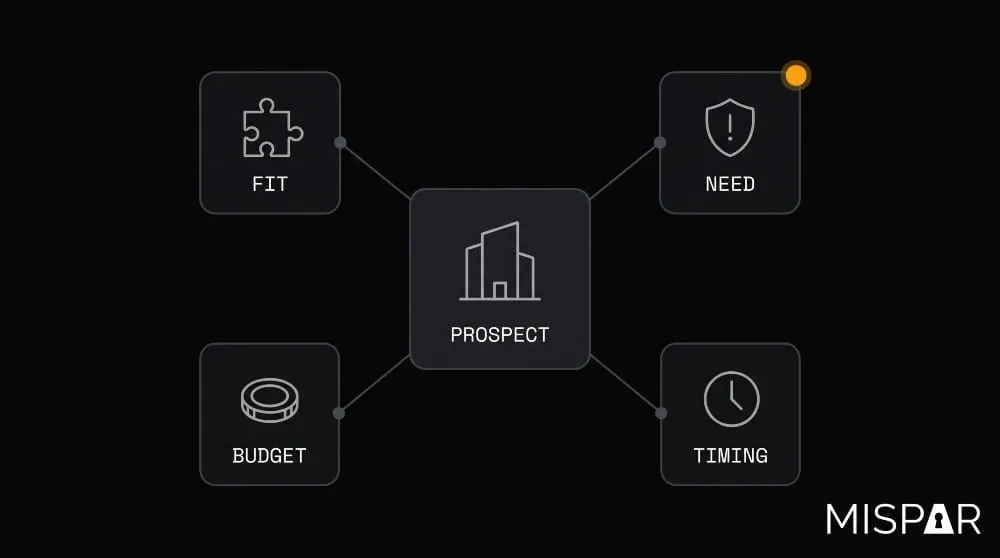
MSSP lead qualification criteria are the checks that decide whether a prospect deserves a security conversation. They cover fit (size, industry, existing stack), need (a real exposure or compliance driver), budget and decision authority, and timing. An MSSP that applies them before the first call saves analyst and sales hours by focusing on prospects that can buy and be served profitably.
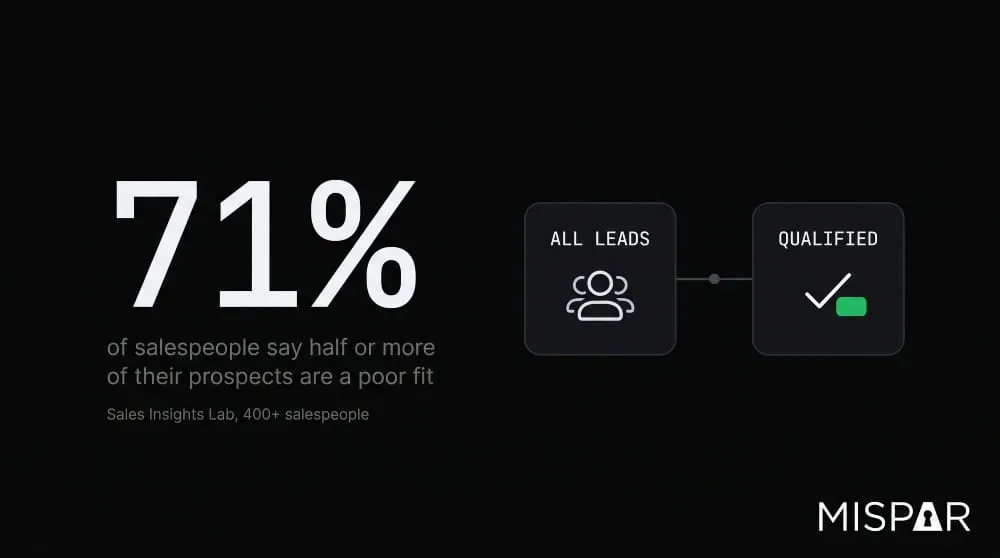
Poor fit is the normal case, not the exception. A Sales Insights Lab study of over 400 salespeople, cited by N-able, found that 71% said at least half of their prospects were not a good fit for what they sold for an MSSP, where every new client adds monitoring load and support obligations; signing a bad fit costs more than losing a deal. This guide covers the criteria, a simple scoring model, how exposure data speeds up qualification, how to match leads to a pricing model, and what happens after a lead qualifies. If you need the basics first, start with what an MSSP is.
What is MSSP lead qualification?
MSSP lead qualification is the process of deciding early, with evidence, whether a prospect is worth pursuing for managed security services. A qualified lead is one you can serve profitably, that has a reason to act now, and that has someone who can approve a purchase.
How it differs from generic MSP lead qualification
Generic MSP qualification asks whether a company needs IT support. MSSP qualification asks whether it has a security problem it will pay to manage. That changes the evidence you collect: security posture, exposed credentials, regulatory pressure, and incident history matter more than headcount or ticket volume. The sales conversation also differs, because a security buyer needs to believe there is a risk before discussing price, so a lead with no visible risk is usually a weak lead.
MQL vs SQL for security services
A marketing-qualified lead has shown interest, for example by running a free scan or downloading a guide. A sales-qualified lead has also met your fit, need, budget, and timing criteria. The distinction matters because free security tools generate plenty of curiosity and few buyers. Treat tool usage as the start of qualification, not the end of it.
Core qualification criteria
Four criteria carry most of the weight, and a lead should clear at least three before it takes sales time.
Fit: size, industry, existing security stack
Fit asks whether you can deliver well to this prospect. Company size determines whether your service tiers make sense, industry determines which regulations and threats apply, and the existing stack determines how much integration work onboarding needs. A prospect with a mature in-house SOC rarely needs a full managed service, while one with only antivirus and no monitoring is usually a stronger candidate.
Need: exposed credentials, compliance pressure, past incidents
Need is why a prospect should act now, and it separates security leads from generic ones. Strong signals include leaked employee credentials, a customer or insurer demanding evidence of controls, an audit on the calendar, or a recent incident. A lead with none of these may still buy, but the sale will take longer and rely on education rather than urgency.
Budget and decision-maker
Budget and authority: ask whether the person you are talking to can fund and approve the service. Security spending often sits with an IT manager, a finance lead, or an owner, and the title on the contact form rarely tells you which. Ask early who signs off and whether security is already a line item, because a prospect with no budget and no approver is a contact, not a lead.
Timing and trigger events
Timing is whether something is forcing a decision soon. Trigger events include a new compliance deadline, a contract renewal with an incumbent provider, a breach at a peer company, a cyber insurance renewal, or a funding round. Leads without a trigger are not worthless, but they belong in nurture rather than in active pursuit.
A simple lead scoring model
A scoring model turns the four criteria into a repeatable decision, so two salespeople reach the same conclusion about the same prospect. Keep it simple enough to apply in a few minutes and adjust the weights after you see which leads convert.
Green / Yellow / Red gate
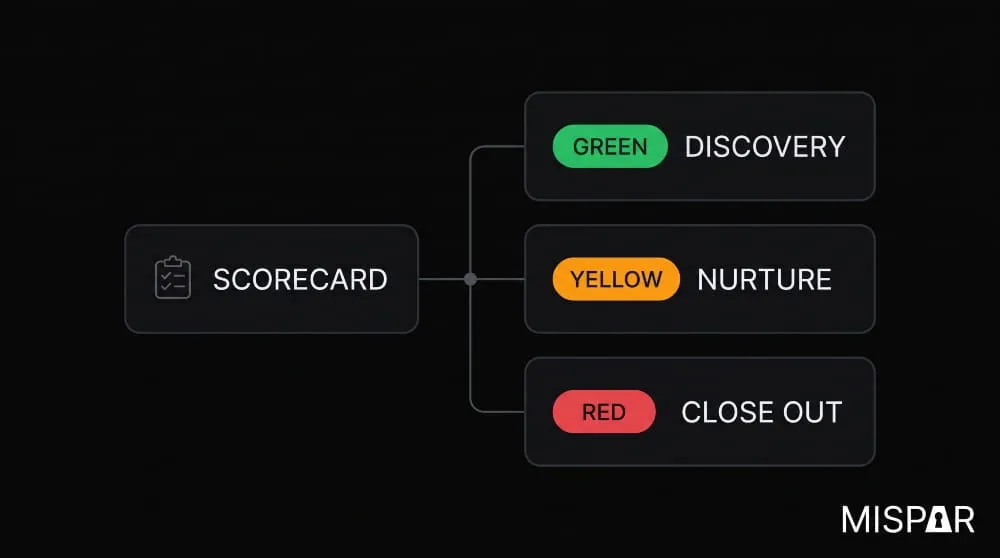
Score each criterion, add the points, and sort leads into three outcomes. Green leads go straight to discovery, yellow leads go to nurture with a defined re-check date, and red leads are politely closed out. The gate works best when it is objective, meaning a lead cannot move forward on enthusiasm alone.
Scorecard
The weights below are an illustrative starting point, not a benchmark. Need is weighted highest because it is the strongest predictor of urgency in security sales.
The top band is green, the middle band is yellow, and anything low or missing need is red. Review the thresholds quarterly against closed deals so the model reflects what actually converts for you.
Using exposure data to qualify faster
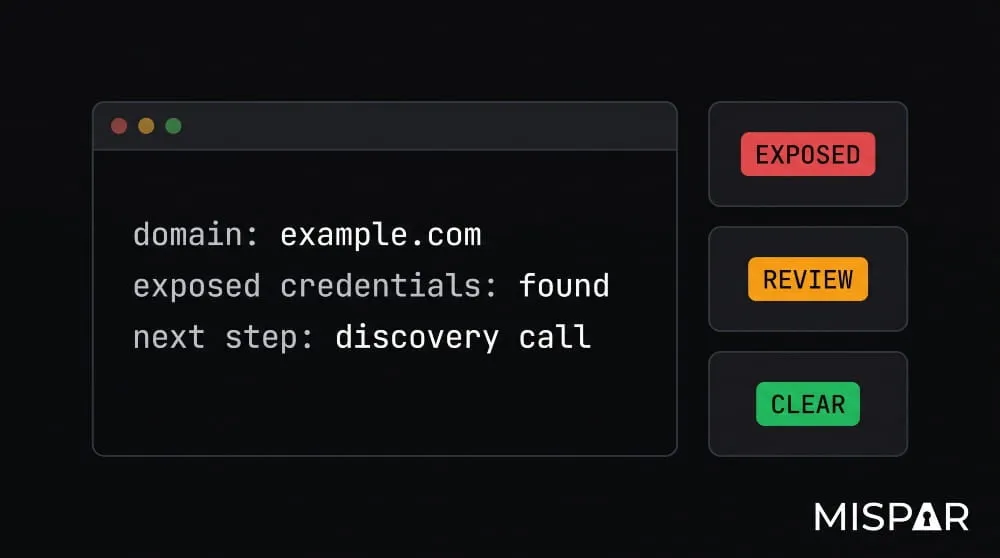
Exposure data lets you test the “need” criterion with evidence, not a conversation. Instead of asking whether a prospect worries about credential theft, you can show whether their domain already appears in leaked data. That turns qualification from a questionnaire into a finding.
Domain and email exposure as a conversation opener
A concrete finding, such as exposed employee emails tied to a company domain, is a stronger opener than a generic pitch. It gives the prospect a reason to reply and gives you a measurable need score. A domain exposure check is one way to produce that evidence, and prospecting features in a wholesale platform can run the same logic across a whole target list.
What to check before the first call
Before you call, confirm whether the domain has exposed credentials, whether employee emails appear in breach data, and what the prospect’s public footprint looks like. Note anything that suggests a compliance driver, such as the sector they operate in. Bring two or three specific findings rather than a long report, and treat a clean result as a signal too, since it usually means lower urgency. Continuous exposure monitoring also keeps this evidence current for leads you have placed in nurture.
Matching leads to a pricing model
Qualification and pricing are linked, because a lead’s size and complexity determine which pricing structure you can profitably offer. Match the model to the lead, not the other way round.
Per-seat, per-endpoint, tiered, bundled
Per-seat pricing scales with employees and suits services tied to user identity and awareness. Per-endpoint pricing scales with devices and suits endpoint-centric services. Tiered pricing packages services into levels, which simplifies sales but requires leads to fit a tier. Bundled pricing combines several services under one fee and works when a prospect has a broad gap rather than a single need. A lead that fits none of your structures cleanly is a signal to qualify harder, not to invent a Custom deal.
Wholesale resale and margin considerations
If you resell a wholesale platform under your own brand, your margin comes from the gap between what you pay and what you charge. Qualification protects that margin, because heavy-support clients that need Custom work erode it quickly. Reselling under your own brand through white-label delivery also means your qualification standards define who your clients are.
Payment models (monthly vs annual)
Monthly billing lowers the barrier to starting but makes churn easier, while annual commitments improve predictability and often suit prospects with a compliance deadline. Offer the model that matches the lead’s timing and budget cycle, and avoid discounting to compensate for a weak qualification score.
Red flags: leads to deprioritize
Some leads look promising and rarely close. Deprioritize prospects who cannot name a decision-maker, who want enterprise-grade coverage on a minimal budget, who have no trigger event and no visible exposure, or who treat security purely as a price comparison. Another warning sign is a prospect who rejects every proposed scope but keeps asking for more meetings. Move these leads to a nurture list and re-check at a fixed interval instead of letting them occupy active pipeline.
From qualified lead to first service
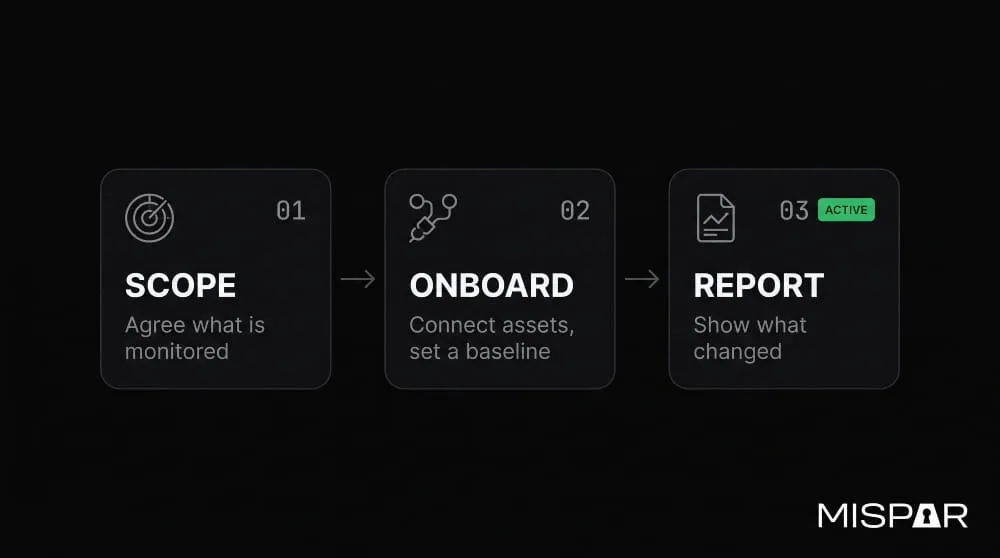
Qualification continues after the lead turns green, because the first service sets the tone for the relationship. A clear scope, agreed expectations, and a quick first result reduce early churn.
Contracts and SLA basics
Define what you monitor, what you respond to, how quickly you respond, and what falls outside the scope. Put response expectations in writing so an SLA reflects what you can actually deliver, not what sounds impressive. Ambiguity at this stage is the most common source of later disputes.
Onboarding process
A workable onboarding sequence confirms scope, collects the assets to monitor, connects data sources, establishes a baseline, and names a contact on each side. Aim for a visible first result early, such as a first exposure report, so the client sees value before the first invoice review.
Reporting cadence
Agree on a reporting rhythm at signing, typically a regular summary of findings, actions taken, and open risks. Reports should lead with what changed and what the client should do, not with raw volume. Consistent reporting is also your best retention tool, since it shows ongoing value.
Marketing and channel: where qualified leads come from
Qualification quality depends on lead source, so it pays to look at where your best clients originated.
How to market an MSSP
Marketing for an MSSP works best when it leads with evidence, not claims. Educational content, free diagnostic tools, and targeted outreach backed by exposure findings tend to attract prospects who already have a problem. Broad awareness campaigns generate volume but usually lower qualification scores.
Playbook and roles
Document the process so it survives staff changes. A short playbook names who runs the first scan, who holds the discovery call, who scores the lead, and who owns nurture. Clearly splitting these roles prevents leads from stalling between marketing and sales.
Tools: CRM and tracking for MSSP sales
Any CRM that supports Custom fields and stages will work. Add fields for each qualification criterion, the score, the trigger event, and the next re-check date, so the scorecard lives where the pipeline does. The tool matters less than the discipline of recording the score and revisiting it.
Frequently Asked Questions (FAQ)
What are the main MSSP lead qualification criteria?
Fit, need, budget, authority, and timing. Need is the most important for security sales because it reflects a real exposure or compliance driver.
How do you score an MSSP lead? Assign points to each criterion, total them, and sort the lead into green, yellow, or red. Green advances to discovery, yellow enters nurture, and red is closed out.
How is MSSP lead qualification different from MSP lead qualification?
It centers on security evidence, such as exposure, compliance pressure, and incident history, rather than general IT support needs.
When should you walk away from a lead?
When there is no identified decision-maker, no budget, no trigger event, and no visible risk, or when the prospect’s expectations cannot be met at a profitable price.
Conclusion
Good MSSP lead qualification criteria come down to evidence: a prospect you can serve well, with a verifiable need, a budget, an approver, and a reason to act now. Score leads consistently, test need with exposure data, match the pricing model to the lead, and treat onboarding as the final qualification step. Platforms like Mispar give MSSPs the wholesale tooling to run this process under their own brand.