
MSSP threat intelligence is a service in which a managed security provider watches sources outside a client’s network, such as leaked credential dumps and underground forums, and tells the client what has been exposed and what to do about it. For an MSSP, it is a recurring service you can resell, built on finding exposure before an attacker uses it.
The evidence for why this matters is practical. Verizon’s 2026 DBIR found that 73% of ransomware victims had experienced a credential leak within the prior year, with roughly half of those leaks occurring within 95 days of the ransomware incident. The same report shows that vulnerability exploitation has overtaken stolen credentials as the most common initial access vector, so external intelligence complements patching and monitoring rather than replacing them. This guide explains what external threat intelligence is, what data a service needs, how to turn data into findings, and how to deliver and package it. For the provider model itself, see what an MSSP is.
What is external threat intelligence for MSSPs?
External threat intelligence for MSSPs is information about threats to a client that originates outside the client’s own systems, collected and interpreted by the provider. It answers a question the client’s own tools cannot: what do attackers already know or hold about this organization?
External vs internal threat intelligence
Internal threat intelligence comes from inside the client’s environment, such as endpoint alerts, network logs, and authentication events. External threat intelligence comes from outside it: leaked credentials, underground chatter, malware logs, and exposed brand or domain assets. The two work together. Internal data tells you what is happening in the environment, while external data tells you what has already left it or is being targeted, often before any internal alert fires.
Why clients can’t easily do this themselves
Most small and mid-sized clients cannot run external threat intelligence in-house because it needs access to hard-to-reach sources, ongoing collection, and someone to interpret the results. A client’s IT generalist rarely has time to watch underground sources or the context to judge which findings matter. That gap is why the service works as a managed offering: the client pays for the outcome, a clear list of what is exposed and what to fix, not for access to raw data.
What data an MSSP threat intelligence service needs
A useful service draws on several types of external data, because each shows a different part of the client’s exposure. Treat the categories below as a checklist when you evaluate a data provider or platform, and confirm what any specific provider actually covers rather than assuming it.
Leaked credentials and breach data
Leaked credentials and breach data show which of a client’s email addresses and accounts have appeared in known breaches or credential dumps. This is usually the highest-value category, because a valid exposed credential can give an attacker direct access. For each finding, you want the affected account, the source or date (where known), and whether the password was exposed in usable form. Mispar’s dark web monitoring covers this need.
Dark web and underground sources
Dark web and underground sources include forums, marketplaces, and closed channels where stolen data and access are traded. Monitoring them can reveal that a client’s data or access is for sale before it is used. Coverage here is hard to verify from the outside, so ask any provider what sources they cover and how often they refresh them, and avoid promising clients complete visibility.
Brand and domain exposure
Brand and domain exposure covers things like lookalike domains, impersonation, and leaked internal references to the client. These signals matter because attackers use convincing copies of a client’s name to phish its staff and customers. They differ from credential findings, since they point to targeting and preparation rather than confirmed compromise.
Malware and infostealer logs
Malware and infostealer logs contain credentials and session data collected from infected devices. They matter because infostealers feed a wider criminal pipeline: Verizon’s 2026 findings describe infostealers as a pipeline to ransomware attacks, with stolen credentials packaged and sold by initial access brokers. Findings from these logs often indicate an infected device on the client’s side, which means the response is not only a password reset but also a device check.
From raw data to usable intelligence
Raw external data is not intelligence until it is matched to a client and ranked by importance. The work between collection and delivery is what clients actually pay for, and it is where most services succeed or fail.
Matching findings to each client
Matching means tying each finding to the right client, domain, and account, and removing noise such as old, already-fixed, or irrelevant records. Maintain an accurate list of each client’s domains, brands and key accounts so that matches are reliable. A finding that cannot be tied to a specific client is not worth sending, and one sent to the wrong client damages trust.
Prioritizing by severity
Prioritization sorts findings by how urgently the client must act. A working scheme separates critical items, such as a recent credential exposure for a privileged account, from items to review and from informational findings that need no action. State the reason for each rating in plain language, so the client understands why one item comes first. Consistent severity labels also make your reports comparable from month to month.
How to deliver threat intelligence to clients
Delivery turns findings into something a client can read and act on, and it determines whether the client sees value. Use more than one channel, because urgent findings need speed and strategic ones need context.
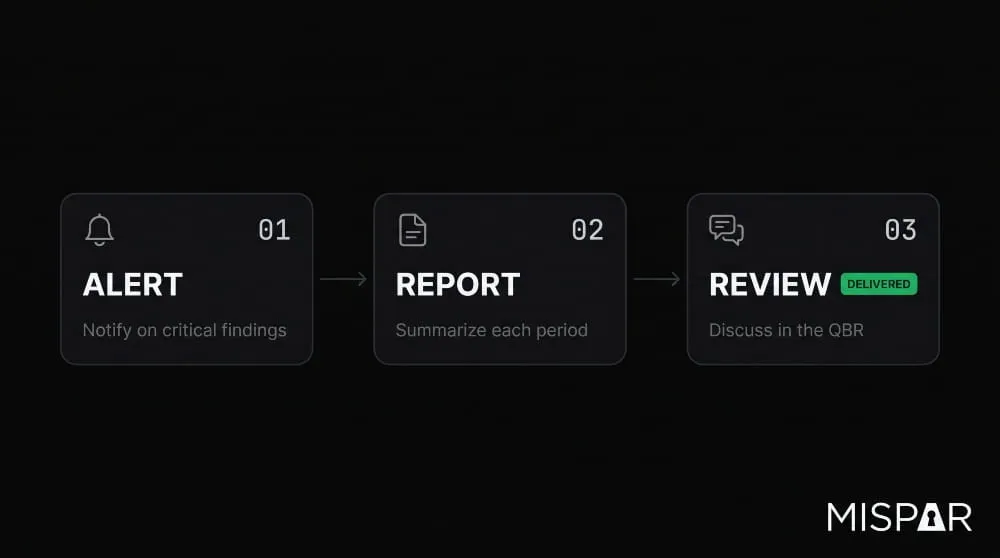
Alerts, reports, and QBR talking points
Use alerts for critical findings that cannot wait, a periodic report for the full picture, and quarterly reviews for trends and decisions. In a report, lead with what changed and what the client should do, and carry unresolved items forward until closed. Findings also give you concrete talking points in a quarterly business review. Our guide to MSSP reporting covers report structure in more detail.
Portal access and white-label delivery
A client portal gives clients on-demand, read-only visibility into current findings and their status between reports. Delivering this under your own brand keeps the client’s relationship with you, not with a vendor behind you, and white-label delivery is designed for that. Mispar is a wholesale platform that MSSPs resell under their own brand, and its intel feed provides external threat data for this kind of service. Confirm current coverage and capabilities with the platform before describing them to clients.
Packaging threat intelligence as a resellable service
Packaging means deciding what is included, at which tier and at what price, so the service is easy to sell and profitable to run. Keep the offer simple enough to explain in a sentence.
Where it fits in your service tiers
External threat intelligence fits naturally as an entry-level or add-on layer, because it is relatively easy to explain and delivers visible results. Many providers include basic exposure monitoring in a base tier and reserve deeper investigation, remediation support, or more frequent reporting for higher tiers. Match the inclusions to what you can deliver consistently, since an unreliable premium tier hurts more than a modest, dependable one.
Pricing considerations
Price the service on what drives your cost to serve, such as the number of monitored domains or users and the depth of reporting and response included. Define what happens when a finding needs hands-on remediation, because that work can erode margin if it is unpriced. The MSSP pricing model guide compares per-seat, tiered, and bundled approaches and shows how scope definitions protect margin.
Common mistakes
The most common mistake is forwarding raw findings without matching, ranking, or recommending an action, which overwhelms clients and weakens trust. Others include overpromising complete dark web coverage, sending alerts with no owner or next step, treating a one-off scan as an ongoing service, and leaving remediation work out of the scope and price. A final one is positioning external intelligence as a replacement for patching and endpoint protection; it is an additional layer that shows exposure, not a substitute for the basics.
Frequently Asked Questions (FAQ)
What is MSSP threat intelligence?
MSSP threat intelligence is a managed service that monitors sources outside a client’s network, such as leaked credentials, underground forums, and malware logs, and reports what has been exposed and what the client should do. It lets an MSSP find exposure before an attacker uses it.
What data does an external threat intelligence service need?
It needs leaked credential and breach data, dark web and underground source coverage, brand and domain exposure signals, and malware or infostealer log data. Each shows a different part of exposure, and the value comes from matching and prioritizing findings per client.
How do MSSPs deliver threat intelligence to clients?
MSSPs deliver it through alerts for urgent findings, periodic reports for the full picture, quarterly reviews for trends, and a client portal for on-demand visibility. Delivering all of it under the MSSP’s own brand strengthens the client relationship.
Does external threat intelligence replace other security controls?
No. It adds visibility into exposure outside the client’s network and works alongside patching, endpoint protection, and monitoring. Verizon’s 2026 data shows vulnerability exploitation now leads as an entry point, so exposure data complements rather than replaces those controls.
Conclusion
Good MSSP threat intelligence comes down to collecting the right external data, matching and ranking it per client, and delivering it in a form clients can act on. Start with a clear scope, be honest about coverage, report consistently, and price for the remediation work that follows. Mispar gives MSSPs the white-label tooling to resell external threat intelligence under their own brand.