
MSP vs. MSSP vs. MDR | Guide to Managed Security Service Models
September 14, 2026
An MSP manages a business’s day-to-day IT operations, while an MSSP focuses specifically on cybersecurity, monitoring, detecting, and responding to threats around the clock. MDR sits in that same security-first category, but focuses on active threat hunting and incident response rather than the broader oversight an MSSP typically provides. The distinction matters more than it used to: managed security has become the fastest-growing segment of the managed services market, expanding at roughly double the rate of general IT services as businesses shift budget from reactive support to dedicated protection. For an MSP weighing whether to expand into security, or a buyer trying to figure out which acronym actually matches what they need, the differences aren’t just semantic; they shape scope, pricing, and how risk is handled when something goes wrong. This guide breaks down where each model starts and ends, and where they overlap.
MSP vs. MSSP: What Actually Separates Them
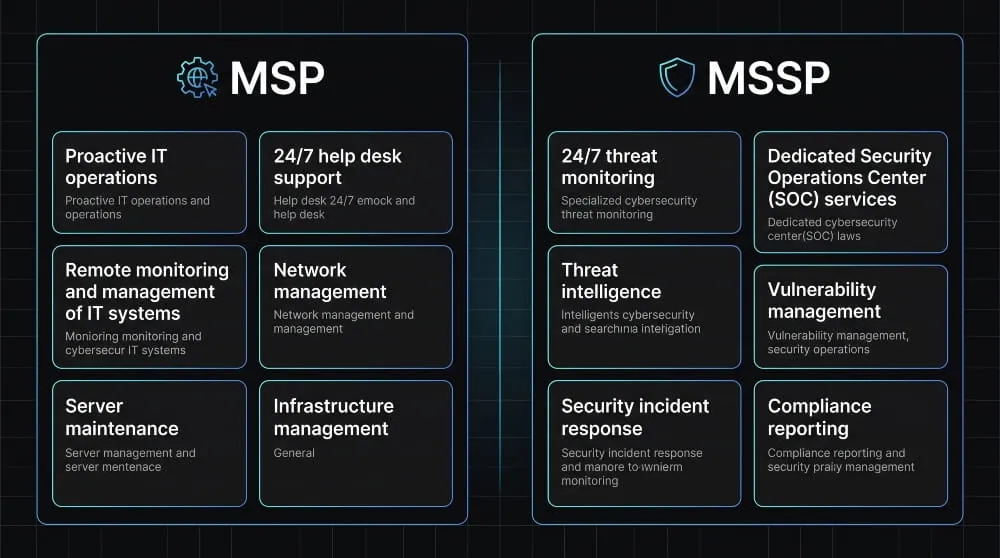
The two models start from different jobs. An MSP is built to keep a business’s technology running: networks, servers, help desk, backups, patching, with security folded in as one responsibility among many. An MSSP exists specifically to secure that environment, treating monitoring, detection, and incident response as the entire mandate rather than a line item. The confusion comes from the fact that most MSPs now sell some security service, which blurs a distinction that used to be much cleaner.
Scope of Services: IT Operations vs. Dedicated Security
An MSP’s scope is operational continuity: keeping systems online, users productive, and infrastructure current. Security tasks like firewall management or antivirus deployment often sit inside that broader IT contract, handled alongside help desk tickets and hardware refreshes. An MSSP’s scope narrows to security outcomes: 24/7 threat monitoring, log analysis, alert triage, and response coordination, usually backed by a security operations center rather than a general IT team. The difference isn’t that MSPs ignore security; it’s that security competes for attention with everything else on their plate, while it’s the only thing on an MSSP’s.
Classification Criteria: When Does an MSP Become an MSSP?
No single regulatory line flips an MSP into an MSSP. Still, the practical markers are consistent: a dedicated SOC or security team, formal detection and response processes, and, increasingly, third-party attestations to back up the claim. That last piece matters more than marketing copy suggests. Across MSP provider listings, 96.1% advertise cybersecurity capabilities. Yet only 9.7% hold a SOC 2 attestation and just 4.3% carry CMMC certification, meaning most “security-capable” MSPs haven’t been independently verified. Buyers and MSPs themselves are increasingly using attestations, not service descriptions, as the real classification test.
Business Model and Revenue Implications of the Transition
Moving from MSP to MSSP isn’t just a services rebrand; it changes the underlying economics. Security-focused contracts typically command higher margins and longer retention than general IT support, because clients treat security as harder to switch providers on and less tolerant of gaps in coverage. That shift is visible in how the market is consolidating: MSP and MSSP acquisitions rose 73% year-over-year in the first quarter of 2026, with outside investors involved in 80% of those deals, a sign that security specialization has become one of the clearest ways for a provider to increase its own valuation, not just its client base.
MSSP vs. MDR, Two Different Security Delivery Models
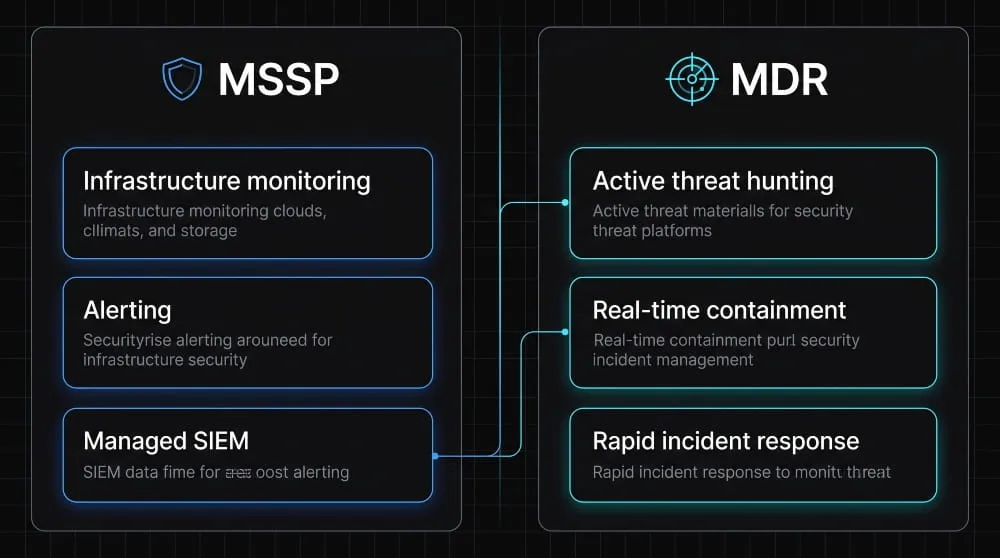
MSSP and MDR both outsource security operations, but they’re built around different jobs: an MSSP manages the broader security function, infrastructure, alerting, and ongoing oversight, while MDR is narrower and more active, focused specifically on hunting down and neutralizing threats in real time. The two categories overlap enough that vendors often blur the line in marketing, but the underlying delivery models are distinct.
MSSP: Monitoring, Alerting, and Managed Infrastructure
An MSSP’s core job is visibility and oversight across a client’s security stack: monitoring firewalls, endpoints, and networks; generating alerts when something looks wrong; and managing the underlying security infrastructure so the client doesn’t have to. That typically includes maintaining tools like SIEM platforms, firewalls, and intrusion detection systems, plus routine reporting for compliance and audit purposes. The tradeoff is response depth: an MSSP flags and escalates threats, but the client’s team (or a separate provider) often still owns the investigation and remediation.
MDR: Active Threat Detection and Response
MDR goes a step further into the incident itself. Instead of just surfacing alerts, an MDR provider actively hunts for threats, investigates suspicious activity, and takes direct action to contain or remediate it, often within the same engagement. This shift toward hands-on response is a big part of why the category has grown so fast: Gartner has projected that half of all organizations will rely on MDR for round-the-clock threat monitoring, detection, and containment, a trajectory analysts expect to keep climbing as breach costs and attacker speed both increase. For organizations without an internal security operations team, MDR effectively rents that active-response capability, not just the monitoring layer.
Where SIEM Fits Into Both Models
SIEM is the data layer underneath both models, not a competing category. It aggregates logs and security events from across an environment so they can be analyzed and correlated- the raw material an MSSP uses to generate alerts and an MDR provider uses to hunt for threats. Some MSSPs manage a client’s SIEM directly as part of their service; some MDR providers layer detection on top of a SIEM the client already owns, or replace it entirely with their own telemetry stack. The practical question when evaluating either isn’t whether a SIEM is involved; it almost always is, but who owns and tunes it.
MSSP vs. MDR vs. SOC-as-a-Service, Compared
SOC-as-a-service sits close to both, and the naming gets murky in practice. In general, an MSSP is the widest-scope model: infrastructure management plus monitoring plus compliance support. MDR is the most response-focused, prioritizing active containment over broad oversight. SOC-as-a-service tends to describe a fully outsourced security operations center that behaves like an in-house SOC, often bundling elements of both MSSP monitoring and MDR-style response under one service. In practice, the labels matter less than the specifics of a given contract: scope, response-time commitments, and who’s on the hook when an alert turns into an actual incident.
How MSSPs Deliver Security: Modern Delivery Models
Most MSSPs today run their operations on cloud-native platforms rather than on-premises hardware, which changes how quickly they can onboard clients and how much visibility they can offer across distributed environments. The shift isn’t cosmetic; it determines whether an MSSP can actually scale past a handful of clients without every new customer requiring Custom infrastructure.
Cloud-Native and Azure-Based MSSP Operations
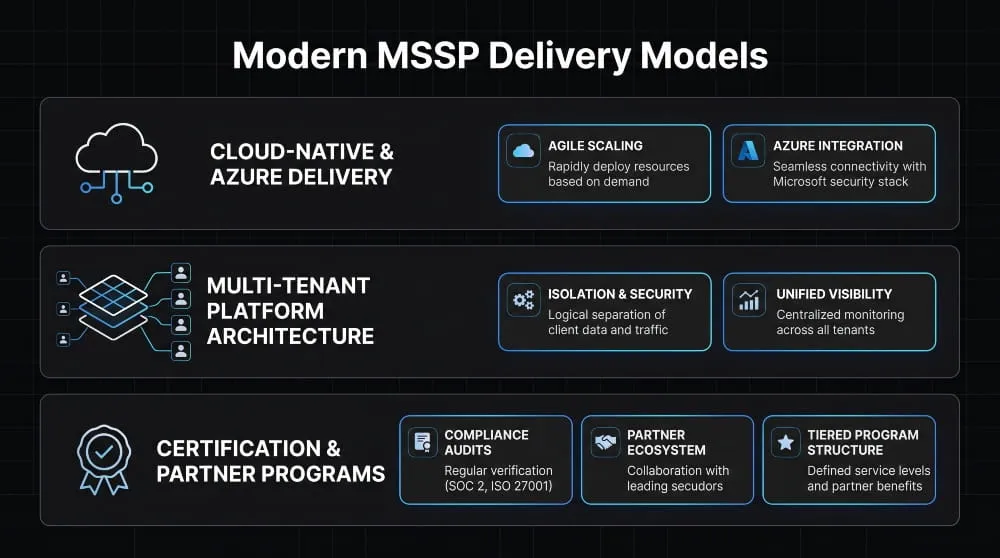
A growing share of MSSPs build their delivery model around cloud-native SIEM platforms rather than maintaining their own on-premises stack, with Microsoft Sentinel now holding over 50% market penetration among organizations evaluating cloud-native security operations centers. For an MSSP, running on Azure means faster client onboarding, built-in scalability, and access to Microsoft’s native connector ecosystem for ingesting logs across a customer’s environment. The tradeoff is architectural: Azure’s tenant boundaries mean each customer’s data typically lives in its own workspace. Hence, an MSSP still has to solve for cross-customer visibility rather than getting it automatically.
Multi-Tenant Platform Requirements
Serving multiple clients from one operations team requires a platform built for tenant isolation without sacrificing central oversight; the SOC needs to see across all customers at once while keeping each customer’s data segregated for compliance and privacy. In practice, this means role-based access controls that scale across dozens of client environments, automation to handle onboarding without manual reconfiguration each time, and tooling like Azure Lighthouse that lets an MSSP manage customer resources without needing standing access inside every individual tenant. Providers that skip this groundwork tend to hit a ceiling: managing security for 10 clients manually doesn’t translate to managing 50 the same way.
What MSSP Certification and Program Structures Look Like
Most major security vendors run formal MSSP partner programs that certify providers on their platforms, completing training, meeting deployment benchmarks, and maintaining a minimum level of certified staff in exchange for deal registration, technical support, and co-marketing. These programs serve as a credibility signal for prospective clients evaluating providers, though certification rigor varies widely from vendor to vendor. Beyond vendor-specific badges, independent credentials, SOC analyst certifications, and cloud security certifications tied to the platforms an MSSP actually runs tend to carry more weight with buyers who’ve learned to look past logo walls on a provider’s website.
Compliance-Driven MSSP Positioning
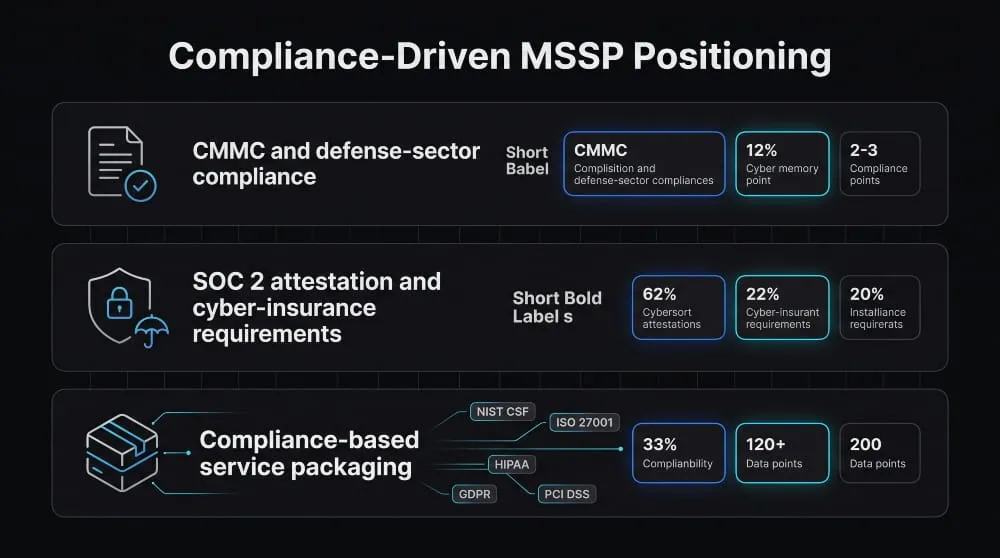
Compliance has become one of the strongest drivers of MSSP demand, not because regulations mandate outsourcing security specifically, but because meeting frameworks like CMMC, SOC 2, and cyber insurance underwriting requirements in-house is expensive and hard to staff. For many organizations, hiring an MSSP is less a security decision and more a compliance one, the fastest, most defensible way to check boxes that carry real financial consequences if missed.
CMMC and the MSSP’s Role in Defense-Sector Compliance
Organizations in the defense industrial base face a hard requirement: CMMC compliance to bid on or retain Department of Defense contracts, and most don’t have the internal expertise to build a compliant security program from scratch. An MSSP with CMMC-aligned experience can implement and manage the specific controls the framework demands, including access management, incident logging, and continuous monitoring, and provide the documentation trail assessors expect during certification. This has made CMMC readiness a distinct MSSP specialty, separate from general managed security, because the framework’s requirements are prescriptive enough that generic security monitoring doesn’t automatically satisfy them.
SOC 2 and Cyber-Insurance-Driven Client Expectations
Two forces outside a company’s own risk appetite now push it toward MSSP-level security: client due-diligence questionnaires that increasingly expect a SOC 2 report, and cyber insurance underwriting that has tightened sharply. Roughly two-thirds of cyber insurers now require endpoint detection and response or managed detection and response on every endpoint as a baseline condition of coverage, not a discount-earning extra, meaning a company without that in place risks being declined outright or priced out at renewal. An MSSP that can produce evidence of 24/7 monitoring and documented response processes directly satisfies both the insurer’s checklist and a client’s SOC 2 audit trail, which is increasingly the actual sales pitch.
How Compliance Requirements Shape Service Packaging
Compliance pressure has pushed MSSPs to package services around specific frameworks rather than selling generic “security monitoring.” A provider might offer a distinct CMMC-readiness track, a SOC 2 evidence-collection service, or an insurance-questionnaire support package, each bundling the same underlying monitoring and response capabilities but organized around the paperwork a client actually needs to produce. This shift matters for how MSSPs position themselves: the technical service barely changes from one framework to the next, but the packaging, reporting format, and sales conversation are built entirely around which compliance deadline or renewal is driving the purchase.
How MSSPs Are Evaluated in the Market
Buyers rarely take an MSSP’s own claims at face value; they lean on third-party analyst research to separate genuine capability from marketing language. That reliance on outside validation is a big part of why analyst positioning carries so much weight in security purchasing decisions specifically, where the cost of choosing wrong is measured in breaches, not just wasted budget.
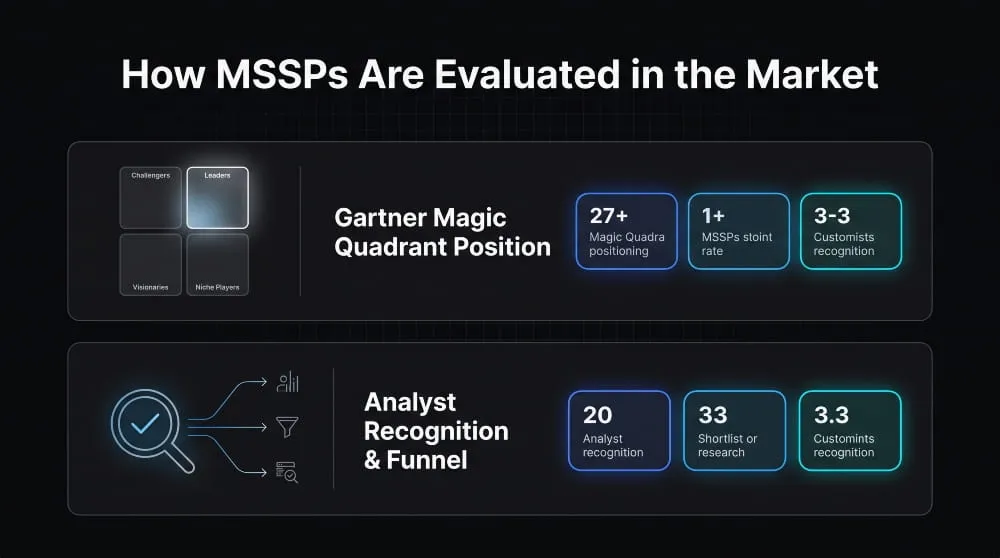
Gartner Magic Quadrant Positioning for MSSPs
Gartner’s Magic Quadrant evaluates MSSPs on two axes, completeness of vision and ability to execute, and sorts providers into Leaders, Challengers, Visionaries, and Niche Players based on where they land. For an MSSP, placement in the Leader quadrant isn’t just a marketing badge; it directly shapes which vendors even make it onto a buyer’s shortlist, since procurement teams often use the MQ as a first-pass filter before evaluating anyone in detail. Providers outside the Leader quadrant aren’t necessarily worse at the work. Still, they’re fighting an uphill battle to get considered once a buyer has already narrowed the field using the report.
What Analyst Recognition Signals to Prospective Clients
Analyst recognition matters less because of the report itself and more because of how deeply it shapes the buying process before a sales conversation even starts: 70% of B2B buyers engage with an analyst or consultant while building their shortlist, and the vendor that ends up on top of that research is the one they contact first roughly 84% of the time. For an MSSP, that means strong Gartner positioning isn’t a nice-to-have for brand credibility; it’s often the mechanism that determines whether a prospective client ever reaches out. Providers without analyst recognition have to work harder to earn a spot in conversations that better-positioned competitors get by default.
Frequently Asked Questions (FAQ)
Is an MSSP the same as an MDR provider?
No, an MSSP manages the broader security function, including infrastructure, monitoring, and alerting, while an MDR provider focuses narrowly on actively hunting and containing threats. Many MSSPs offer MDR as one service within a wider portfolio, but the two terms aren’t interchangeable. The distinction matters most when evaluating response speed and who owns the response during an actual incident.
Can an MSP become an MSSP?
Yes, and it’s a common transition, though it requires more than rebranding, typically a dedicated security team, formal detection and response processes, and often third-party attestations like SOC 2. Notably, only 9.7% of MSPs that market cybersecurity capabilities hold a SOC 2 attestation, which separates a genuine MSSP transition from a marketing relabel. The shift also changes the business model, since security-focused contracts tend to carry higher margins than general IT support.
Do MSSPs need SIEM infrastructure?
In practice, yes, SIEM is the data layer that makes monitoring and alerting possible, aggregating logs across a client’s environment for analysis. Some MSSPs manage a client’s existing SIEM directly, while others run their own platform or telemetry stack instead. Either way, an MSSP without some form of centralized log correlation can’t deliver the visibility the service is built on.