
What Is White Label Cyber Security?
White label cyber security is a security product or service built by one company and sold by another under its own brand, so the client sees the reseller’s name, portal, and reports instead of the vendor’s. It lets an MSP or MSSP add security offerings without building the underlying technology. A white label cybersecurity platform handles the engineering, data, and updates, while the provider owns the client relationship.
White label vs reseller vs OEM
A reseller sells a vendor’s product under the vendor’s name and usually earns a margin or commission. White label removes the vendor’s name: the provider presents the product as its own. OEM is a third model, where one company embeds another’s technology inside a larger product it builds itself. In practice, white label sits between the two: more brand control than reselling, far less engineering than OEM.
What “white labeled” means in practice.
Your brand, their technology. The client logs in to a portal on your domain, receives alerts and reports carrying your logo and colors, and contacts your team for support. The vendor stays in the background, running the infrastructure, keeping the data current, and shipping new features.
What white label cyber security services include
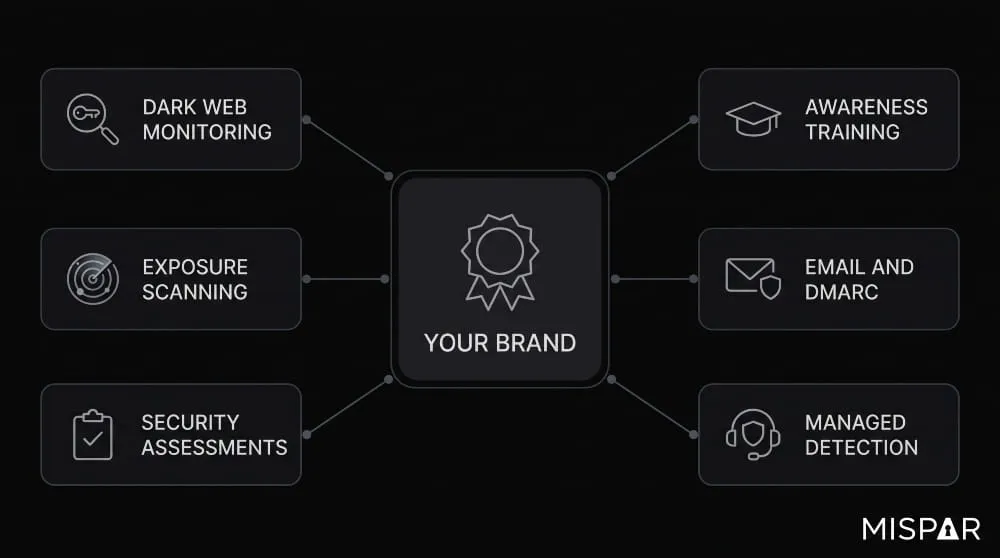
The category covers anything a provider can deliver to clients under its own name: dark web and credential monitoring, exposure and attack surface scanning, security assessments, awareness training, email security and managed detection and response. Some arrive as software you operate; others as a service the vendor delivers. The sections below separate the two.
White label cyber security vs white label security
The broader phrase “white label security” also covers cameras, alarm systems and home security, which are a different market with different buyers and suppliers. This guide covers digital security only: protecting client identities, domains, endpoints, email, and data.
Who it’s for: MSPs and MSSPs
MSPs use white label cyber security to add a recurring security line to an IT contract without hiring a security team. MSSPs use it to widen a portfolio with specialist capabilities, such as dark web monitoring or exposure scanning, that would be expensive to build and maintain alone.
How White Label Cyber Security Works
In a white label arrangement, the vendor builds, hosts, and maintains the technology, and the provider brands, prices, and delivers it to clients. The vendor ensures reliability, data quality, and support for the provider. The provider handles packaging, client communication, and first-line response.
Provider and reseller roles
The vendor runs the platform, collects and processes security data, and fixes problems on its side. The reseller decides which services to sell, sets retail prices, onboards clients, and explains findings in plain language. Clear role boundaries matter: the client should never need to know a vendor exists, and the vendor should never contact the client directly.
Branded portals, domains and the client-facing experience
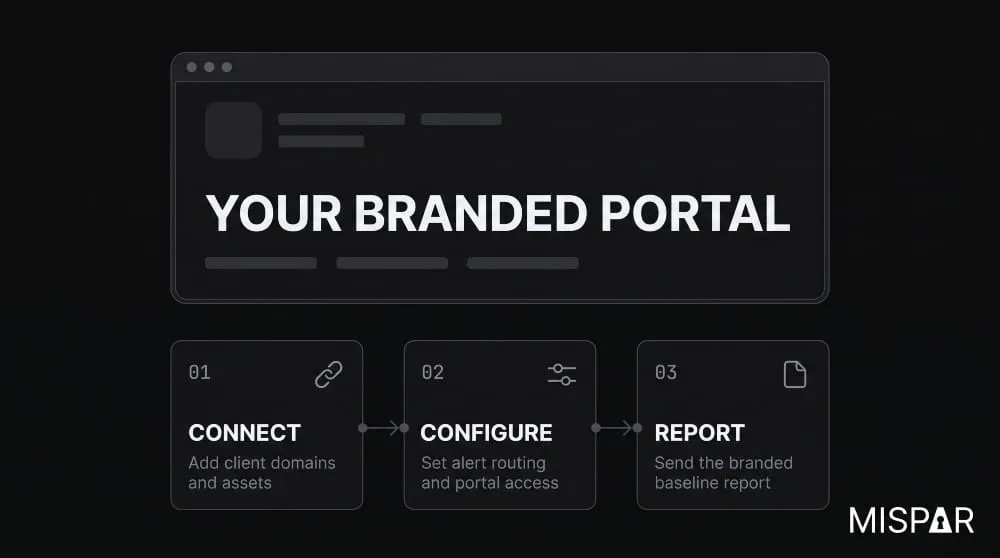
A credible white-label setup brands everything the client touches: a Custom domain for the portal, your logo and colors, branded email notifications, and PDF reports. The more of that experience that carries your identity, the stronger the perception that the service is yours. A dedicated client portal is usually the visible centerpiece.
Pricing and margin models at a high level
Vendors usually charge the provider a wholesale rate per client, per user, per domain, or per monitored asset, sometimes with tiers or minimums. The provider sets its own retail price. Margin is the gap between the two, and it widens as you add clients without adding headcount. Always model margin at your expected client count, not at a single client.
Onboarding and delivery workflow
A typical flow is: add the client, connect their domains or assets, configure alert routing, give them portal access, and send a baseline report. After that, the service runs on a cadence of scheduled reports and alerts that trigger when something needs attention. Good platforms make onboarding take minutes, not a project.
White Label Security Services vs. White Label Platforms
White label security services mean the vendor’s staff do the work, and you resell the outcome, while a white label platform gives you the technology to run the service yourself under your brand. The right choice depends mainly on whether you have people to operate security tools.
| Comparison Dimension | Services Model | Platform Model |
|---|---|---|
| Who does the work | Vendor’s team | Your team, using vendor technology |
| Staffing you need | Minimal | Analysts or technicians who can act on findings |
| Margin potential | Lower, since labor is built into the wholesale price | Higher, since you add the labor |
| Control over client experience | Moderate | High |
| Best fit | MSPs without security staff | MSSPs and MSPs with a security function |
Services: the vendor delivers the work, and you resell it
In this model, the vendor monitors, investigates, or responds, and you present the result as your own. It is the fastest way to launch, and it suits providers that want security revenue without building a team. The tradeoff is dependence on the vendor’s quality and a thinner margin.
Platforms and software: you run the service on the vendor’s technology
Here you operate the tooling, interpret alerts, and speak to the client. You keep more of the revenue and shape the experience, but you need people who can act on what the platform finds.
White-label security solutions and program platforms with partner branding
Some vendors package several capabilities, such as assessments, policies, training, and reporting, into a branded security program you offer as one subscription. These bundles simplify packaging, but check how deeply the partner branding goes before committing.
Which model fits an MSP versus an MSSP
Most MSPs without a dedicated security function start with services or a lightly managed platform. MSSPs, who already have analysts, usually prefer platforms because they can add their own detection logic and response on top.
Hybrid models
Many providers mix both: a platform for visibility and monitoring, with the vendor’s services as overflow or specialist capacity. This lets you grow into the platform model without turning clients away in the meantime.
What Can You White Label?
You can white label dark web monitoring, threat intelligence, security assessments, vulnerability scanning, awareness training, email security, and managed detection and response. Each differs in how much work it takes to deliver and how easily clients understand its value.
Dark web and credential monitoring
Monitoring alerts you when client credentials or domains appear in breach data, infostealer logs, or dark web sources. It is one of the easiest services to explain, because the finding is concrete: this email and password are exposed. See how dark web monitoring works as a white-label service.
Threat intelligence and exposure scanning
Threat intelligence feeds and exposure scans show clients what attackers can already see about them: leaked data, exposed subdomains, and risky assets. They make strong recurring services because new exposure appears constantly.
Security assessments and risk reports for prospecting
A white-label security assessment tool for IT consultants and providers produces a branded risk report on a prospect’s domain in minutes. That report becomes the opening of a sales conversation. The prospecting workflow turns assessments into pipeline instead of one-off deliverables.
Vulnerability and attack surface scanning
Scanning identifies exposed services, outdated software, and misconfigurations. It pairs well with monitoring, since one shows what is exposed and the other shows what has leaked.
Security awareness training and phishing simulation
White label security awareness training lets you deliver branded courses and simulated phishing campaigns under your name. MSP-built platforms usually add multi-client management. It is a separate product category from monitoring, so many providers buy it from a dedicated vendor and combine it with a monitoring platform.
Email security and DMARC
White-label email security platforms filter threats and protect client domains. DMARC is a common MSP revenue line: you set up and manage domain authentication for clients, report on spoofing attempts, and keep policies up to date as email systems change.
Managed detection and response
White-label MDR means the vendor’s security operations center watches client environments and responds to incidents under your brand. It is service-led by nature and typically the highest-cost capability to white label, so it suits providers who want 24/7 coverage without building a SOC.
Benefits of White Label Cyber Security
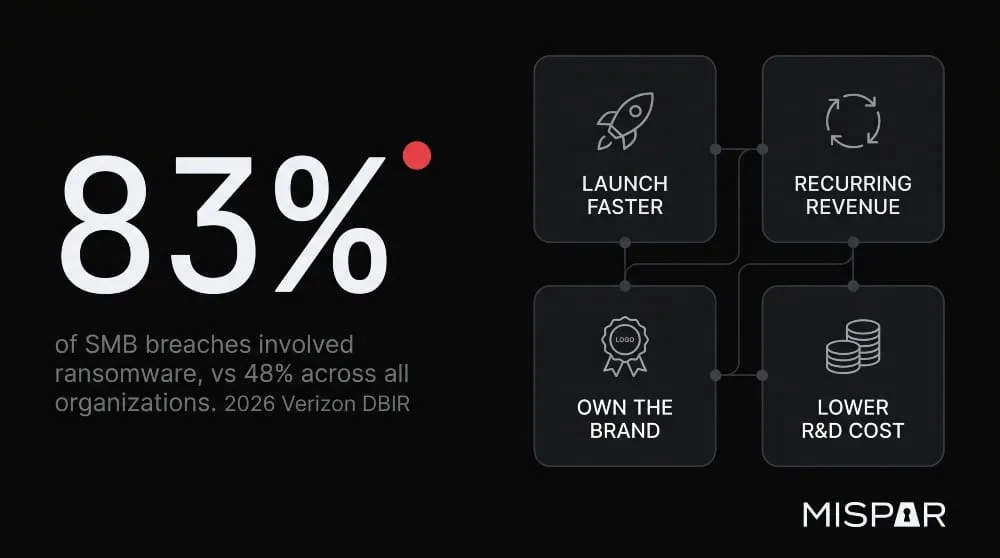
White label cyber security lets a provider sell security faster, earn recurring revenue, and keep client relationships, without the cost of building technology. Demand is real: Verizon’s 2026 Data Breach Investigations Report found ransomware in 83% of breaches at small and medium-sized businesses, compared with 48% of breaches across all organizations. The clients most likely to need protection are the ones most likely to rely on an MSP.
Launch services without building technology
Building detection, data collection, and reporting from scratch takes years of engineering. White label turns that into a vendor relationship you can start in weeks.
Recurring revenue and margin
Security services bill monthly, and a multi-tenant platform serves each additional client at low marginal cost. That combination is what makes the model attractive to providers.
Brand ownership and client retention
When the client sees your name on every alert and report, security strengthens your relationship instead of your vendor’s. Clients are less likely to leave a provider that is visibly protecting them.
Faster time to market and lower R&D cost
The vendor spreads development costs across all its partners, so you gain new features without funding them. You can add a service when a client asks, rather than after a long build.
White Label Cyber Security Software and Platforms for MSPs
The best white label cyber security software for MSPs combines deep branding, multi-tenant management, role-based access, and API access in one console. These capabilities determine whether the platform scales with your client base or becomes a per-client burden.
Must-have platform capabilities
Look for full branding control, scheduled and on-demand reports, configurable alert routing, and a client portal. Also check data quality: the platform is only as useful as the breach, infostealer, and exposure sources behind it.
Multi-tenant management and role-based access
Multi-tenant architecture keeps each client’s data isolated while giving your team one place to manage everyone. Role-based access lets technicians, account managers, and clients see only what they should.
API and integration support
An API and integrations with your PSA, ticketing, and SIEM tools let findings flow into the workflows you already use. Without them, every alert becomes manual work.
Platform vs point solution
A point solution does one job well, such as phishing simulation. A platform covers several related jobs in one console. Point solutions can be best-in-class for a single need, while platforms reduce the overhead of running many tools.
Consolidating several white label tools vs running each separately
Running separate white label tools means separate logins, branding setups, billing, and reports. Consolidating reduces that overhead and gives clients one coherent experience, but it ties more of your service to a single vendor. Weigh the operational savings against the concentration risk.
White Label Reports and Assessments: Branding, Client Reporting and Proof of Value
Branded reports show clients the value of a security service, and branded assessments help providers win new clients. Both turn technical findings into something a business owner can read and act on.
What branded security reports should include
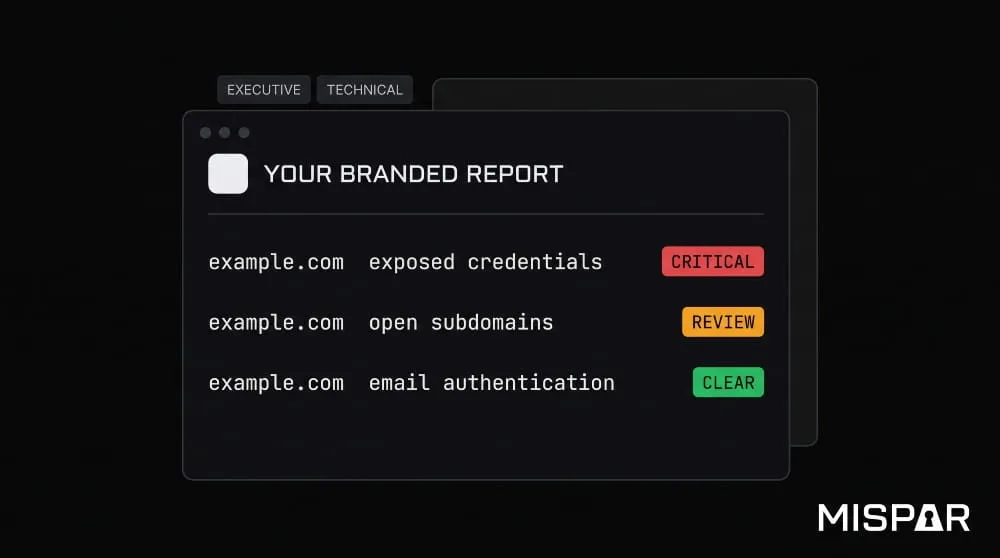
A useful report states what was found, how serious it is, what was done, and what the client should do next. It should carry your branding throughout, with no vendor names in headers, footers, or file metadata. See how white label reporting is typically structured.
Using branded assessments to win new clients
Run an assessment on a prospect’s domain and send the branded results before a sales call. A concrete finding, such as exposed credentials, starts a more productive conversation than a generic pitch.
Report cadence and scheduling
Monthly reports are a common baseline, with immediate alerts for critical exposure. The goal is a rhythm clients can expect: regular proof that the service is working, plus fast notification when it matters.
Executive vs technical reports
Executives want a summary of risk and trend, while technical contacts want details and remediation steps. Offer both from the same data, so each audience gets the level of detail it needs.
Reports as a retention and upsell tool
A report that shows what was caught and what remains exposed makes the case for expanded services. It also gives account managers a natural agenda for renewal conversations.
How to Choose a White Label Cyber Security Partner
Choose a white label cyber security partner by testing branding depth, multi-tenant design, support quality, and contract terms, then confirming them in a trial with real client data. A strong demo is not enough; the partner you pick becomes part of your brand.
Evaluation checklist
Check how completely the vendor can be hidden: portal domain, emails, PDF reports, support documentation, and login pages. Confirm that tenant isolation is built in, that role-based access exists, and that pricing scales sensibly with client count. Ask how support works when something breaks at a client site.
How to evaluate a white-label security services vendor
For a services vendor, ask about service level agreements, response times, and escalation paths. Find out who owns the client relationship and whether the contract restricts the vendor from approaching your clients. Review minimum commitments, termination terms, and what happens to your data if you leave.
Questions to ask in a demo or trial
- Can I remove every reference to your brand, including emails and report files?
- How is client data isolated between tenants?
- What does onboarding a new client require from my team?
- What is your process when a data source fails, or an alert is wrong?
- Can I export my client data if I leave?
Red flags
Watch for shallow branding that only changes a logo, per-seat pricing that punishes growth, no tenant isolation, and vague answers about data sources. A vendor who cannot explain where its data comes from is a risk to your reputation.
Partner vs Vendor
A vendor sells you software. A partner invests in your success: it supports your onboarding, listens to product feedback, and avoids competing with you for your clients. Test this during the trial by seeing how the vendor handles your questions.
Common Mistakes When Reselling Cyber Security
The most common mistakes in reselling cybersecurity are buying a platform before defining a service, underpricing, and neglecting reporting and onboarding. All three are avoidable with planning before launch.
Buying a platform before defining a service tier
Providers sometimes sign with a vendor and then work out what to sell. Decide your tiers, what each includes and who delivers it first, then pick the platform that supports them.
Underpricing and skipping packaging
Selling security as a cheap add-on undervalues the work and attracts clients who see it as a commodity. Package services into clear tiers with defined deliverables so the price reflects the value.
Ignoring client reporting and onboarding
A service clients cannot see is a service clients cancel. Build reporting and a consistent onboarding process into every plan from day one.
Compliance and Trust Considerations
When you resell security, you inherit questions about how the vendor handles client data, so check the vendor’s data practices before you sign. Clients, auditors, and insurers will ask you, not your vendor.
Data handling and tenant isolation
Confirm where data is stored, how long it is retained, who can access it, and how each client’s data is separated from every other tenant’s. These answers should be written, not verbal.
Client due diligence and cyber insurance questions
Clients and insurers commonly ask what monitoring and controls a provider has in place. Having a documented service, with reports as evidence, makes those questionnaires faster to complete. Keep copies of reports as proof that monitoring ran.
Contractual responsibilities between provider and reseller
Your agreement with the vendor should define who is responsible for data protection, incident notification, and service availability. Have a lawyer review it, since responsibilities may differ by jurisdiction and contract.
Conclusion
White label cybersecurity lets MSPs and MSSPs sell security under their own brand without building the technology, as long as they choose a model that fits their team and a partner that protects their brand. Start by defining the services you want to sell, then evaluate platforms against that plan. To see how it works in practice, explore the white label feature, or learn how Mispar gives MSSPs a wholesale platform to resell under their own name.
Frequently Asked Questions (FAQ)
What is white label cyber security?
White label cyber security is security technology or service from one company that another company sells under its own brand. The client sees the reseller’s identity throughout, while the vendor operates behind the scenes.
What are white label cyber security services?
White label cyber security services are security offerings, such as monitoring, assessments, training, email security, or managed detection and response, that a provider delivers to clients under its own name. The vendor’s team performs some, and others run on the vendor’s platform.
Is white label cyber security profitable for MSPs?
It can be, because it adds recurring revenue without the cost of building technology. Profitability depends on wholesale pricing, how many clients you serve, and how much labor each client needs, so model margin before you commit.
What is the difference between white label and reseller?
A reseller sells a vendor’s product under the vendor’s brand, while white label removes the vendor’s identity so you can sell it as your own. White label gives you more brand control and a closer client relationship.
What should I look for in a white label security services vendor?
Look for clear service levels, deep branding, strong tenant isolation, and honest answers about data sources. Review the contract for minimums, termination rights, and who owns the client relationship.
Can I white label security awareness training or email security?
Yes. Both are available as white-label offerings from dedicated vendors. They are separate product categories from monitoring, so many providers combine several white-label tools to build a fuller security stack.
Can I brand the reports and client portal?
In most white label platforms, yes. Check how far branding extends: the best setups cover the portal domain, logo, colors, emails, and PDF reports, with no vendor references remaining.
How do I start offering white label cybersecurity?
Define the services and tiers you want to sell, choose between a services and platform model, and run a trial with a partner using real client data. Then price your tiers, onboard a first group of clients, and build reporting into the plan from the start.