
Deep Web vs. Dark Web | What’s the Real Difference?
September 12, 2026
The deep web and the dark web are not the same thing, even though the terms get used interchangeably: the deep web is simply any part of the internet that isn’t indexed by search engines- think online banking portals, private email, and internal company databases- while the dark web is a small, deliberately hidden subset of the deep web that requires special software like Tor to access. In other words, every dark web page is technically part of the deep web, but the vast majority of the deep web has nothing to do with the dark web at all.
That distinction matters more than it might seem. Estimates suggest the deep web makes up somewhere around 90–96% of the entire internet, while the dark web accounts for a sliver of that, often cited at well under 0.1% of total web content. Most people interact with the deep web daily without ever realizing it; almost nobody stumbles onto the dark web by accident. Below, we’ll break down how the two differ, where the “iceberg” visual everyone references comes from, and why the distinction matters if you’re trying to protect your personal or business data.
What Is the Deep Web?
The deep web is any web content that standard search engines like Google or Bing don’t index, meaning you can’t find it through a normal search, even though it’s often just as legitimate and everyday as the pages that are indexed. You don’t need special software or technical know-how to reach it; you just need the right login, link, or permission, since most deep web content sits behind a password, a paywall, or a form that search engine crawlers can’t get past.
Deep Web Examples
Most people use the deep web constantly without thinking of it that way. Logging into online banking, checking a personal email inbox, viewing medical records through a patient portal, or pulling up a company’s internal HR system are all deep web activities, because none of that content is meant to be publicly searchable. Academic research databases, subscription news archives, and cloud storage accounts like Google Drive fall into the same category: the content exists on the internet, but it’s walled off from crawlers and anyone without the right credentials.
How Big Is the Deep Web?
The deep web is dramatically larger than the visible, searchable internet most people think of as “the web.” Widely cited estimates put it at roughly 90–96% of all online content, meaning the pages you can find through a Google search represent only a small fraction of what’s actually out there. That scale is part of why the deep web/dark web distinction gets confused so often; people assume something that big and hidden must be dangerous, when in reality it’s mostly made up of the same mundane, private systems almost everyone relies on every day.
What Is the Deep Web?
The deep web is any web content that standard search engines like Google or Bing don’t index, meaning you can’t find it through a normal search, even though it’s often just as legitimate and everyday as the pages that are indexed. You don’t need special software or technical know-how to reach it; you just need the right login, link, or permission, since most deep web content sits behind a password, a paywall, or a form that search engine crawlers can’t get past.
Deep Web Examples
Most people use the deep web constantly without thinking of it that way. Logging into online banking, checking a personal email inbox, viewing medical records through a patient portal, or pulling up a company’s internal HR system are all deep web activities, because none of that content is meant to be publicly searchable. Academic research databases, subscription news archives, and cloud storage accounts like Google Drive fall into the same category: the content exists on the internet, but it’s walled off from crawlers and anyone without the right credentials.
How Big Is the Deep Web?
The deep web is dramatically larger than the visible, searchable internet most people think of as “the web.” Widely cited estimates put it at roughly 90–96% of all online content, meaning the pages you can find through a Google search represent only a small fraction of what’s actually out there. That scale is part of why the deep web/dark web distinction gets confused so often; people assume something that big and hidden must be dangerous, when in reality it’s mostly made up of the same mundane, private systems almost everyone relies on every day.
Deep Web vs Dark Web: Side-by-Side Comparison
The core difference comes down to access: the deep web is unindexed but generally reachable with a normal browser and the right credentials, while the dark web is intentionally hidden and requires specialized software like Tor to access. Once you see the two laid out against each other, the confusion between them tends to disappear fast.
Key Differences Table
| Feature | Deep Web | Dark Web |
|---|---|---|
| Accessibility | Reached with a standard browser, given the right login or link | Requires special software (e.g., Tor) and often exact .onion addresses |
| Encryption | Standard web encryption (HTTPS); not specially anonymized | Heavily anonymized by design, routing traffic through multiple encrypted layers |
| Indexing | Not indexed by search engines, but often discoverable through the site itself | Not indexed and not discoverable through conventional means at all |
| Typical Use | Banking, email, medical records, internal business systems | Mix of legitimate privacy-focused use and illicit marketplaces/forums |
Are the Deep Web and Dark Web the Same Thing?
No, the dark web is a small subset of the deep web, not a separate thing entirely. Every page on the dark web is, technically, part of the deep web because search engines don’t index it. Still, the reverse isn’t true: the overwhelming majority of the deep web (your email inbox, your bank’s login portal) has no connection to Tor, .onion sites, or anything associated with the dark web. Treating the two as interchangeable is the single most common misunderstanding people have about how the internet is actually structured.
The Three Layers of the Internet: Surface, Deep, and Dark Web
The internet is commonly broken into three layers: the surface web, deep web, and dark web, based on how accessible and visible each one is, not on how the content was built or who owns it. Thinking of the internet this way makes it much easier to see exactly where the dark web actually fits, instead of treating it as some separate, parallel network.
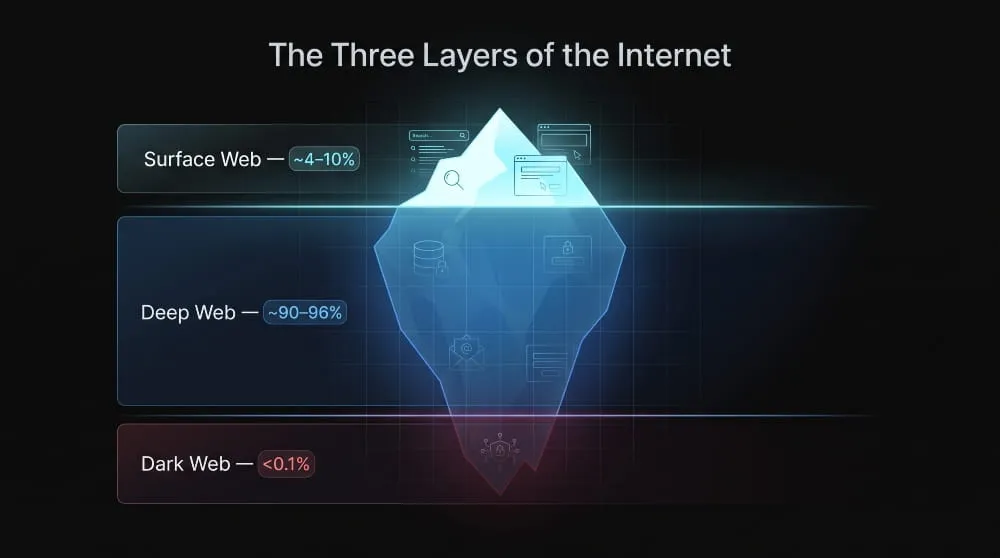
The “Iceberg” Visual Explained
The iceberg comparison has become the standard way to explain this structure because it maps so cleanly onto how the layers actually work: the small visible tip above the waterline represents the surface web, the much larger mass just below it represents the deep web, and the narrow, hard-to-reach point at the very bottom represents the dark web. The metaphor sticks because it captures two things at once: how little of the internet is actually visible to the average user, and how the dark web isn’t a separate structure but simply the deepest, least accessible point of the same iceberg.
Where Each Layer Sits and How Much of the Internet Each Makes Up
The surface web is the tip of the iceberg, everything indexed by search engines and reachable through a normal Google search, but it’s estimated to make up only around 4–10% of the internet. Below that sits the deep web, the bulk of the iceberg, commonly cited at roughly 90–96% of all online content, covering everything from email accounts to internal business databases. At the very bottom is the dark web, a narrow slice within the deep web that’s often estimated at under 0.1% of total internet content. The layers aren’t equal in size or risk; most of the mass, and most everyday internet activity, sits in that middle deep web layer, far from the dark web most people picture when they hear the term.
Which Is More Dangerous: the Deep Web or the Dark Web?
The dark web carries far more risk than the deep web, largely because the deep web is mostly made up of ordinary, legitimate systems like email and banking. In contrast, the dark web’s anonymity makes it a more common home for illegal marketplaces and scams. That said, “dangerous” depends heavily on what you’re doing and where; simply having deep web accounts (which almost everyone does) carries essentially no risk on its own.
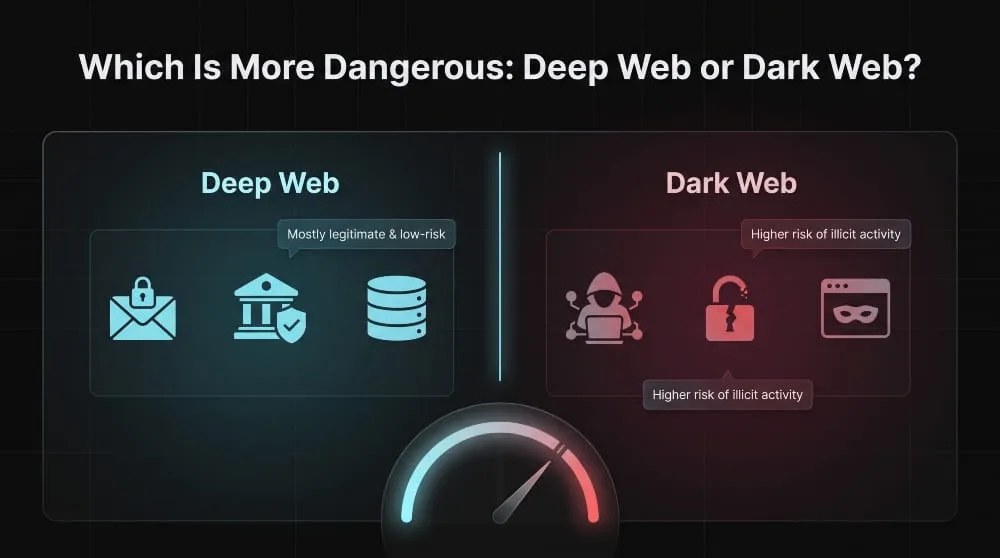
Legal vs. Illegal Activity on Each
Deep web activity is overwhelmingly legal and mundane: logging into a bank account, checking work email, or accessing a subscription database isn’t remotely risky or illicit; it’s just content that search engines aren’t allowed to crawl. The dark web is different in kind, not just degree. Its anonymity has legitimate uses, including protecting journalists, activists, and whistleblowers in high-risk environments. Still, that same anonymity also makes it a hub for illegal activity; drug and weapons marketplaces, stolen data sales, and fraud forums are all well-documented parts of the dark web ecosystem. Being on the dark web itself isn’t illegal, but much of what happens there is.
Common Misconceptions People Search For
The most common misconception is that “deep web” and “dark web” are two words for the same dangerous place; in reality, the deep web is something nearly everyone uses safely every day, and only the dark web carries the reputation for illegal activity. Another frequent misunderstanding is that simply visiting the dark web will get you hacked or arrested; accessing it through Tor isn’t illegal in most countries, though what you do once there can be. People also tend to overestimate how large the dark web actually is, picturing it as some vast hidden internet, when in reality it’s a narrow fraction of overall web content compared to the deep web sitting above it.
Why This Distinction Matters for Businesses
Understanding the difference between the deep web and the dark web isn’t just trivia; it directly affects where a business should look for signs of a breach. Stolen company data doesn’t sit quietly on the deep web alongside your email and banking portals; it tends to surface on the dark web, where stolen credentials, customer records, and internal documents are bought, sold, and traded because anonymity protects the people trading them.
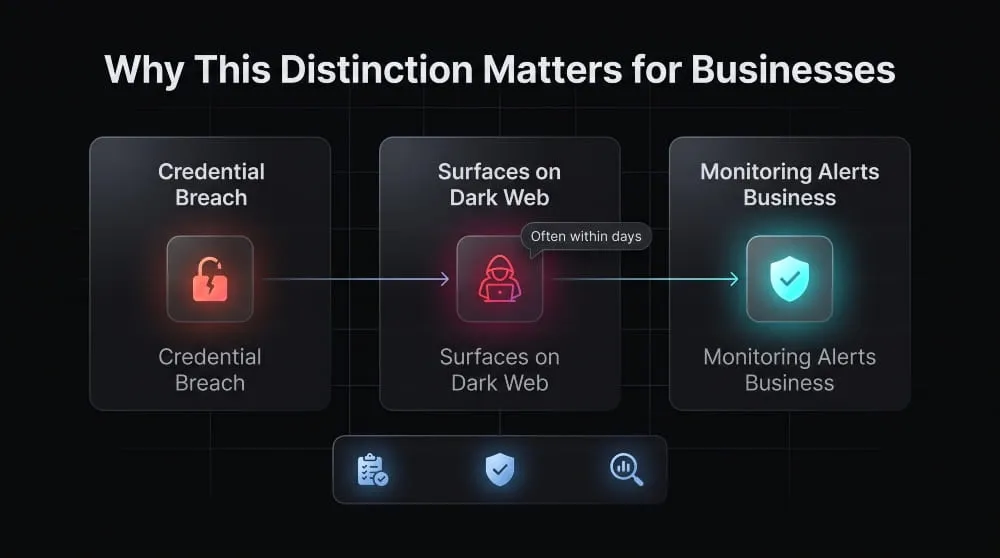
Where Breached Credentials and Company Data Actually Surface
When an employee’s password is compromised through a phishing attack, a third-party breach, or reused credentials, it rarely stays contained. Stolen login data is routinely posted or sold on dark web marketplaces and forums, often within days of the original breach, sometimes bundled with thousands of other credentials from the same incident. A password manager can reduce this risk by encouraging stronger, unique passwords. Still, it can’t tell a business when credentials it already issued have shown up for sale after a breach elsewhere. That’s a distinct problem: it requires actively watching the part of the internet where stolen data actually surfaces, not just securing the part where it originated.
This is also why compliance frameworks increasingly expect businesses to demonstrate they’re watching for exposed credentials, not just preventing them. Cyber insurance underwriters and SOC 2 auditors alike are paying closer attention to whether a company can show ongoing breach visibility, not just password hygiene.
If you want to see whether your organization’s credentials are already circulating on the dark web, explore how dark web monitoring works and what it can catch that a password manager alone can’t.
Frequently Asked Questions (FAQ)
Is deep web the same as dark web?
No, the dark web is a small, hidden subset of the deep web, not a separate network. Every dark web page is technically part of the deep web, but almost none of the deep web is part of the dark web. The deep web includes everyday things like email and banking; the dark web doesn’t.
What percentage of the internet is the deep web vs. dark web?
The deep web makes up roughly 90–96% of all online content, while the dark web accounts for a sliver of that total, often cited at well under 0.1%. By comparison, the surface web is only around 4–10% of the internet. Most of the internet’s mass sits in that middle deep web layer.
Is Tor the dark web or the deep web?
Tor is the software most commonly used to access the dark web, not the dark web itself. Using Tor isn’t illegal and doesn’t automatically mean visiting dark web content, since it’s also used for privacy-focused browsing on the regular internet. It’s the access tool, not a layer of the internet on its own.