
Credential stuffing is an automated attack in which criminals take username and password pairs leaked from one service and try them on other services, betting that people reused the same login. Layered controls (MFA or passkeys, breached-password screening, bot defenses, and monitoring) stop it by ensuring a stolen password alone isn’t enough.
What Is Credential Stuffing?
Credential stuffing is the automated replay of leaked login pairs against a service they were not stolen from. The attacker never has to break into the target’s systems. They only need a login that already works.
Credential stuffing meaning, in one sentence
Credential stuffing means feeding stolen logins from past breaches into another site’s login form, automatically and at scale, until some of them work.
Credential stuffing attack definition
Verizon’s DBIR team defines credential stuffing as an attack on an organization’s authentication system that uses a list of already-compromised usernames and passwords. The key difference from guessing attacks is that the attacker is not guessing. Each pair worked somewhere, so the only open question is whether the victim reused it. Any single pair has a low chance of working, but lists run to millions of rows, so even a small success rate can yield many hijacked accounts.
Credential stuffing in cyber security
Security frameworks treat it as an identity-based, automated attack. OWASP catalogs it as OAT-008 in its Automated Threats to Web Applications project, and MITRE ATT&CK lists it as technique T1110.004 under brute force. In practice, it is an initial access method. Compromised credentials were the initial access vector in 22% of the breaches Verizon reviewed for its 2025 report.
A simple example, step by step
A hobby forum is breached, and its database of emails and passwords leaks. An attacker adds those pairs to a larger list, loads it into automation that mimics a login to an online retailer, and routes the traffic through a pool of proxy addresses. Most attempts fail. For the small share of customers who reused their forum password, the login succeeds, and the attacker now holds an account with saved payment methods, loyalty balances, or personal data. The retailer was never breached, and the customer never did anything on its site except reuse a password.
How Credential Stuffing Attacks Work
A credential stuffing attack needs three ingredients: a list of credentials, automation to test them, and infrastructure to hide the traffic.
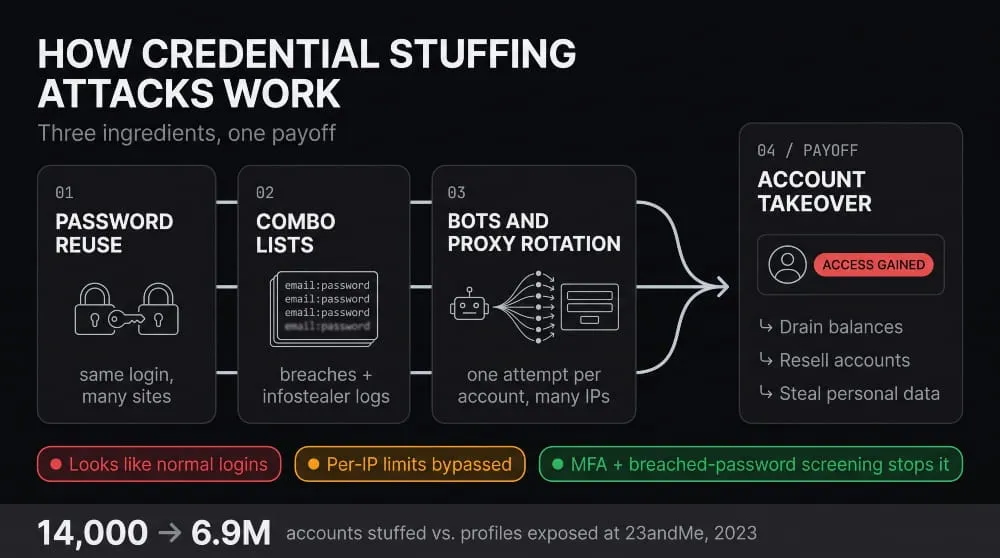
Password reuse is the fuel.
The attack only pays off because people reuse the same password across multiple services. A breach at one company becomes a risk at every other company where its customers recycled that login. That is why the targeted company often can’t detect it on its own network until logins start arriving.
Credential stuffing lists and combo lists
A combo list is a plain file of email and password pairs, usually one per line, built from old breaches, infostealer malware logs, and earlier stuffing runs. Lists are deduplicated, filtered by domain, and traded or sold. Infostealers keep them fresh. Verizon’s 2025 DBIR, as summarized by Aembit, found company credentials in infostealer logs on 30% of corporate-managed devices and 46% of unmanaged ones.
Bots, botnets and proxy rotation
Automation does the testing, and proxies hide the source. In August 2022, the FBI warned that criminals use proxies and configuration files to mask and automate credential stuffing against US businesses. In the Roku case, a researcher told BleepingComputer that attackers ran a Roku-specific configuration for months, rotating through proxy lists to bypass brute-force protections and CAPTCHAs. Spreading attempts across thousands of addresses means no single IP looks busy enough to block.
Credential stuffing tools attackers use
Credential stuffing tools are automation programs that take a combo list and test each pair against a site’s login flow, usually through rotating proxies. OpenBullet, an open-source web-automation tool, and forks such as SilverBullet are among the best-known examples. Each target site is typically described in a configuration file that attackers can share or sell, which is why a new target can be hit within days. That matches the FBI’s warning and the Roku case above, both of which centered on configuration files and proxy rotation.
For defenders, a shared configuration is a useful signal. Many attackers running the same config send near-identical requests: the same header order, TLS fingerprint and user agent, from different IP addresses. That is the pattern the detection rules below look for.
From successful login to account takeover
Once a login works, the attacker monetizes it. In the DraftKings case, the attacker added a new payment method to each hijacked account, deposited a few dollars, and withdrew the full balance to it. In the Dunkin’ case, attackers used hijacked loyalty accounts to spend or resell stored-value cards. In the PayPal case, the exposed data included Social Security numbers and tax IDs. Criminals also sell accounts in bulk to other criminals.
Why credential stuffing is so effective
It is cheap because the lists already exist and the tools are commodity software. It is quiet, because each attempt uses a unique, real credential pair, so the traffic looks like ordinary logins. It exploits the one weakness no company fully controls: how customers manage their own passwords.
Credential Stuffing vs Password Spraying, Brute Force and Credential Harvesting
Credential stuffing replays known pairs, password spraying tries a few common passwords across many accounts, brute force tries many guesses against one account, and credential harvesting is how attackers steal credentials in the first place.
Comparison table
| Attack | Input Data | Target | Volume Pattern | Best Defense |
|---|---|---|---|---|
| Credential stuffing | Leaked username and password pairs | Many accounts on one service, using logins stolen elsewhere | Often one attempt per account, spread across many IPs | MFA or passkeys, breached-password screening, bot management |
| Password spraying | One or a few common passwords | Many accounts at one organization | A few attempts per account, slow and spread over time | Banned-password lists, MFA, alerting on spread-out failures |
| Brute force | Generated password guesses | One account at a time | Many attempts against a single account | Rate limiting, lockout or throttling, long passwords |
| Credential harvesting | Credentials typed into fake pages or captured by malware | Individual users | Happens before any login traffic | Phishing-resistant MFA, email and web filtering, awareness |
Is credential stuffing social engineering?
No. Credential stuffing does not trick a person into doing anything. It is an automated attack on a login endpoint. The confusion comes from harvesting, which is often social engineering (a phishing page, for example) and can supply the credentials later stuffed. In many real incidents, the two are links in the same chain.
Which attack leaves which signals
Stuffing shows many different usernames from a source, each tried once, with a high failure rate and a thin tail of successes. Spraying shows the same password attempted across many accounts. Brute force shows many failures concentrated on one account and often triggers lockouts. Harvesting leaves little trace at the login page. The tell is a successful login with a valid password from unfamiliar infrastructure.
Real-World Credential Stuffing Attacks and Statistics
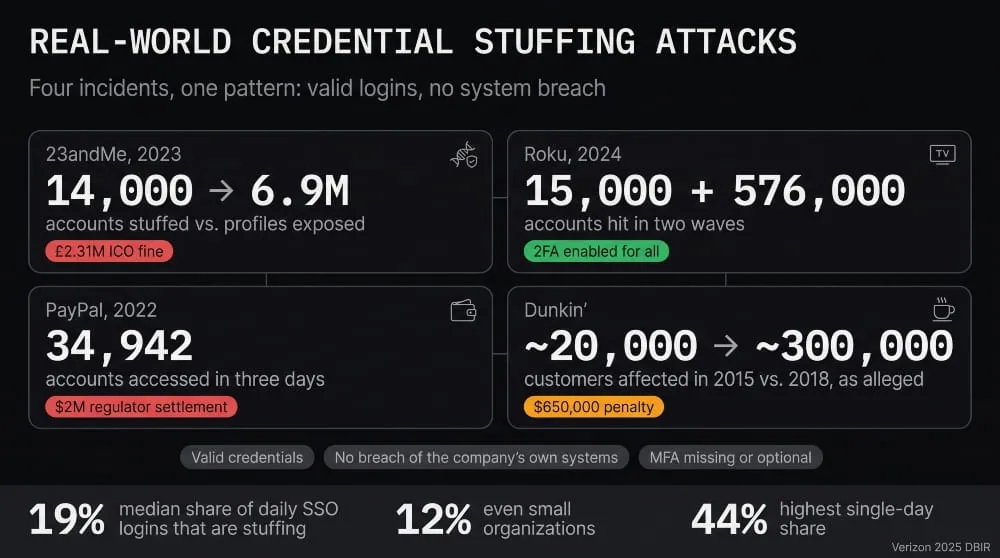
Credential stuffing has hit streaming, payments, genetics, and food retail, and the pattern repeats. The company’s systems weren’t breached; attackers used valid credentials, and strong authentication was missing or optional.
Case studies: 23andMe, Roku, PayPal and Dunkin’
23andMe is the clearest example of how far one weak point can spread. Attackers used credential stuffing between April and September 2023 to reach about 14,000 accounts, roughly 0.1% of registrants. Because of the DNA Relatives sharing feature, that access exposed profile data on about 6.9 million people. The UK ICO later fined the company £2.31 million, citing, among other things, the lack of mandatory MFA.
Roku disclosed two waves in 2024. The first affected about 15,000 accounts, and a second affected another 576,000. Roku said fewer than 400 accounts saw unauthorized purchases. It reset passwords on affected accounts and enabled two-factor authentication for every account.
PayPal’s incident was short but serious. Between December 6 and 8, 2022, attackers accessed 34,942 accounts using valid credentials. New York’s financial regulator later finalized a $2 million settlement and cited the absence of mandatory MFA among its findings.
Dunkin’ shows the cost of slow response. New York’s Attorney General alleged that attacks starting in 2015 hit nearly 20,000 customers, with roughly 300,000 more affected in 2018, and that the company failed to investigate despite repeated warnings. The settlement required notifications, password resets, refunds, and $650,000 in penalties and costs.
How the attack has changed since 2018
The 2015 Dunkin’ attacks were essentially scripted bots. Today, the tooling is configuration-driven and sold as a commodity; traffic is routed through proxy pools to defeat per-IP limits; and infostealer malware refreshes lists with credentials captured only days earlier. MFA is no longer the end of the story either. The 2025 DBIR documents a surge in MFA bypass techniques, including prompt bombing, token theft, and adversary-in-the-middle attacks.
One sourced statistic block
Verizon’s 2025 DBIR analyzed single sign-on provider logs for 2,301 organizations over two years and found that credential stuffing made up a median 19% of daily authentication attempts. Small organizations still saw about 12%, and the highest single-day share was 44%. The practical reading is that credential stuffing is background noise for most login systems, not an occasional event.
Is Credential Stuffing Illegal?
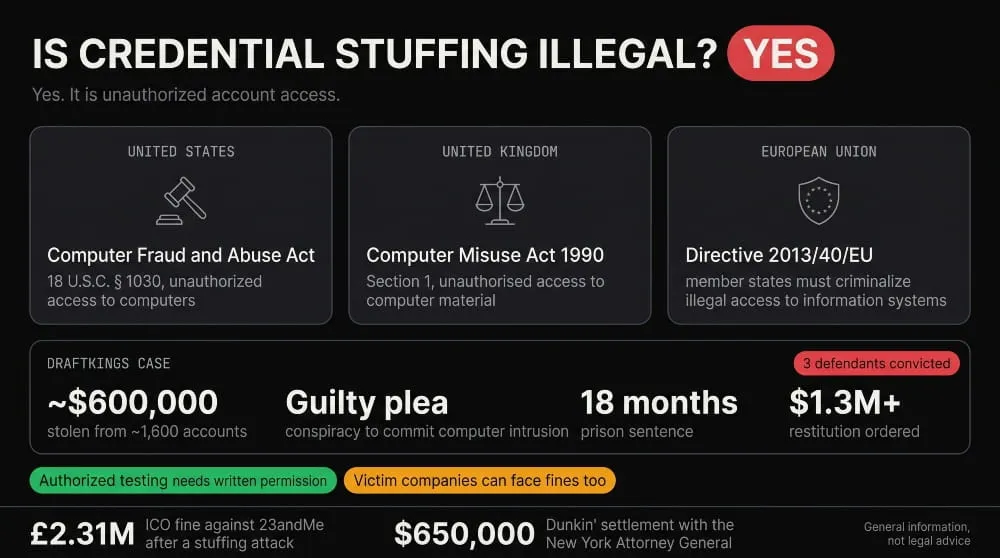
Yes. Credential stuffing is unauthorized access to someone else’s account, and it is prosecuted as computer intrusion in the US and under comparable laws elsewhere. This is general information, not legal advice.
The CFAA and US law
The Computer Fraud and Abuse Act (18 U.S.C. § 1030) is the main federal statute covering unauthorized access to computers. The DraftKings case shows how it works in practice. Joseph Garrison pleaded guilty to conspiracy to commit computer intrusion after taking about $600,000 from roughly 1,600 accounts. The court sentenced him to 18 months in prison and ordered him to pay more than $1.3 million in restitution. Two co-conspirators also pleaded guilty; one sold access to compromised accounts. Testing credential lists against systems you do not own, or have no written authorization to test, is the line that matters.
Internationally
Most jurisdictions criminalize it under unauthorized-access laws. In the UK, section 1 of the Computer Misuse Act 1990 covers unauthorized access to computer material. In the EU, Directive 2013/40/EU requires member states to criminalize illegal access to information systems. Penalties and definitions vary by country, and companies that fail to protect accounts can face separate regulatory action under data protection laws, as the 23andMe and Dunkin’ cases show.
How to Detect Credential Stuffing
Credential stuffing is detected through patterns across many logins rather than any single failed attempt. The signals are a surge in failures, many unique usernames per source, and successful logins that look wrong for the account.
Failed-login spikes and low per-account attempt counts
Watch the overall failure rate against your rolling baseline, not just failures per account. Stuffing tries each username once or twice, so account lockout rarely fires. The giveaway is a high count of distinct usernames attempted in a short window, with a failure rate well above normal.
Proxy and IP-rotation signals
Distributed attacks defeat per-IP thresholds, so correlate traffic with other attributes. OWASP recommends correlating authentication traffic with proxy intelligence and hosting-provider IP ranges to spot highly distributed attacks and to trigger mitigation. Clusters of attempts from the same ASN, many accounts touched by one network fingerprint, and logins from datacenter ranges are all worth flagging.
Device and behavioral signals
Bots that rotate IPs often reuse the same client environment. OWASP notes that fingerprinting can catch bots that rotate IP addresses but reuse client environments, and advises passive, network-level signals first with privacy disclosures where required. Behavioral clues include logins with no prior page activity, inhuman timing, and a successful login followed immediately by a payment-method or email change.
Detection rules your security team can start with
Treat these as starting points and tune them to your own baseline:
- Alert when the ratio of unique usernames to total attempts from one source approaches one-to-one.
- Alert when the failed-login share across the whole service rises well above its rolling baseline.
- Alert on clusters of attempts sharing one ASN, TLS fingerprint, or user agent across many accounts.
- Flag successful logins from hosting-provider ranges, or from a new device, shortly after a failure burst.
- Flag sensitive changes (payment method, email, password) in the first minutes after a login from a new device.
Credential stuffing tools attackers use
Credential stuffing tools are automation programs that take a combo list and test each pair against a site’s login flow, usually through rotating proxies. OpenBullet, an open-source web-automation tool, and forks such as SilverBullet are among the best-known examples. Each target site is typically described in a configuration file that attackers can share or sell, which is why a new target can be hit within days. That matches the FBI’s warning and the Roku case above, both of which centered on configuration files and proxy rotation.
For defenders, a shared configuration is a useful signal. Many attackers running the same config send near-identical requests: the same header order, TLS fingerprint and user agent, from different IP addresses. That is the pattern the detection rules below look for.
How to Prevent Credential Stuffing
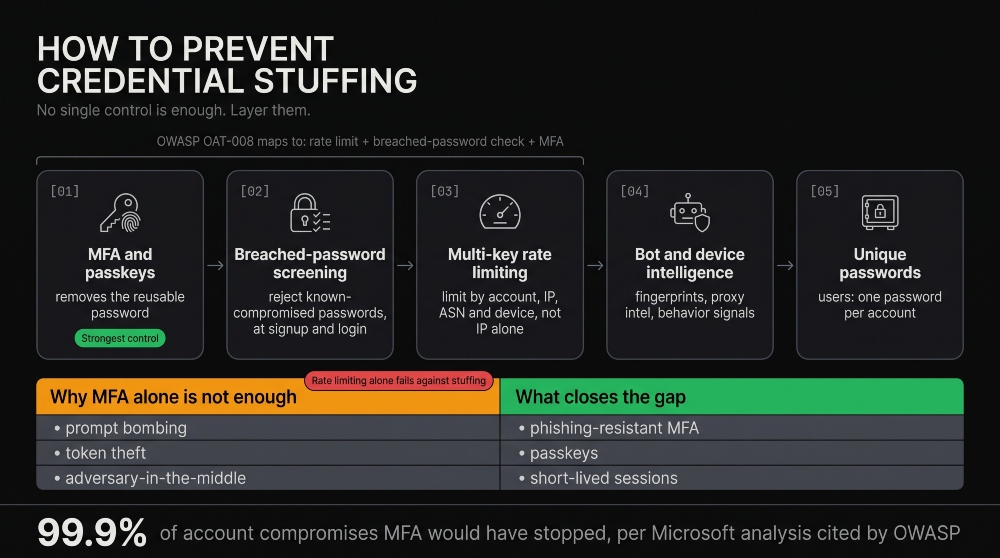
The most effective prevention is layered: MFA or passkeys, breached-password screening, rate limiting on multiple keys, and bot and device intelligence. No single control is enough.
MFA and passkeys (does 2FA stop it?)
MFA is the strongest single defense. OWASP calls it by far the best defense against most password-related attacks, citing Microsoft analysis suggesting it would have stopped 99.9% of account compromises. It does not make stuffing harmless, though. Attackers can still confirm which passwords are valid, and they may try to bypass MFA through prompt bombing, token theft, or adversary-in-the-middle phishing. Passkeys and other phishing-resistant methods help most, because there is no reusable password to replay.
Breached-password screening
Checking passwords against known-compromised lists closes the door on logins attackers already hold. NIST SP 800-63B Revision 4, released in 2025, requires checking new or changed passwords against a blocklist of commonly used, expected, or compromised values and rejecting them if they match. Screening at login and signup catches credentials that leaked after the password was set.
Rate limiting, and what to do beyond it
Rate limiting alone is weak against stuffing because each account sees few attempts. OWASP advises applying limits across multiple keys rather than IP alone, and warns that a limit keyed to the username and IP pair lets one IP try many usernames before any limit fires. Layer limits by account, IP, ASN, and device, add progressive delays, and pair them with detection rather than relying on lockout.
Bot management and device intelligence
Bot defenses make automated replay expensive. Options include device and connection fingerprinting, proxy and datacenter IP intelligence, behavioral analysis, and cryptographic attestation tokens that prove a real device without identifying the user. Weigh the privacy implications, since some jurisdictions require disclosure of fingerprinting.
For users: unique passwords and managers
Individuals can defeat the attack almost entirely: use a unique password for every account, store them in a password manager, and enable MFA wherever it is offered. Reusing passwords is the only way a breach elsewhere reaches you, so removing reuse removes the risk.
OWASP cheat sheet and OAT-008, mapped to controls
OWASP’s bot management guidance maps OAT-008 credential stuffing to three controls: rate limiting, breached-password checks, and MFA. The Credential Stuffing Prevention Cheat Sheet adds device fingerprinting, IP intelligence, and multi-step login flows. Used together, they cover the attack from three directions: stop the login, reject the leaked password, and slow or classify the bot.
CISA and NIST guidance
CISA’s public guidance for individuals and organizations consistently pairs unique passwords with MFA, and it pushes phishing-resistant MFA for higher-risk users. NIST’s guidance in SP 800-63B Rev. 4 shifts toward longer passwords, blocklist screening, and changing a password only when there is evidence of compromise. It rejects routine periodic expiration.
What to Do After a Credential Stuffing Attack
After an attack, contain first by forcing resets and revoking sessions on affected accounts. Then document and notify, then rotate any credentials that may have been exposed.
Contain, reset, and revoke sessions.
Identify which accounts were successfully accessed, not just attempted. Force password resets on those accounts, revoke active sessions and tokens, require step-up verification on sensitive actions, and block the attacking infrastructure. Tighten rate limits and bot rules while the campaign is active. Roku reset passwords for affected accounts, notified customers, refunded unauthorized charges, and turned on two-factor authentication for everyone.
Notify and document
Investigate and keep records. Dunkin’s penalty followed in part from the failure to investigate repeated warnings about the attacks. In the 23andMe case, the ICO pointed to a five-month gap between the start of the stuffing activity and the company’s public acknowledgment. Whether a successful stuffing attack triggers legal breach-notification duties depends on the jurisdiction and the data involved, so involve counsel early. One law-firm analysis called that question complicated.
Credential rotation guidance
Rotate credentials based on evidence, not on a calendar. NIST’s current guidance favors changing passwords when compromise is suspected rather than on a schedule. Rotate any service account passwords or API keys that were reachable from hijacked accounts, and tell users to change the same password anywhere else they used it.
Synthient Credential Stuffing Threat Data: What It Is and What It Means
The Synthient Credential Stuffing Threat Data is a Have I Been Pwned (HIBP) entry that indexes nearly 2 billion unique email addresses and 1.3 billion unique passwords from credential stuffing lists that the threat-intelligence firm Synthient collected. It is one of the clearest recent views of the raw material behind the attacks described in this guide.
What is in the Synthient data set
HIBP founder Troy Hunt announced the load on November 5, 2025, covering 1,957,476,021 unique email addresses. It is a separate corpus from the Synthient stealer-log data that HIBP released the month before, which held 183 million credential pairs. Stealer logs come from malware on infected machines. This set is different: it consists of lists recombined from older breaches, spans 32 million unique email domains, and mixes long-compromised pairs with ones never seen before. About 625 million of the passwords were new to HIBP.
Is the Synthient data a data breach?
No single company was breached. The data did not come from one breach. It is an aggregate. Hunt notes that individual rows can’t be traced to a specific source site or breach, and HIBP does not offer a lookup of email and password pairs. Appearing in it means your address is tied to a password that circulates in the kind of list attackers replay. It does not tell you which service leaked it.
How to check if you are in it
Search an address with the email breach check to see whether it appears in breach data. To test a password, use HIBP’s Pwned Passwords search instead of looking for a pair. For a whole organization, run the domain exposure check.
Getting Ahead of Stuffing: Know Which Credentials Are Already Exposed
Stuffing only works with credentials that have already leaked, so the earliest defense is knowing which of yours are exposed before attackers try them.
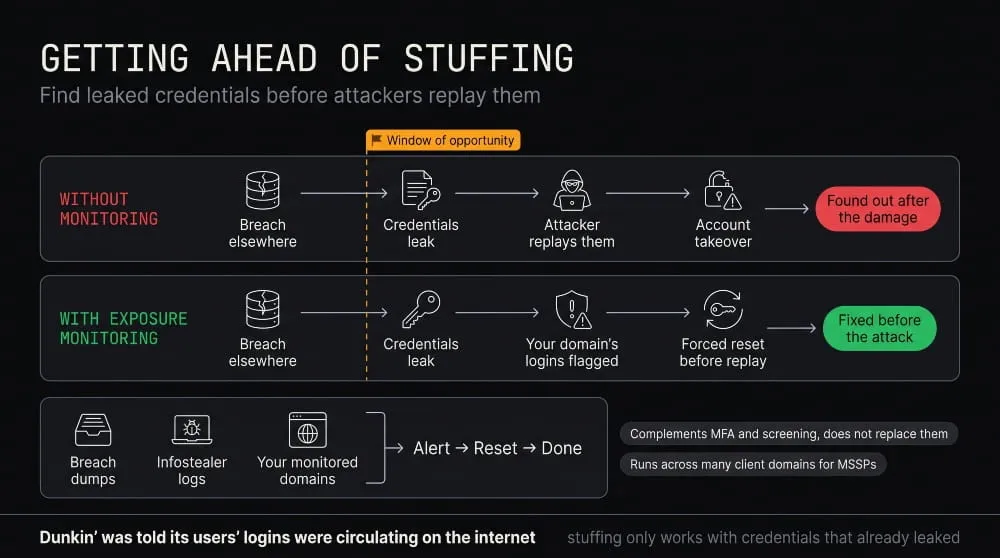
Why stuffing starts with credentials that already leaked
The Dunkin’ case shows the timeline. The company’s own notice said its security vendor had identified usernames and passwords, likely taken from other companies’ breaches, that were circulating on the internet. The credentials were available long before the damage was done. An organization that finds its users’ leaked logins first can force resets before attackers replay them.
How continuous exposure monitoring fits alongside the controls above
Controls like MFA and bot defense protect the login page. Exposure monitoring covers the other side by watching for your domains’ credentials showing up in breach dumps and infostealer logs. Dark web monitoring turns “this password leaked” into an alert you can act on, and Mispar’s monitoring feature does this continuously across client domains for MSSPs that resell it under their own brand. It complements MFA and screening rather than replacing them.
Frequently Asked Questions (FAQ)
What is credential stuffing in simple terms?
Credential stuffing is when criminals take usernames and passwords leaked from one website and automatically try them on other websites, hoping people reused the same password. When it works, they get into accounts without ever hacking the target’s systems.
Is credential stuffing the same as a brute force attack?
No. Brute force guesses passwords, usually many guesses against one account. Credential stuffing replays real username-and-password pairs from past breaches, typically one attempt per account across many accounts. The defenses differ, too: lockout and throttling suit brute force, while MFA and breached-password screening suit stuffing.
Does MFA stop credential stuffing?
MFA stops most credential-stuffing logins because a stolen password is no longer enough. It is not complete protection, since attackers can still confirm valid passwords and try MFA bypass methods such as prompt bombing or token theft. Phishing-resistant MFA and passkeys close most of that gap.
How do I know if I’m being credential stuffed?
Look for a spike in failed logins, many different usernames attempted from the same networks, logins from data center or proxy ranges, and successful logins followed quickly by account changes. A rise in password-reset requests or customer complaints about unauthorized activity is another sign.
Is credential stuffing a data breach?
Not in the narrow sense, because attackers log in with valid credentials rather than breaking into the company’s systems. In legal and regulatory terms, though, the resulting exposure of customer data has drawn enforcement and fines, as the 23andMe, PayPal, and Dunkin’ cases show. Treat a successful stuffing campaign as a security incident and check your notification obligations.
Does credential stuffing have a CVE, and is it a vulnerability?
No. Credential stuffing is not a flaw in software, so there is no CVE to patch. It is an attack technique that abuses password reuse. MITRE ATT&CK tracks it as T1110.004, and OWASP lists it as OAT-008. The fix is controls: MFA or passkeys, breached-password screening, bot defenses and monitoring.
What is the Synthient Credential Stuffing Threat Data?
It is a Have I Been Pwned entry covering nearly 2 billion unique email addresses and 1.3 billion unique passwords from credential stuffing lists compiled by Synthient. It is an aggregate of older breaches, not a breach of one company.