
An MSSP pricing model is the structure a managed security service provider uses to charge clients, most often a recurring monthly fee set by users, devices, data volume, or a tiered package. The model matters because it decides whether adding clients widens or erodes your margin, so it is worth choosing deliberately rather than copying a competitor’s price sheet.
This guide explains how MSSPs earn money, the main pricing models and when each one works, how clients are billed, and what protects margin as the client base grows.
The MSSP Business Model at a Glance
An MSSP earns recurring revenue by delivering continuous security operations to many clients from one shared team and one shared platform, and it makes money when the cost of serving each extra client grows more slowly than the fee that client pays.
What an MSSP actually sells
An MSSP sells ongoing security coverage, not hours of labor. The core of that coverage is monitoring of client environments, detection of suspicious activity, response when something is confirmed, and reporting that shows clients what was found and what was done. Many providers wrap additional services around that core, such as vulnerability management, threat intelligence, or compliance reporting. For a fuller definition of the provider model, see what an MSSP is.
Because clients are buying an outcome rather than a task, pricing has to describe the scope of coverage clearly. Vague scope is the most common source of disputes and of lost margin, a theme that returns throughout this guide.
Recurring revenue as the core of the model
The MSSP model runs on recurring contracts. Clients pay a fixed or usage-linked fee each month, usually under a term agreement, which makes revenue predictable and lets the provider plan staffing and tooling ahead of demand. The trade-off is that costs arrive before revenue does. Onboarding a client, connecting its data sources, and tuning detection all take effort before steady-state monitoring begins, so the first months of a contract are the least profitable ones.
Where margin comes from
Margin comes from leverage: one analyst team, one detection stack and one reporting process serving many clients at once. Each new client adds some cost, such as extra data volume or analyst attention, but far less than the cost of building a separate security function for that client. The wider the gap between what a client pays and what it costs to serve, the higher the margin. Everything else in pricing, from the unit you charge by to the scope you promise, either protects that gap or erodes it.
MSSP Pricing Models Explained
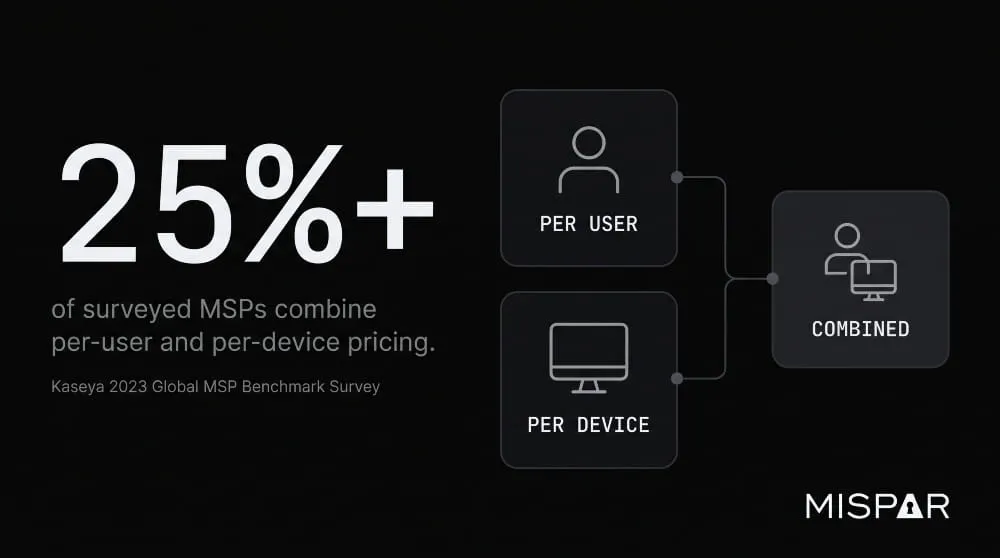
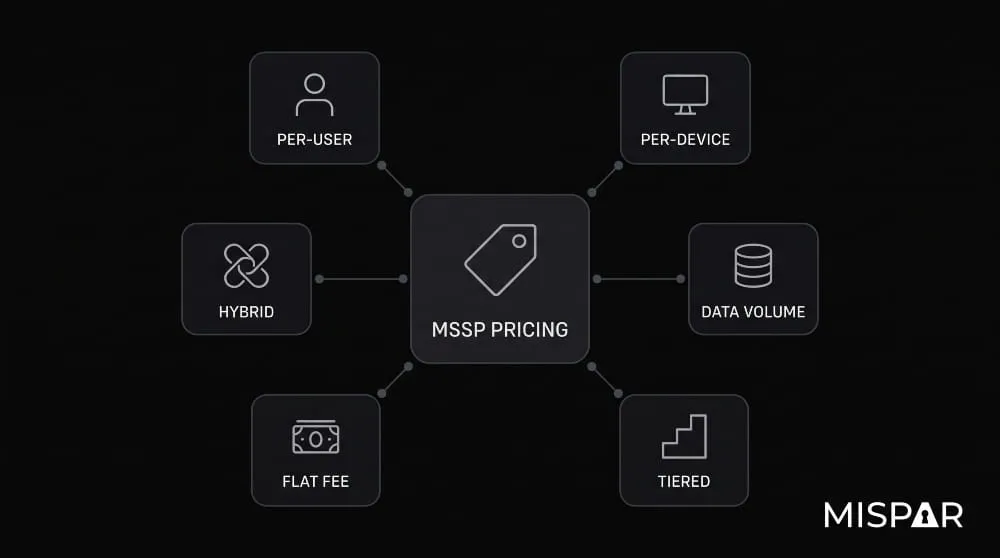
MSSPs typically choose from six structures: per-user, per-device, data-volume, tiered packages, flat fee, and hybrid. No single one dominates. In Kaseya’s 2023 Global MSP Benchmark Survey, billing models were spread fairly evenly across respondents, and more than a quarter used a combination of per-user and per-device pricing. That survey covers managed service providers broadly rather than MSSPs specifically, but it shows the same pattern security providers see: the best model depends on the service and the client, not on a universal standard. For how pricing logic differs between IT management and security services, see MSP, MSSP and MDR compared.
Per-user pricing
Per-user pricing charges a flat monthly fee for each employee covered, regardless of how many devices that person uses. It is easy for clients to understand and budget, and it scales naturally with company size. It works best when the service is tied to people, such as identity protection, email security, or user-focused monitoring. Its main weakness is definition: contracts should state exactly what counts as a user, because shared accounts, service accounts, and contractors turn into arguments at renewal otherwise.
Per-device or per-endpoint pricing
Per-device pricing charges a fixed monthly fee for each endpoint or server monitored. It suits services where the provider’s cost follows the device, such as endpoint detection and response or device-level monitoring. It is simple to quote and audit. The risk is that clients with many devices per employee see the bill climb quickly and push back, while the provider’s per-device cost may not rise at the same pace.
Data-volume pricing
Data-volume pricing charges by the amount of data the provider ingests, usually measured in gigabytes per day or events per second. It ties the price directly to a major cost driver of log-based monitoring, since storage, processing, and SIEM licensing often scale with volume. That makes it attractive for the provider’s margin, but it can make client bills hard to predict. A noisy system or a new log source can change the monthly fee overnight, so providers using this model often add volume bands or caps to keep invoices stable.
Tiered service packages
Tiered packages bundle services into levels, commonly named something like essential, standard, and advanced, each with a fixed scope and price. Clients choose the level that matches their needs, and the provider gets a natural upgrade path. The model reduces negotiation and makes sales conversations simpler. Its weak point is the boundary between tiers: if the differences are unclear, clients on lower tiers ask for higher-tier services, and the provider absorbs the cost.
Flat-fee and bundled pricing
A flat fee covers a defined scope of services for one monthly price. It is the simplest model for clients and gives the provider predictable revenue. It works well for mature operations with strong automation and tightly controlled scope. Without that discipline, it turns into a margin trap, because routine requests that were never priced keep consuming analyst time while the fee stays the same.
Hybrid models
Hybrid models combine a base fee with a usage component, for example, a per-user charge plus an allowance for data volume or metered services. The base fee gives the provider predictable revenue, and the usage component protects margin when a client consumes more than expected. The cost is complexity: hybrid pricing needs clear billing rules and reporting so clients understand what they are paying for.
MSSP Pricing Models Compared
The right pricing model is the one whose charging unit follows your cost to deliver the service. Practitioners writing for MSSP Alert make a similar point: forcing a service into a pricing unit that does not match its underlying cost structure can compress margin or even produce loss-making contracts, so the pricing unit and the cost structure should be checked against each other before a service goes to market.
Side-by-side table
| Model | How It Is Charged | Best Fit | Main Risk |
|---|---|---|---|
| Per-user | Flat fee per user per month | People-centered services such as identity or email protection | Unclear definition of a user |
| Per-device | Flat fee per endpoint per month | Endpoint monitoring and device-based services | Multi-device users inflate client bills |
| Data-volume | Fee by log ingest or events per second | Log-based monitoring and SIEM-heavy services | Unpredictable bills and client resistance |
| Tiered | Fixed price per service level | Providers selling to many similar clients | Scope creep between tiers |
| Flat fee | One price for a defined scope | Mature operations with strong automation | Margin erodes if scope is not controlled |
| Hybrid | Base fee plus usage | Services with variable consumption | Billing complexity |
How scope drives which model works
Scope decides the model more than preference does. A narrow, well-defined service, such as monitoring a set number of domains, fits per-unit or flat pricing because cost to serve is easy to predict. A broad service that includes investigation and response is harder to price per unit, because the work depends on how many incidents occur, so tiers or hybrid models with defined inclusions fit better. The more the cost to serve varies with client behavior, the more a pricing model needs a usage component or firm scope limits to protect margin.
MSSP Payment Models
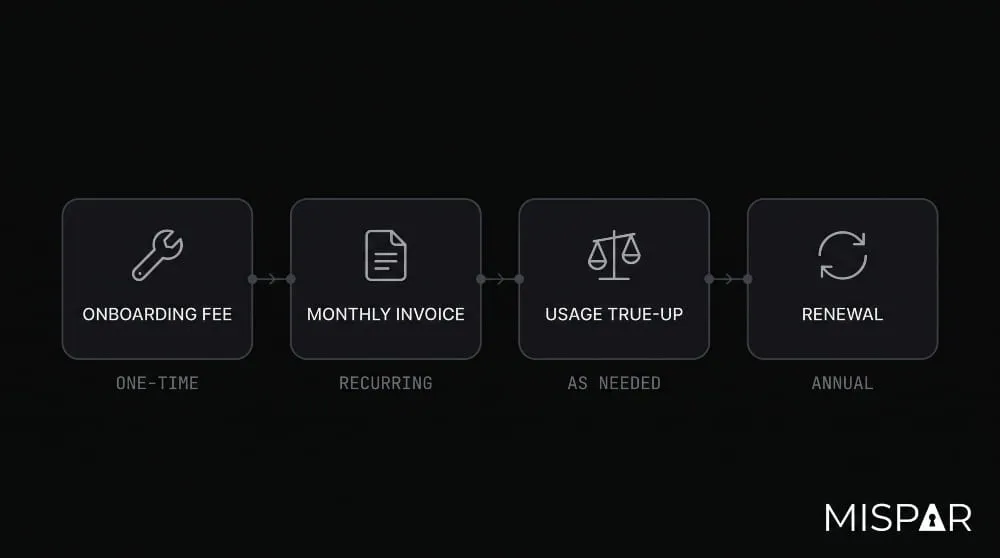
MSSPs are usually paid through recurring monthly invoices under a fixed-term contract, with optional annual prepayment, one-time onboarding fees, and usage true-ups added on top. The payment model determines cash flow and risk, and it should be designed alongside the pricing model rather than after it.
Monthly recurring billing vs annual prepay
Monthly billing is the default. It is easy for clients to adopt and spreads cost evenly, but it leaves the provider with a smaller cash buffer and a higher exposure to churn. Annual prepayment improves cash flow and commitment, and providers often offer a discount for it. The trade-off is that the client pays up front and expects the service to hold up, so it suits providers confident in their delivery and clients who prefer predictable annual budgets.
Minimum commitments and contract terms
Many MSSPs set a minimum monthly fee or a minimum term, typically a one-year or multi-year agreement, so that onboarding and tuning costs can be recovered. Longer terms improve revenue stability but reduce flexibility for clients, so providers commonly pair them with clear renewal terms and defined scope-change processes. Writing down what happens when a client adds users, devices, or data sources prevents pricing disputes mid-term.
Onboarding and setup fees
Onboarding takes real effort: connecting data sources, configuring detection, setting escalation paths and training client contacts. Some MSSPs absorb that cost in the monthly fee, while others charge a separate setup fee. A separate fee recovers the upfront cost and signals that onboarding is real work, though it can make a quote look more expensive. Whichever approach you choose, price it deliberately so that early-contract costs are not a hidden loss.
Usage true-ups and overage handling
When pricing includes a usage component, such as data volume, metered searches, or added users, providers need a rule for what happens when usage exceeds the included amount. A true-up adjusts the invoice periodically to match actual consumption, while an overage rate charges for the excess as it occurs. Both work if the thresholds and rates are stated in the contract and clients receive usage reporting that lets them see it coming.
MSSP Security Margins
An MSSP’s margin is what remains of each client’s fee after the cost of delivering the service, and it widens when the cost to serve grows more slowly than revenue. Margins vary widely by service mix, client size and degree of automation, so there is no single benchmark worth copying, and any target you adopt should come from your own cost model.
The MSSP cost structure
Three cost groups drive most of an MSSP’s expense. The first is people: analysts, engineers, and the staffing needed to cover 24/7 monitoring, which takes several times as many people as there are seats on any single shift. The second is tooling: licenses for SIEM, endpoint, threat intelligence and other platforms, often priced by volume or seats. The third is overhead: management, sales, compliance and support. Knowing the fully loaded cost to serve a typical client is the starting point for every pricing decision.
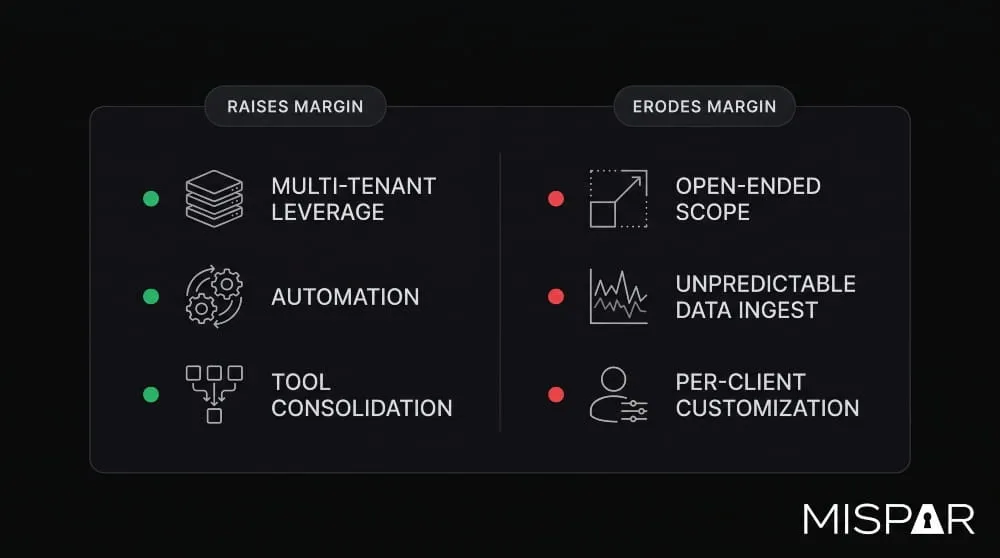
What raises margin
Three levers matter most. Multi-tenant leverage lets one team and one platform serve many clients, so each added client costs less than the last; a multi-tenant setup with role-based access and per-client views is what makes this practical. Automation removes repetitive triage and reporting work so each analyst can cover more clients. Tool consolidation reduces the number of licenses and integrations the team must maintain, which lowers both direct cost and operational friction. For how to evaluate the stack itself, see MSSP software.
What erodes margin
Margin erodes in predictable ways. Open-ended scope lets clients request more work than the fee covers. Unpredictable data ingest raises tool and storage costs while a flat price stays fixed. Per-client customization, such as Custom integrations, one-off reports, and bespoke detection rules, adds delivery cost that standard pricing never anticipated. The common thread is variation: the more each client differs from the standard offering, the harder it is to price profitably.
Choosing a Pricing Model by Service and Client Type
Choose a pricing model by matching the unit you charge to what drives your cost, then adjusting for how the client buys. Service type and client size are the two inputs that usually settle the choice.
Monitoring-only vs full detection and response
Monitoring-only services have predictable cost, because the work is largely automated collection and alerting, so per-unit or flat pricing fits well. Full detection and response includes investigation and action, where workload depends on incident volume, so tiered pricing with defined response inclusions or a hybrid with an incident allowance protects margin better. Clearly stating what response includes, and what triggers additional charges, matters more here than in monitoring-only offers.
Smaller vs larger clients
Smaller clients generally prefer simple, predictable prices, which makes per-user pricing or fixed tiers a good match and keeps sales cycles short. Larger clients have more complex environments and expect scoped agreements, so volume-based or hybrid pricing with negotiated terms tends to fit. Serving both usually means offering standard packages at the small end and customized scopes at the top, rather than stretching one model across everyone.
Pricing only works when the client fits the offer, so qualify a prospect’s size, need and budget before quoting. Our guide to MSSP lead qualification criteria explains how to score leads before you choose a model for them.
Pricing add-on services
Add-ons such as vulnerability scanning, compliance reporting, or additional threat intelligence are easier to sell and price when they are separate line items with their own scope. Pricing them separately keeps the base package clean, gives clients a visible upgrade path, and lets you charge for work that would otherwise be absorbed. It also helps you see which services carry the best margin.
How a Wholesale Platform Changes MSSP Economics
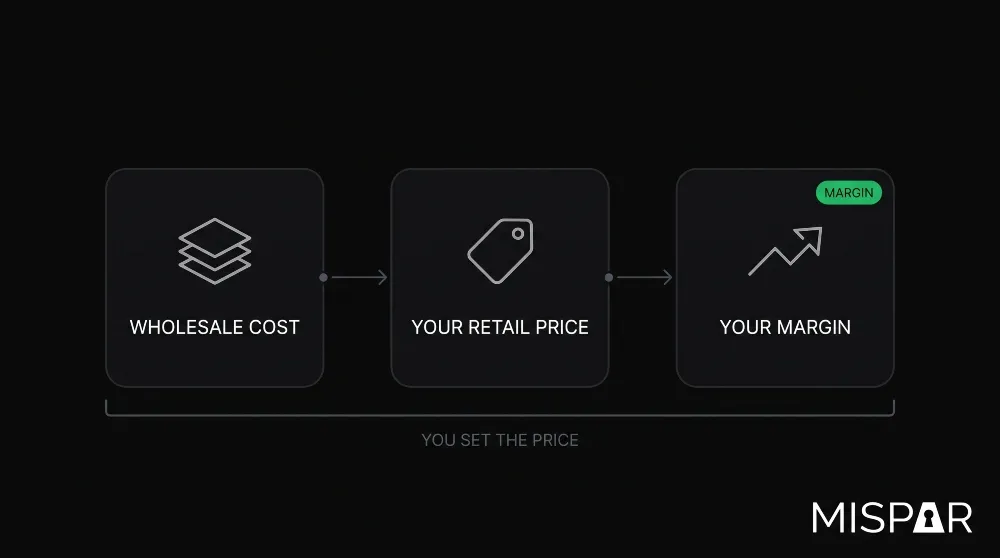
Reselling a wholesale platform turns a large fixed build cost into a variable cost per client, so you can launch a service line without building the technology and set your own retail price on top of a known wholesale cost. This changes the economics most for providers adding a new service such as dark web monitoring, where building data collection in-house is a major undertaking in its own right.
Reselling instead of building
Building a security capability means paying for development, data sourcing, and maintenance before the first client signs. Reselling a platform shifts that into a cost that scales with use. Mispar’s model works this way: a subscription sets limits such as organizations, domains, and team members, and prepaid credits fund metered services such as live searches, reports, and domain monitoring, so cost follows your client count rather than a fixed investment. Plan and credit details are shared on a demo.
Setting your own retail price on a wholesale cost
When the provider controls the retail price, margin becomes a matter of how well the price is set above the cost to serve. Because metered costs are visible before they are incurred, you can model each client’s cost and choose a per-client or tiered price that covers it with room to spare. The practical step is to calculate cost per client from the credits and limits it consumes, then add the margin you need.
Packaging a service under your own brand
Clients buy from the provider they know, so the service should carry your name. White label capabilities let an MSSP present reports, portals, and alerts as its own, which supports a premium price and strengthens the client relationship. Packaging also gives you the chance to define a clear service tier with named inclusions, which feeds back into the pricing models above.
Building and Testing Your Pricing
A pricing model is built from your costs, tested against the market, and revised as you learn. Start with what it costs to serve, set the scope in writing and review the result regularly as the client base changes.
Start from cost-to-serve
Calculate the fully loaded monthly cost of serving a typical client: analyst time, tooling licenses, data costs, and overhead. Divide by the pricing unit you plan to use, whether users, devices, or tiers, to get a cost per unit, then add your target margin. Starting from cost rather than from a competitor’s price keeps the model tied to what you can actually afford to deliver.
Define scope boundaries in the contract.
State what is included, what triggers additional charges, and how changes are handled. Define the units precisely, including what counts as a user, device, or data source. Specify response inclusions, reporting frequency, and escalation paths. Clear boundaries protect margin and also protect the relationship, because clients know what they are paying for.
Review pricing as the client base grows.
A price that works for ten clients may not work for a hundred. Review pricing at least annually against actual cost to serve, client usage, and churn. Look for clients whose usage drives cost far above their fee, and for services that consistently need more analyst time than priced. Adjust tiers, add usage components, or update scope terms for new contracts before problems spread across the book.
Conclusion
MSSP pricing comes down to matching what you charge to what it costs to deliver, in a way clients understand and your contracts defend. Choose the model that follows your cost drivers, set clear scope, and review it as you grow. For providers adding services without building them, a wholesale platform such as Mispar turns a fixed investment into a cost that scales with your client count.
Frequently Asked Questions (FAQ)
What is the most common MSSP pricing model?
There is no single most common model. Surveys of managed service providers show billing models spread fairly evenly, and combinations of per-user and per-device pricing are among the most used. MSSPs choose based on what drives their cost: per-user for people-centered services, per-device for endpoint services, data-volume for log-heavy monitoring, and tiers or hybrids when scope varies.
How do MSSPs make money?
MSSPs earn recurring fees from clients and profit from the gap between those fees and the cost of delivering the service. Because one team and one platform serve many clients, each added client costs less to serve than it pays, and that gap is the margin. Add-on services and onboarding fees can add revenue on top.
How do MSSPs bill their clients?
Most bill monthly under a fixed-term contract. Some offer annual prepayment, often at a discount, and many add one-time onboarding fees. Where pricing includes usage, such as data volume or metered services, invoices may include true-ups or overage charges based on actual consumption.
Should an MSSP charge per user or per device?
Charge by the unit that tracks your cost. Per-user pricing fits services tied to people, such as identity and email protection, and is simple for clients to budget. Per-device pricing fits endpoint-based services. If clients have many devices per user, per-user pricing is usually fairer, provided your contract defines what a user is.
What affects an MSSP’s profit margin?
Margin depends on the cost to serve relative to the fee. It rises with multi-tenant leverage, automation, and tool consolidation, and it falls with open-ended scope, unpredictable data ingest, and per-client customization. Analyst coverage for 24/7 monitoring and tooling licenses is the largest cost driver.
What is an MSSP business model?
An MSSP business model is a recurring-revenue model in which a provider delivers continuous security operations to many clients from one shared team and one shared platform. Clients pay a monthly fee, and the provider earns margin because the cost of serving each additional client grows more slowly than the fee that client pays.
How is MSSP pricing different from MSP pricing?
MSP pricing usually follows the cost of managing IT, so it is commonly set per user or per device. MSSP pricing has to follow the cost of security operations, which also depends on data volume, monitoring depth and incident response. That is why MSSPs more often use tiered packages, data-volume bands or hybrid models with defined inclusions. For a fuller comparison, see MSP, MSSP and MDR compared.