
What Are Dark Web Sites? Types, Legality, Risks & Legitimate Examples (2026 Guide)
September 16, 2026
Dark web sites are web pages hosted on encrypted, anonymized networks, most commonly Tor’s .onion domains, that aren’t indexed by standard search engines like Google and can’t be reached with a regular browser. They range from legitimate news mirrors and privacy tools to forums, leak sites, and illicit marketplaces, all sharing one trait: they’re built to keep both the site operator and the visitor anonymous. According to the Tor Project, there are roughly one million active .onion addresses at any given time, a tiny fraction, well under 0.01%, of the estimated web as a whole. That obscurity is exactly why dark web sites carry a reputation far larger than their actual footprint: for most people, the real question isn’t how to find them, but what they are, whether visiting one is legal, and why a business would ever need to care.
What Is a Dark Web Site?
A dark web site is a web page that loads only through specialized anonymizing software and isn’t indexed by mainstream search engines; most run on Tor’s network and use “.onion” addresses instead of the .com or .org domains found on the surface web. Where a normal website connects your browser directly to a server, a dark web site routes that connection through multiple encrypted relays, masking both the visitor’s location and the server’s. The result is a layer of the internet built specifically for anonymity, which is why it hosts everything from press freedom tools to criminal marketplaces under the same basic architecture.
How Dark Web Sites Are Structured and Accessed
Dark web sites live on .onion domains, long strings of random characters generated by the hosting software itself rather than registered through a standard domain registrar; there’s no central authority tracking who owns what. Reaching one requires Tor Browser or similar software that can resolve .onion addresses and route traffic through the Tor relay network; a standard browser like Chrome or Safari can’t load them. For a full walkthrough of the setup process and safety precautions, see our guide on accessing the dark web.
Dark Web Sites vs. Deep Web Content
Dark web sites are often confused with the “deep web,” but they aren’t the same. The deep web is simply any content not indexed by search engines: your online banking portal, a company’s internal wiki, a private Google Doc, and it’s accessed through ordinary browsers with the right login credentials. Dark web sites are a much smaller, deliberately hidden subset that requires anonymizing software by design, not just a password. For the full breakdown of how these categories differ, see deep web vs. dark web.
Is It Legal to Visit Dark Web Sites?
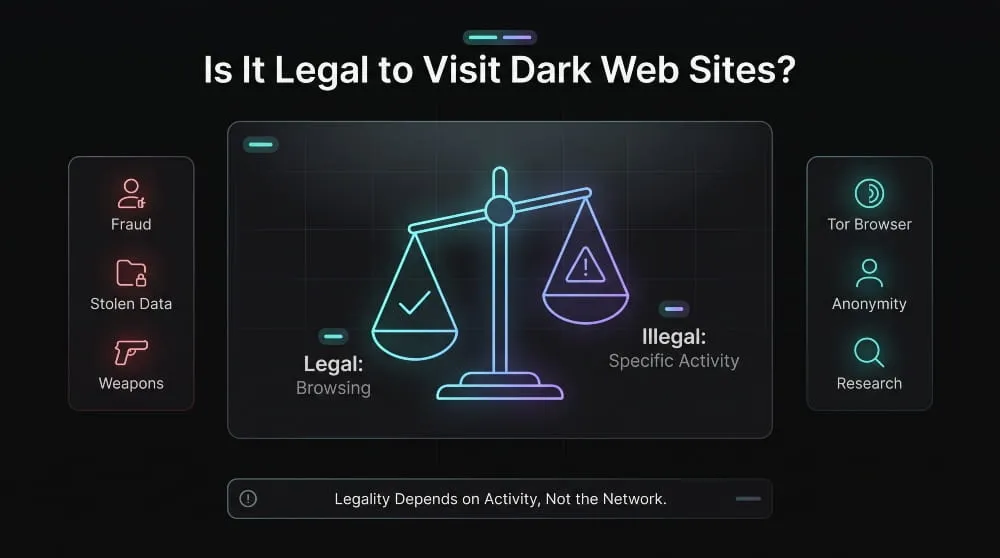
Yes, visiting dark web sites is legal in the United States and most other countries; using the Tor Browser and browsing .onion addresses is not a crime in itself. Legality depends not on the network you’re on, but on what you do once you’re there.
What Makes Specific Activity Illegal (Not the Network Itself)
Tor and .onion domains are neutral technology, used by journalists, researchers, and privacy-conscious users just as often as by criminals. Legal trouble comes from specific actions: buying stolen data or drugs, accessing child exploitation material, purchasing weapons, or participating in fraud are illegal regardless of whether they happen on the dark web or the surface web; the network is just the delivery method, not the offense. Simply loading a page, even one advertising illegal goods, isn’t the same as transacting on it, though it can still expose a visitor to real risk, which is the more practical concern for most people.
Risks of Visiting Even “Just to Look”
Even browsing without any intent to buy or engage carries risk that has nothing to do with legality. Dark web sites are unmoderated and frequently used to distribute malware, and a single page can attempt to fingerprint or exploit a visitor’s browser. Law enforcement also monitors known marketplaces and forums, meaning visitors to certain sites, even out of curiosity, can end up logged or flagged in broader investigations. For most people and especially for businesses, the safer approach isn’t avoiding the dark web entirely but understanding what’s actually on it and why it matters, which is where structured monitoring becomes more useful than manual browsing.
Types of Dark Web Sites
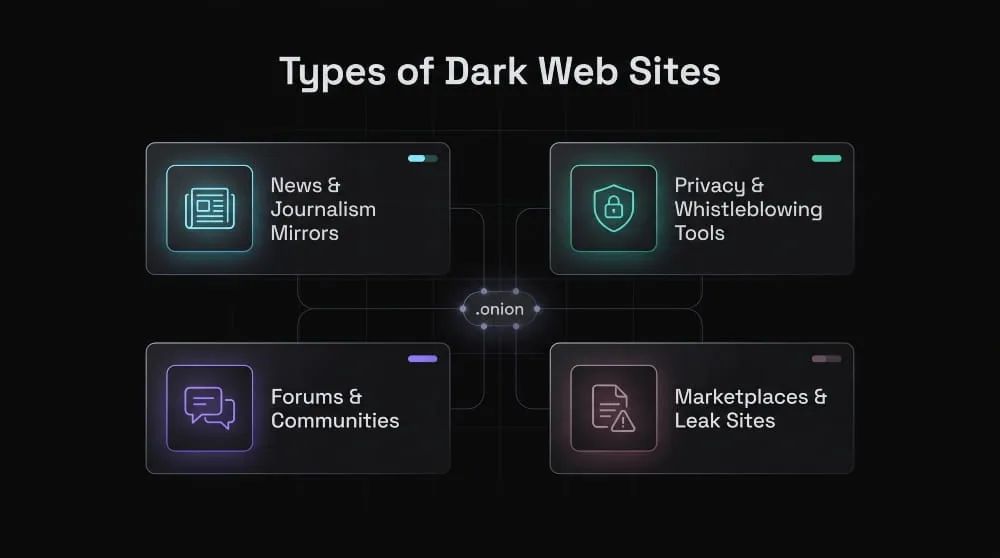
Dark web sites fall into a handful of broad categories, ranging from entirely legitimate to explicitly criminal, and understanding that range matters more than knowing individual addresses.
News & Journalism Mirrors
Several major news organizations maintain .onion mirrors of their sites specifically so readers in countries with heavy internet censorship can access reporting without detection. These mirrors carry the same verified content as the organization’s regular website; they exist purely to route around surveillance and blocking, not to hide anything about the publisher itself.
Privacy & Whistleblowing Tools
A significant share of dark web infrastructure exists to protect anonymity for legitimate reasons: secure document submission platforms let sources share information with journalists without revealing their identity, and privacy-focused search engines and email providers cater to users who don’t want their activity tracked. Activists, researchers, and people living under restrictive governments use these tools widely, not just security-conscious individuals.
Forums and Communities
Dark web forums cover an enormous range of topics, from cybersecurity research and technical discussion to communities built around anonymity itself. Some mirror ordinary internet forums but relocate for privacy reasons; others are more specialized and cater to niche or fringe interests. Content moderation varies widely from one forum to the next, and no consistent standard exists.
Illicit Marketplaces and Leak Sites
This is the category most people picture when they hear “dark web,” and it’s a real, active part of the ecosystem: marketplaces trading stolen data and dedicated leak sites where ransomware groups publish data stolen from breached organizations to pressure them into paying. What matters for businesses isn’t locating these sites; it’s understanding that this is where stolen company credentials, customer records, and internal documents frequently surface after a breach, often before the affected organization even knows an incident occurred. That gap between exposure and discovery is the core problem continuous dark web monitoring is built to close.
Well-Known Legitimate Dark Web Sites
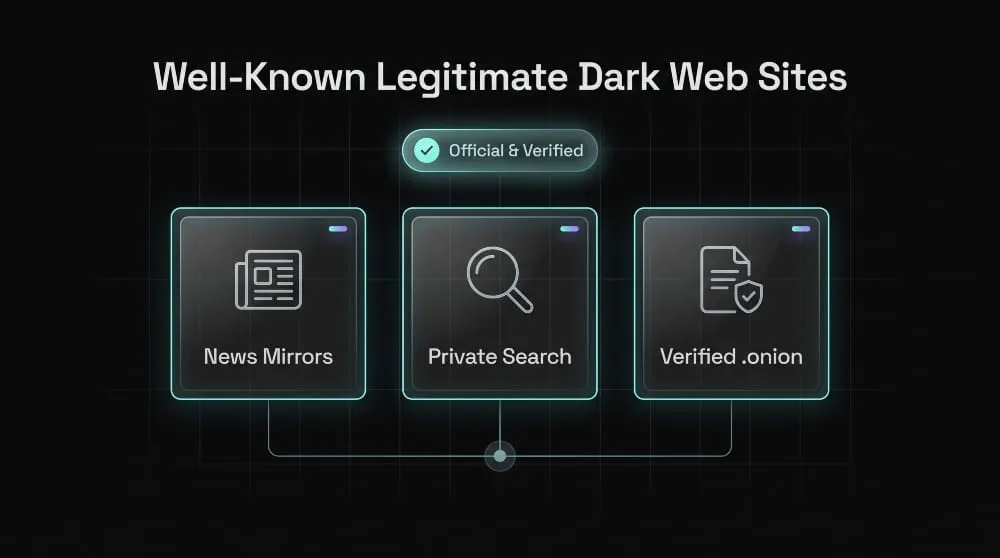
Not every dark web site is illicit; several widely recognized organizations run official .onion versions of their platforms, and a few examples show the network itself is neutral infrastructure.
News Organizations With .onion Mirrors
The New York Times, BBC, and ProPublica are among the most cited examples of legitimate dark web sites, each operating a verified .onion mirror of their standard website. ProPublica was one of the first major outlets to launch one, specifically to give readers in censored regions a reliable, unblockable way to access its investigative journalism. These mirrors don’t offer different content from the organizations’ regular sites; they exist solely to bypass network-level blocking and protect reader anonymity.
Privacy-Focused Search Engines
DuckDuckGo, known on the surface web for not tracking user searches, also operates an official .onion version that lets Tor users search without exiting the anonymity network. Other dark-web-native search tools attempt to index .onion sites specifically, since standard search engines don’t crawl them. However, coverage tends to be inconsistent given how much of the dark web is deliberately unindexed. These tools show how “dark web site” describes the hosting method, not the intent behind the content.
How Many Dark Web Sites Exist?
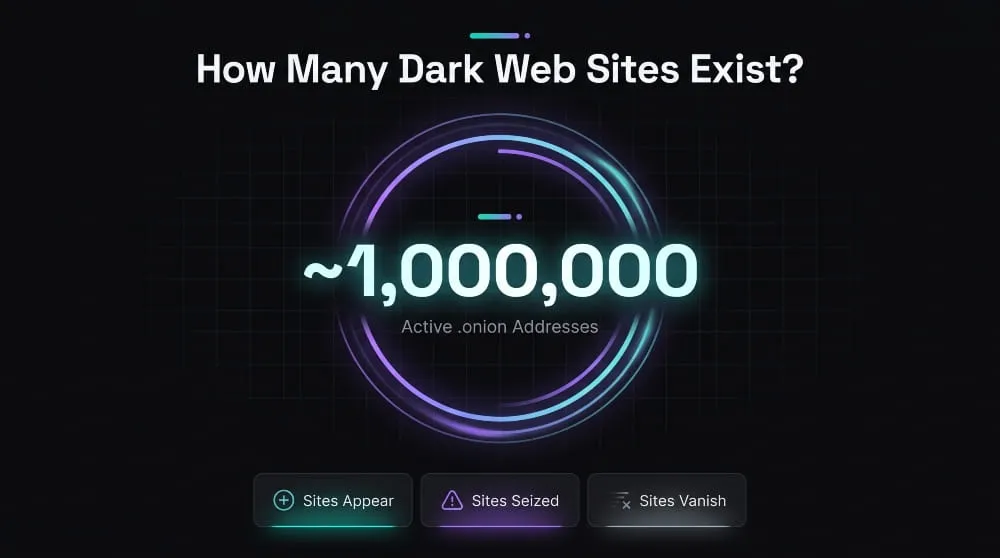
The dark web is far smaller than its reputation suggests. The Tor Project puts the number of active .onion addresses at roughly one million at any given time, and that figure is constantly shifting rather than growing steadily. Many sites appear and vanish within weeks, whether because of law enforcement action, hosting failures, or operators abandoning a project, which makes the dark web’s footprint far more volatile than the relatively stable surface web.
Why Dark Web Sites Get Seized or Shut Down
Law enforcement agencies across multiple countries have run coordinated operations that seize marketplace infrastructure and display takedown notices in place of the original site, often as part of multi-year investigations that trace server locations and operator identities despite the anonymity layer. Sites also disappear for less dramatic reasons: some are exit scams, where operators take funds and vanish, and others fold when the underlying Tor hosting becomes unreliable, or the operators lose interest. This churn is part of why static lists of dark web sites go stale almost immediately; any directory is likely to be inaccurate within months.
Why Businesses Should Care About Dark Web Sites
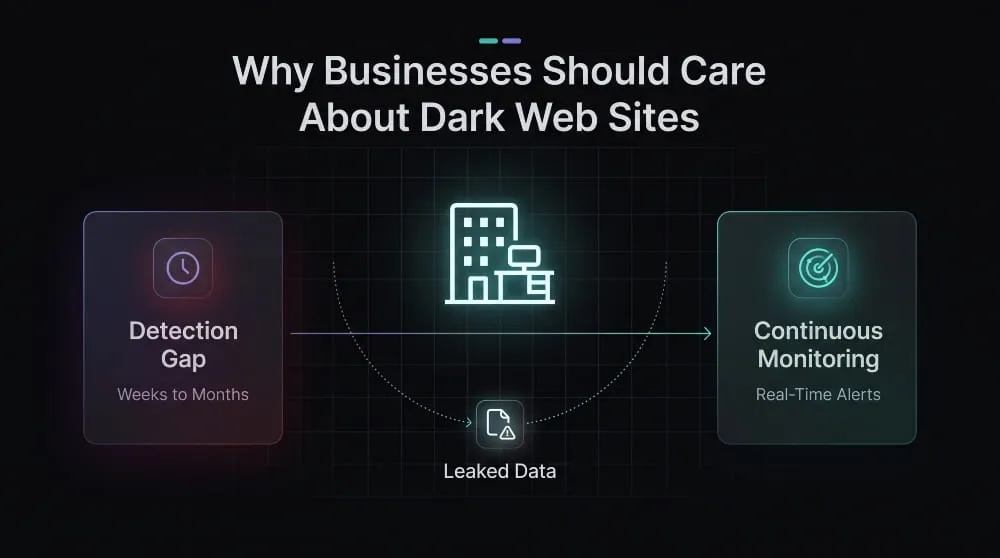
For most companies, dark web sites aren’t a browsing risk; they’re where stolen organizational data ends up without warning, making them a security concern even for employees who never go near Tor.
Company Data Ending Up on Leak Sites
When an organization is breached, stolen credentials, customer records, or internal files often surface on dark web marketplaces or ransomware leak sites before the company even knows an incident occurred. That gap can stretch for weeks or months, during which exposed employee logins or customer data are actively bought, sold, or used to stage further attacks. The business doesn’t need a presence on the dark web for this to happen; the exposure originates from the breach, not from anything the company did on that network.
How Continuous Dark Web Monitoring Differs From Manually Checking Sites
Manually checking dark web sites for company mentions isn’t practical at scale: marketplaces and forums are numerous, short-lived, and often require specialized access, and no single person can watch them all continuously. Continuous dark web monitoring instead scans marketplaces, leak sites, and forums on an ongoing basis and flags exposed credentials or data as soon as they appear, cutting the detection gap from months to something closer to real time. That shift, from occasional manual checks to automated, always-on coverage, is the practical difference between hoping a breach doesn’t surface and knowing the moment it does.
Frequently Asked Questions (FAQ)
What do dark web sites look like?
Most dark web sites look strikingly similar to ordinary websites: text, images, navigation menus, sometimes even polished design, with the main visual differences being long, randomized .onion addresses instead of readable domain names and, often, a more bare-bones or dated aesthetic since fewer resources go into design. There’s no universal “dark web look”; a news mirror and a forum can look as different as any two ordinary websites.
How do you find dark web sites?
Dark web sites aren’t discoverable through Google or other standard search engines, since crawlers can’t index .onion addresses. Finding one typically means already knowing the specific address, using a dark-web-specific search tool, or following links shared within forums and communities; there’s no centralized directory equivalent to a surface-web search engine.
Are dark web sites safe to visit?
Visiting a dark web site carries more risk than browsing the surface web, even when the visit itself is legal. Pages can attempt to deliver malware, and because the space is largely unmoderated, there’s no reliable way to know what a link leads to before clicking it. Treat any dark web site the way you’d treat an unverified download from an unfamiliar source.
How many dark web sites are there right now?
Estimates put the number of active .onion addresses at roughly one million at any given time, though that figure shifts constantly as sites go offline and new ones appear.
Can dark web sites be traced back to their owners?
Sometimes. Tor’s anonymity layer makes tracing difficult but not impossible; law enforcement has identified and prosecuted operators of major dark web marketplaces through investigative techniques that don’t rely on breaking Tor’s encryption, often by exploiting operational mistakes rather than the network’s design.