
An MSSP and a SOC aren’t competing options because they sit at different levels. A SOC (security operations center) is the function that monitors, investigates, and responds to threats. An MSSP is a business that sells security services and usually delivers them by running SOCs on behalf of its clients. SIEM and SOAR are the tools that sit inside either one. The rest of this guide separates the roles, shows where each tool fits, and explains how operators connect them. It also covers a signal gap SIEM-centric detection tends to miss: dark web monitoring.
MSSP vs SOC at a Glance
The short answer: a SOC is a capability, and an MSSP is a provider. A SOC is the people, processes, and technology that detect and respond to security events, whether it lives inside one company or inside a service provider. An MSSP is an external company that delivers managed security services to multiple clients, and running a SOC is typically the core of what it sells. For the full definition of the provider model, see its own page. This guide focuses on how that provider relates to the SOC.
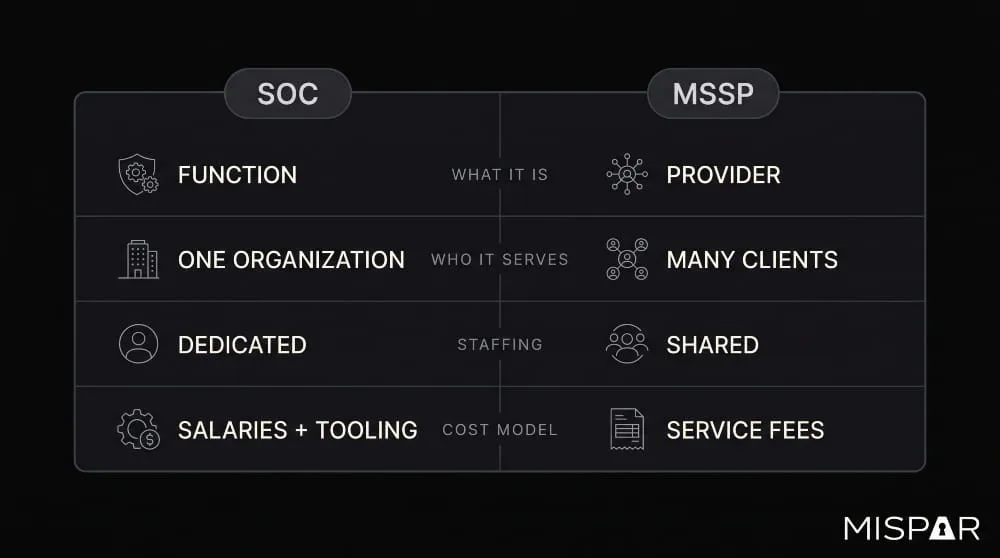
The comparison below shows how the two differ on the points buyers and operators ask about most.
| Dimension | SOC | MSSP |
|---|---|---|
| What it is | A security operations function (team, process, tooling) | A company that sells managed security services |
| Who owns it | Usually one organization (in-house) or a provider’s delivery team | An independent provider serving many clients |
| Who it serves | One organization, or the clients of the provider that runs it | Many client organizations at once |
| Staffing | Analysts and engineers dedicated to one environment | Analysts shared across clients, often in shifts |
| Scope | Detection, triage, investigation, response | Monitoring and response, plus services such as vulnerability management or reporting |
| Tooling | SIEM, SOAR, endpoint and network telemetry | The same tools, run multi-tenant across clients |
| Cost model | Salaries, tooling, facility, 24/7 coverage | Recurring service fees from clients, with cost spread across the client base |
In plain terms, asking “MSSP or SOC?” is like asking “airline or aircraft?” The SOC does the work, and the MSSP is one way of organizing who owns and staffs it. A company can build its own SOC, buy the service from an MSSP, or split the work between the two.
What a SOC Does
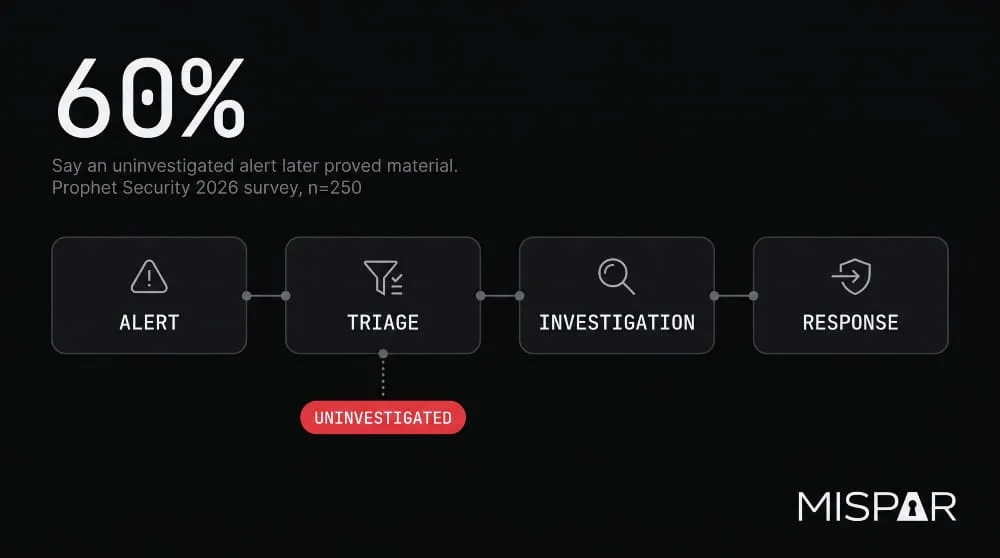
A SOC continuously watches an environment for signs of compromise, decides which signals matter, investigates them, and coordinates the response. The core loop is monitoring, triage, investigation, and response. Monitoring collects telemetry from endpoints, networks, identity systems, cloud services, and applications. Triage sorts that stream into alerts worth looking at and noise. Investigation establishes what happened, what was touched, and how far it spread. Response contains the threat and restores normal operations.
Most SOCs organize analysts into tiers. Tier 1 handles first-line triage and escalates what it cannot resolve. Tier 2 performs deeper investigation and containment. Tier 3, or a dedicated threat hunting and engineering group, handles complex incidents, detection content, and tuning. Smaller operations often compress these into fewer roles, but they still have to cover the same functions.
The central constraint on any SOC is capacity. In a 2026 survey of 250 security leaders and practitioners, 60% said an alert they ignored or never investigated later turned out to be material, meaning it risked data exposure, downtime, or business disruption. This is a vendor survey, so treat the figure as directional, but it matches the pattern seen across many SOC studies: volume outruns analyst time, and incidents start in the alerts that fall through the cracks.
An internal SOC differs from traditional security operations in scope. Traditional security operations often meant periodic log review, a firewall team, and an IT help desk handling incidents when someone noticed them. A SOC replaces that with continuous, structured detection and a defined response process, regardless of who staffs it.
The Role of the SOC Inside an MSSP
Inside an MSSP, the SOC is the production line. Analysts monitor many client environments from one operation, using shared tooling and standard playbooks, and they escalate to each client according to that client’s contract. The economic logic is that one 24/7 team and one tooling investment serve dozens or hundreds of clients, which is something few individual organizations can afford on their own.
The services a SOC delivers inside an MSSP usually include log and event monitoring, alert triage, incident investigation and response guidance, and recurring reporting. Many providers add vulnerability scanning, threat intelligence, endpoint monitoring, and compliance reporting around that core. The mix varies by provider and by service tier, so the SOC is best understood as the engine and the service catalog as the packaging.
Multi-tenant operation is what makes this work, and it is the hardest part to get right. Each client needs isolated data, its own detection tuning, separate escalation contacts, and its own reporting, while the analysts still work from one queue. Role-based access, per-client views and consistent playbooks keep that from turning into chaos. Operators evaluating platforms should look closely at how tenancy is handled, a key theme in MSSP software selection.
MSSP vs In-House SOC: Build, Buy or Blend
Building an in-house SOC gives an organization direct control and deep familiarity with its own environment. Buying from an MSSP gives it coverage and expertise without building the team. Blending the two splits the work to fit the organization’s strengths. None of the three is universally right, and the choice usually comes down to cost, control, and response speed.
On cost, the in-house path carries salaries for round-the-clock coverage, tooling licenses, training, and the cost of keeping experienced analysts. Round-the-clock coverage is the largest driver, because covering every shift of the year takes a team far larger than the number of seats on any single shift. Retention matters too, since analyst turnover resets institutional knowledge. An MSSP converts that fixed cost into a service fee and spreads the staffing and tooling across its client base, though the client gives up some customization.
On control and visibility, an in-house team knows the business context and can act directly on its own systems. An MSSP sees the telemetry it is given and responds within the permissions it has been granted, so integration depth and clear escalation paths decide how well it performs. Response speed depends less on who employs the analysts than on how well detection, escalation, and authority to act are defined.
Hybrid models are common. An organization might keep a small internal team for response and business context while an MSSP provides overnight monitoring and first-line triage. Others keep detection engineering in-house and outsource alert handling. The split works best when teams document and test the handoffs between them.
SOC-as-a-Service vs MSSP
SOC-as-a-Service (SOCaaS) is a delivery model in which a provider supplies SOC capability on a subscription basis, typically centered on monitoring, detection, and response. An MSSP is a broader category that may include SOC services among others. In practice, the two overlap heavily, and many providers use the terms interchangeably, so the differences come down to scope and packaging.
SOCaaS usually includes monitoring, alert triage, investigation, and response guidance. It often leaves out the broader managed services an MSSP might offer, such as managing firewalls, running vulnerability programs, or producing compliance reports. Some SOCaaS offerings also stop short of taking response actions, and limit themselves to notifying the client’s own team.
They differ most in contract shape. SOCaaS tends to be sold as a defined capability with a narrower service description. An MSSP engagement can be wider and more customized. For an operator building a service line, the practical question is how to package SOC capability so clients understand what they are buying, which is where tiering, clear response boundaries and consistent reporting matter. Operators who resell under their own brand can build that packaging on white-label capabilities instead of building every component themselves.
MSSP vs SIEM
A SIEM (security information and event management) system is a tool, and an MSSP is a company. A SIEM collects and normalizes log data from across an environment, correlates events, applies detection rules, and stores evidence for investigation. It produces alerts, but it does not decide what to do about them. People, usually a SOC, do that.
An MSSP uses a SIEM as a core tool. Providers typically run a SIEM across many clients, either as a multi-tenant platform they operate or as a client-owned platform they monitor. The first model gives the provider consistent tooling and economies of scale. The second gives the client ownership of its data but requires the provider to adapt to each client’s stack.
The three roles line up like this.
| Layer | Role | Example Question It Answers |
|---|---|---|
| SIEM | Collects, correlates and stores security data, and raises alerts | What happened across my systems, and does it match a known pattern? |
| SOC | Triages, investigates and responds to alerts | Is this alert real, how bad is it, and what do we do? |
| MSSP | Provides the SOC and tooling as a service to many clients | Who staffs and runs this for me? |
A SIEM without a SOC produces alerts nobody works. A SOC without good data in its SIEM has little to investigate. An MSSP is a way of getting both, delivered by someone else.
MSSP vs SOAR
SOAR (security orchestration, automation and response) is a tool that automates parts of the response process, while an MSSP is the provider that may use it. SOAR platforms run playbooks that enrich alerts with context, open tickets, query other tools, and take predefined response actions such as isolating a host or deactivating an account. They reduce manual effort on repetitive tasks.
Automation and human analysts do different jobs. Automation is strong at speed and consistency on well-understood, repeatable tasks, such as looking up an IP reputation or collecting the same five pieces of context for every phishing report. Analysts are needed when the situation is ambiguous, when business context changes the right answer, or when an action carries risk. The practical design goal is to automate the mechanical steps and keep people in charge of judgment.
Automated threat hunting is where this distinction gets blurry. Automation can run recurring queries and flag anomalies across large data sets faster than a person could. It does not replace a hunter’s ability to form a hypothesis about how a particular adversary might behave in a particular environment. For an MSSP, the useful pattern is to let automation handle breadth and let analysts handle depth. Providers often use SOAR to increase the number of clients each analyst can handle without lowering investigation quality.
MSSP vs SIEM vs SOAR
An MSSP is a service, SIEM is the platform that collects and correlates security data, and SOAR is the automation layer that acts on alerts. An MSSP often operates a SIEM for its clients and may use SOAR to speed up response, so they work together rather than compete. The useful question is not which to pick but who owns, tunes and acts on each one.
How the Pieces Fit Together
The simplest way to see the relationship is as a pipeline. Data sources (endpoints, identity systems, cloud services, networks) feed a SIEM. The SIEM correlates that data and raises alerts. SOC analysts triage and investigate those alerts. SOAR automates repeatable steps and carries out approved response actions. The results flow into client reporting, which closes the loop by showing clients what was found and what was done.
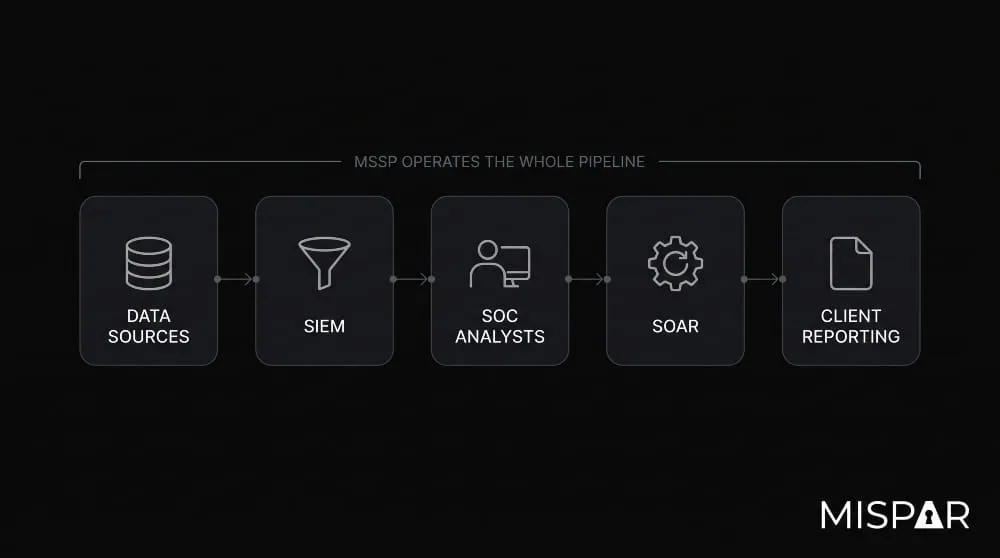
Each layer adds a different kind of value. Data sources determine what can be seen at all, so gaps there are blind spots no later layer can fix. The SIEM adds correlation and retention. The SOC adds judgment and accountability. SOAR adds speed and consistency. Reporting adds proof of value, which matters especially for an MSSP, since clients renew based on what they can see the service doing.
An MSSP operates this whole pipeline for its clients. Its job is to keep every layer working, keep clients’ data separated, and keep the output understandable to people who do not read logs for a living.
Feeding the SOC Better Signal
SIEM-centric detection is strong at catching suspicious behavior inside an environment, but it has a blind spot for credentials stolen elsewhere. When infostealer malware captures an employee’s login on a personal device, or a third-party breach leaks it, nothing unusual may happen inside the client’s network until the attacker signs in with valid credentials. At that point, the activity can look like a normal login, which is hard for log-based detection to flag.
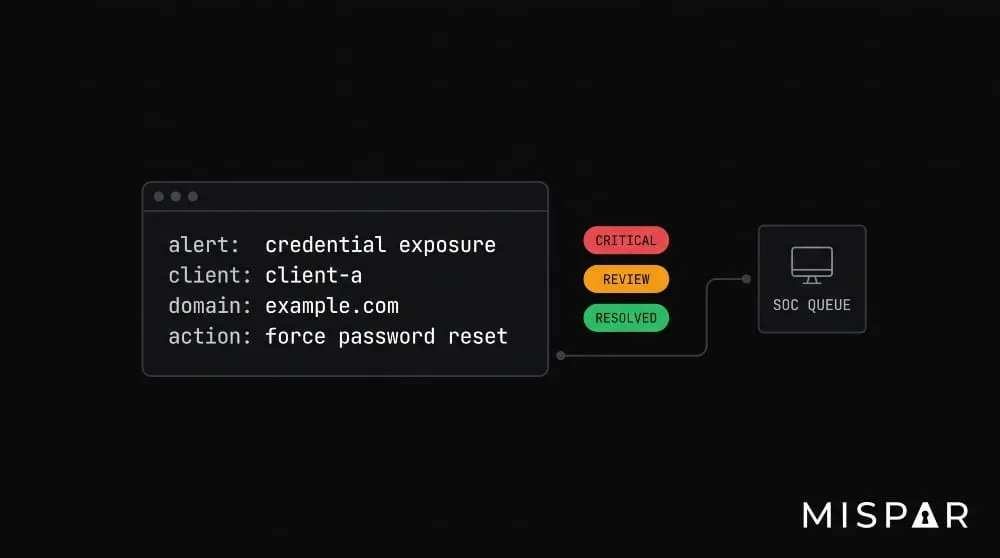
Dark web monitoring addresses this by watching places where stolen credentials appear, including breach dumps, infostealer logs, and criminal marketplaces, and matching what it finds against client domains. The alert arrives before the attacker uses the credential, which turns a possible breach into a password reset. That makes it an early-warning input for the SOC, not a replacement for SIEM.
In the SOC workflow, a credential exposure alert enters the same queue as other alerts, carries a severity based on factors such as whether the password is in plaintext and whether the account is privileged, and triggers a defined playbook: force a reset, review recent sign-ins, and confirm multi-factor authentication is on. For a multi-client operation, the alerts must be separated per client and routed to the right contacts. This is the kind of feed that Mispar provides for MSSPs, which can then deliver it to their clients under their own brand, adding a signal that standard log-based detection does not cover.
Conclusion
The question was never really MSSP or SOC. A SOC is the function that detects and responds, an MSSP is a provider that delivers it as a service, and SIEM and SOAR are the tools that make it work at scale. Operators who understand where each layer starts and stops can design clearer services, set honest expectations with clients, and fill the gaps that log-based detection leaves open. Adding early-warning signals such as credential exposure alerts is one of the most practical ways to strengthen that pipeline, and Mispar was built to help MSSPs deliver exactly that.
Frequently Asked Questions (FAQ)
Is an MSSP the same as a SOC?
No. A SOC is a security operations function made up of people, processes, and tools that monitor for and respond to threats. An MSSP is a company that sells security services, and it typically runs one or more SOCs to deliver them. An MSSP contains a SOC, but a SOC does not have to belong to an MSSP, since many organizations run their own.
Can an MSSP replace an in-house SOC?
It can, and many organizations rely on an MSSP as their only security operations capability. Others use one to supplement a smaller internal team, for example by covering nights and weekends. Whether it fully replaces an in-house SOC depends on the organization’s size, regulatory needs, and how much control it wants over investigation and response.
Does an MSSP need a SIEM?
In practice, almost always. A SIEM gives an MSSP the centralized log collection, correlation, and retention it needs to detect threats across client environments. Some providers run their own multi-tenant SIEM, and some monitor a SIEM the client owns, but either way the SIEM is the main source of alerts the SOC works from.
What is the difference between SIEM and SOAR?
A SIEM collects and correlates security data and raises alerts when it sees suspicious patterns. SOAR takes those alerts and automates the response steps, such as enriching context, creating tickets, and carrying out approved actions. SIEM tells you something may be wrong, while SOAR helps you act on it faster and more consistently. Many SOCs use both together.
What is SOC-as-a-Service?
SOC-as-a-Service is a subscription model in which a provider supplies security operations capability, usually monitoring, detection, investigation, and response guidance, without the customer building its own SOC. It overlaps heavily with what many MSSPs offer, though it is often narrower in scope. For the wider provider landscape, including how MSPs, MSSPs and MDR services compare, see MSP, MSSP and MDR compared.
What is the difference between SOC-as-a-service and an MSSP?
SOC-as-a-service describes an outsourced security operations center that works like an in-house SOC, while an MSSP typically manages a broader set of security tools and alerts. The labels overlap, so check what the contract covers, especially who investigates and responds when an alert becomes an incident.