
The dark web is the part of the internet that you can only reach with anonymity software such as Tor, and it can’t be found through Google or other search engines. It holds everything from privacy-focused news sites to criminal marketplaces, and in most countries simply visiting it is legal, even though much of what is traded there is not.
It is a small corner of the web, but a real one. According to Tor Project metrics cited by the Congressional Research Service, about 430,000 people a day in the United States used Tor in the first ten months of 2024, which was 13.7% of daily Tor users worldwide. Tor is the most common way in, though not everyone using it is visiting the dark web. This guide explains what the dark web is, how it works, what you will actually find there, and how to stay safe, whether you’re curious about it or worried about your own data.
What Is the Dark Web?
The dark web is the part of the internet that is deliberately hidden. Its sites don’t appear in search engines, and you can only reach them with anonymity software such as Tor, which conceals both the visitor and the site’s operator. The word “dark” refers to this concealment, not to the content, and the dark web hosts both ordinary privacy-focused services and criminal activity. Researchers describe it as reachable through anonymized networks such as Tor or I2P, and Tor itself began in 2002 as a U.S.-developed onion routing project.
Dark Web vs Deep Web vs Surface Web
The surface web is everything search engines index, such as news sites, Wikipedia and online stores. The deep web is everything they don’t, mostly because it sits behind a login or paywall: your email inbox, online banking, medical portals and private cloud files. Almost all of it is ordinary and harmless. The dark web is a small, intentionally hidden slice of the deep web that needs special software to open, so it is part of the deep web but not the same thing. For a fuller comparison, see deep web vs dark web.
Dark Web vs Darknet
A darknet is a network built to keep its traffic and participants anonymous, such as Tor, I2P or Freenet. The dark web is the collection of websites and services that live on those networks. People often use the two words interchangeably, and in everyday conversation that is fine. Strictly speaking, the darknet is the infrastructure and the dark web is what you find on it.
Why the Dark Web Isn’t One Place
There is no central directory, owner or address for the dark web. It is thousands of independent sites run by individuals, organizations, companies and criminals, and many are short-lived or unlisted by design. Large companies such as Facebook have even adopted onion services for their own sites. That is why “the dark web” is better understood as a way of reaching hidden sites than as a single destination you can visit.
Is the Dark Web Real?
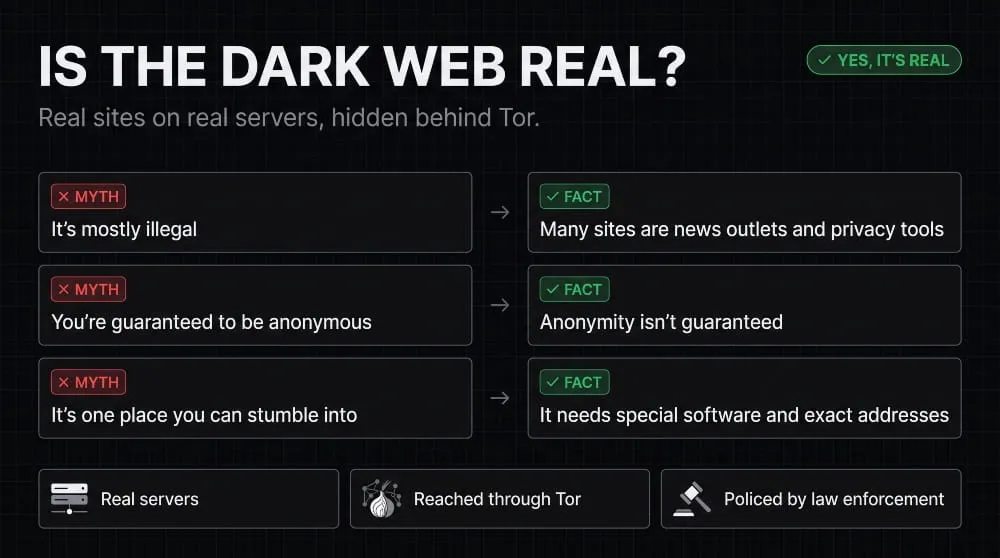
Yes, the dark web is real. It is a set of actual websites and services running on anonymity networks like Tor, and anyone with the right software can open them. What isn’t real is much of the folklore around it: it is not a secret global criminal empire, and it is not the vast hidden majority of the internet that the iceberg diagrams suggest.
Does the Dark Web Actually Exist?
The dark web exists in the same way any website does: servers host it and people connect to it. The difference is that those servers hide their location and the visitor’s identity. It is also messier than its reputation. A 2018 academic measurement study of Tor found that more than 90% of attempted connections to onion services failed. Many dark web addresses are dead, mistyped or short-lived, which makes it less like a polished underground marketplace and more like a poorly maintained corner of the web.
Common Myths vs Facts
The most common myth is that the dark web is mostly illegal. Much of the traffic on Tor goes to the ordinary internet, and the network is used for private browsing and bypassing censorship as well as for crime. A second myth is that it guarantees anonymity. Researchers note that anonymity on the dark web is not guaranteed, and law enforcement investigates crimes committed there. A third is that it is a single place you can stumble into. It isn’t, because you need specific software and usually an exact address.
Why Is the Dark Web Allowed to Exist?
The dark web exists because the technology behind it has legitimate uses and is legal in most countries. The Tor Project says its users include ordinary people who want protection from identity theft, people living under internet censorship, companies researching competitors privately, and even governments and law enforcement. Banning anonymity tools outright would also remove protection from journalists, activists and anyone at risk, which is why most democratic governments focus on prosecuting the crimes committed with them rather than the tools.
Who Created the Dark Web?
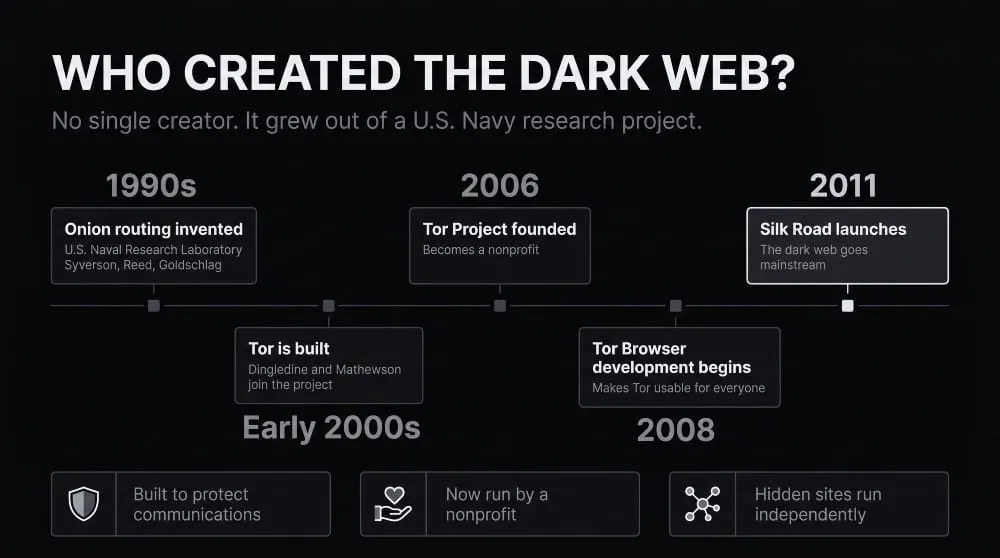
No single person created the dark web. It grew out of onion routing, a technique developed in the mid-1990s by researchers at the U.S. Naval Research Laboratory to protect government communications online, and it became what people now call the dark web once the public could use Tor and run hidden sites. Three computer scientists at the lab, Paul Syverson, Michael Reed and David Goldschlag, developed its core principles.
Where Onion Routing and Tor Came From
The original idea was to route internet traffic through several servers and encrypt it at each step, so no single point in the chain knows both who is talking and what they are saying. In the early 2000s, MIT graduate Roger Dingledine began working with Syverson on the Naval Research Laboratory’s onion routing project and named it Tor, short for The Onion Routing. Nick Mathewson, a classmate of Dingledine’s, joined soon after. The name stuck, and it also explains why dark web addresses end in .onion.
Who Owns or Runs the Dark Web Today
Nobody owns the dark web, and no company or government controls it. The software most people use to reach it is maintained by a nonprofit. The Tor Project became a 501(c)(3) nonprofit in 2006, and development of Tor Browser began in 2008. The Tor Project builds and maintains the tools, but it doesn’t operate the sites, which are run independently by thousands of people and organizations. Nor does it control what they publish.
How the Dark Web Grew
Tor Browser made the technology usable for ordinary people, and a single marketplace made the dark web famous. Ross Ulbricht launched Silk Road in 2011, and it went on to host about 1.2 million transactions between roughly 957,000 users, worth around $1.2 billion, before its seizure in 2013. Silk Road was a drug marketplace, and its shutdown didn’t end the model, because many similar markets followed it and are still seized and replaced today. That cycle is much of why the dark web’s reputation leans criminal, even though privacy and censorship-circumvention uses came first.
How the Dark Web Works
The dark web works by sending your connection through a chain of volunteer-run servers, with encryption at every step, so that no single point knows both who you are and what you are visiting. Websites can hide their own location in the same way, which is why their addresses look nothing like normal web addresses. The original idea behind onion routing was to route traffic through multiple servers and encrypt it at each step.
How Tor and .onion Addresses Work
Most people reach the dark web through Tor Browser. Tor routes your web traffic through other users’ computers, so you connect to sites indirectly and the traffic can’t easily be traced back to you. Dark web sites, called onion services, go a step further by hiding their servers as well. Connections to these services use six-hop circuits, compared with three hops for regular internet sites, so neither side learns the other’s location. Their .onion addresses are generated from a cryptographic key, which is why they are long strings of characters that you can’t guess or remember.
Why Search Engines Don’t Index the Dark Web
Search engines find pages by following links from site to site, and the dark web is built to resist that. There is no central directory, many sites are unlisted on purpose, and addresses change or disappear. Specialized search engines can search it, but they cover only a fraction of what exists. That is why a normal Google search will never show you a dark web site, even if you type its exact name.
The Iceberg Myth and How Big the Dark Web Really Is
The popular iceberg diagram puts the surface web at the tip and the dark web as a huge hidden mass underneath. In reality, most of the hidden part is the ordinary deep web: password-protected accounts, private databases and paywalled content. The dark web is a thin slice of that. No one has a reliable count of how much of the internet it makes up, and the “5% of the internet” claim you often see has no solid source behind it. The best measurement comes from the Tor Project, which estimated in 2015 that about 3.4% of client traffic on Tor went to hidden services. Later internal estimates moved around, rising to almost 8% in mid-2016 and falling back to around 3% in 2017, and Tor itself carries only a small share of internet traffic. So the dark web is real but small compared with the visible web.
What’s on the Dark Web?
The dark web holds a mix of ordinary and illegal content, from news outlets and privacy tools to stolen data and fraud services. Most of it is not as dramatic as its reputation suggests. Many sites are simple, some are broken or abandoned, and legitimate organizations run a good share of the well-known ones.
Legitimate Uses
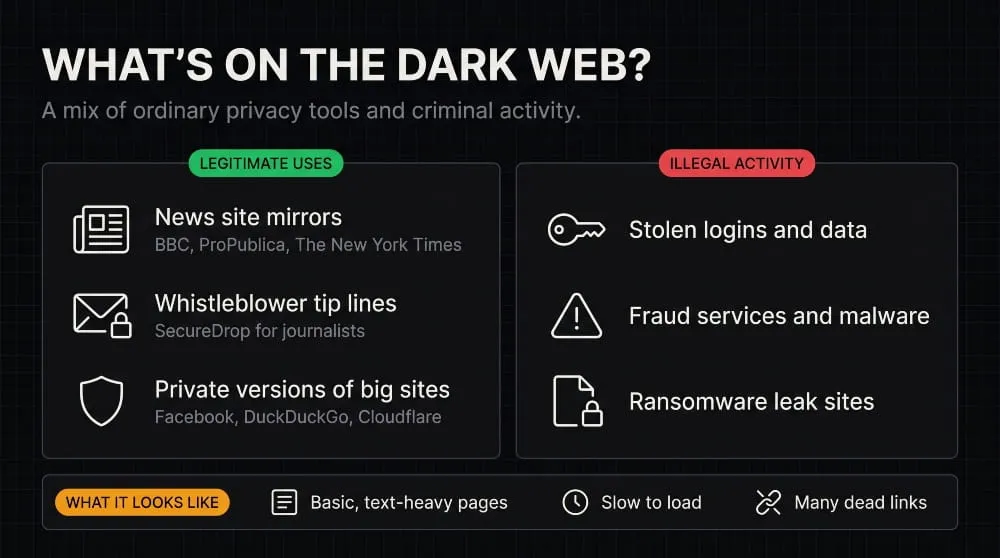
Many of the best-known dark web sites are run by mainstream organizations that want people to reach them privately or under censorship. ProPublica launched an onion version of its site so that anonymous sources and people living under oppressive governments could read its reporting in relative anonymity. The BBC built a Tor mirror in response to geoblocking, and large sites including Cloudflare, DuckDuckGo and Facebook also offer onion services alongside their regular addresses. Whistleblowing is another major use. SecureDrop lets sources contact journalists securely over Tor, and organizations such as The Guardian, The New York Times and ProPublica have adopted it.
Illegal Activity
The dark web also hosts criminal activity. This includes marketplaces for stolen data and credentials, fraud services, malware and hacking tools, and forums where criminals trade information. Ransomware groups also use hidden sites to publish data stolen from victims. There is no reliable figure for what share of the dark web is criminal, and claims you see online vary widely. What is certain is that the criminal side matters most to businesses and individuals whose data ends up there, which is covered later in this guide. Law enforcement actively investigates these activities, and illegal marketplaces are regularly seized and replaced.
What the Dark Web Looks Like
Visiting the dark web is much less cinematic than people expect. Most sites look like ordinary websites, often more basic and text-heavy, and they usually load slowly because traffic passes through several relays. Addresses are long strings of letters and numbers ending in .onion, and there is no Google-style search to guide you. Many links are dead, and listings on directories are often out of date. A typical session feels closer to the early web of the 2000s than to the shadowy underworld shown in films.
Who Uses the Dark Web and Why
People use the dark web for very different reasons: journalists, activists and privacy-minded individuals use it for protection, researchers and security teams study it, criminals use it to trade illegal goods and stolen data, and law enforcement works to disrupt them. The same anonymity that protects a whistleblower also protects a fraudster, which is why the dark web is hard to describe with a single label.
Journalists, Activists and Privacy-Minded Users
For people at risk, anonymity is a safety tool. Reporters use the dark web to receive tips from sources who can’t safely contact them any other way. SecureDrop instances, for example, are only available through the Tor network. Activists and ordinary citizens in countries that censor or monitor the internet use it to read blocked news and communicate privately, and some people simply prefer not to be tracked by advertisers or internet providers.
Researchers and Security Teams
Security researchers, threat intelligence analysts and academics study the dark web to understand how attackers work. They watch for leaked credentials, stolen company data and mentions of their organizations or clients, and they track how criminal groups sell access and malware. This is the legitimate counterpart to the criminal activity: the people who monitor these sites for exposed data, often through dedicated monitoring services, are working to protect the people whose information is being traded.
Criminals
Criminals use the dark web for the same reason everyone else uses privacy tools, which is to avoid being identified. They sell stolen data, run fraud services and trade in illegal goods. The model keeps changing as pressure grows. Europol has observed criminals moving to smaller, independent shops to avoid marketplace fees and reduce the risk of being detected as traditional marketplaces come under pressure. The result is a more fragmented criminal landscape, which makes it harder to track but not impossible.
Law Enforcement, Arrests and Takedowns
Law enforcement is an active presence on the dark web, not a distant observer. In May 2025, Europol-led Operation RapTor resulted in 270 arrests of dark web vendors and buyers across four continents, with agencies from ten countries taking part. Europol said a takedown is the beginning of follow-up investigations aimed at identifying and arresting high-value vendors, which is why arrests often follow months or years after a marketplace is seized. The operation followed 2023’s Operation SpecTor, which led to 288 arrests. The practical lesson is that anonymity on the dark web is a safeguard that can fail, not a guarantee.
Is the Dark Web Legal? Is It Dangerous?
In most countries the dark web is legal to access, but it is risky in practice. What can get you into legal trouble is what you do there, and the main dangers are scams, malware and exposure of your own data, not the technology itself.
Is the Dark Web Legal?
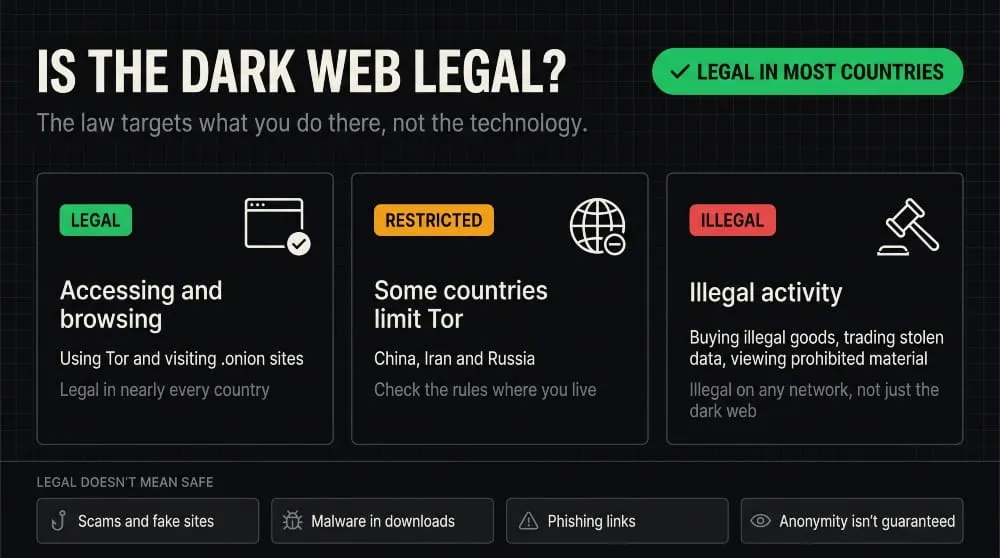
In most places, visiting the dark web and using Tor are not crimes. Accessing the dark web is legal in nearly every country, including the U.S., the UK, Canada, Australia and India, and hosting a site on it is legal as long as the content and services are legal. The law targets activities such as buying illegal goods, trading stolen data or viewing prohibited material, whichever network they happen on. The picture changes in some countries. In places such as China, Iran and Russia, access to Tor is restricted or blocked, and using it can carry legal consequences. Laws also change, so check the rules where you live. For a fuller country-by-country breakdown, see is the dark web illegal.
Why the Dark Web Can Be Dangerous
The biggest risks are practical, not legal. Many dark web sites are scams that take payment and deliver nothing, and fake or cloned versions of real sites are common, built to steal logins or money. Files downloaded there can carry malware, and links can lead to phishing pages. Some content is disturbing or illegal to view, and stumbling onto it can create real legal problems. There are also no consumer protections: there is no review process, no refund and no one to complain to if you are cheated.
Can You Be Tracked on the Dark Web?
You can be, although it is difficult. Tor is designed to make tracking hard, but it is not a guarantee. Researchers note that anonymity on the dark web is not guaranteed. People are most often identified through their own mistakes, such as reusing a username or password, sharing personal details, or logging into a personal account. Law enforcement can also combine information from seized servers, financial records and other sources to identify users, as the arrests described earlier show.
Basic Safety Principles
The safest approach is to treat the dark web like an unfamiliar neighborhood. Don’t download files or open attachments, don’t enter real personal details or reuse passwords, keep Tor Browser up to date, and stay away from anything illegal. If you only need to know whether your information has been exposed, you don’t need to visit at all, because monitoring tools can check on your behalf, as covered later in this guide.
How People Access the Dark Web
Most people reach the dark web with Tor Browser, a free browser made by the Tor Project that connects through the Tor network and can open .onion addresses. No special hardware or account is needed, but you do need to know the address of the site you want, because there is no search engine that covers everything. This section is only an overview. For device-specific setup and safety steps, see how to access the dark web.
What You Need to Reach It
Two things are required: Tor Browser and an onion address. Tor Browser development began in 2008 and made Tor accessible to everyday internet users and activists. Some regular sites now point Tor users to their onion version automatically. Since Tor Browser 9.5, a site’s Onion-Location header can promote its onion service to Tor Browser users. A VPN is optional, and whether it helps depends on your situation, which the access page covers. Tor is the best-known route, but the dark web can also be reached through other anonymized networks such as I2P.
Is Tor the Same as the Dark Web?
No. Tor is the technology and the dark web is the set of hidden sites you can reach with it. Using Tor does not mean you are visiting the dark web, because you can use it to browse ordinary websites more privately, and many people do exactly that. Visiting a .onion address is what takes you to the dark web itself.
The Dark Web and Your Data
Your personal and login data can end up on the dark web after a data breach, a phishing attack or an infection with data-stealing malware, and you don’t need to visit the dark web to find out whether it has. Stolen information is traded and leaked there, and the practical response is to check whether you are exposed and make the exposed data useless.
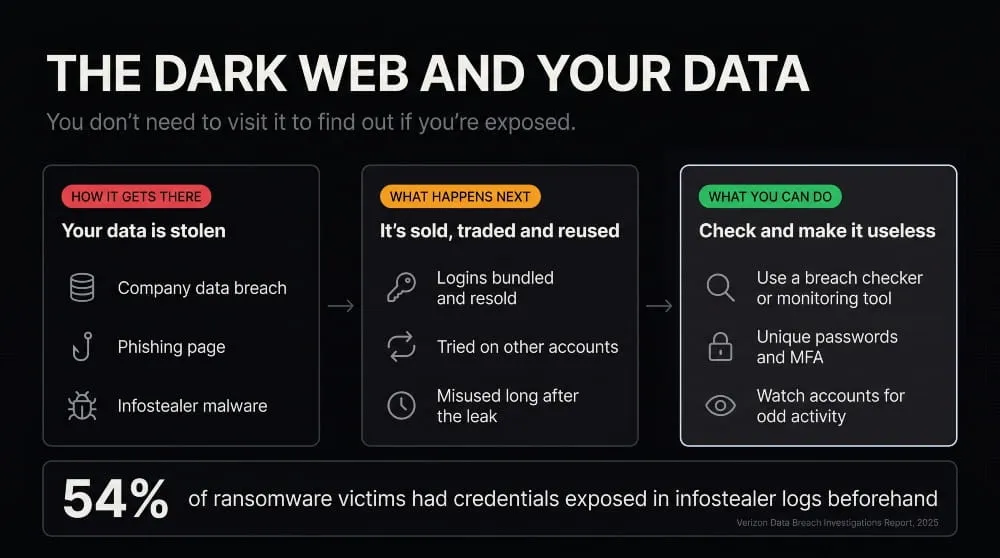
How Your Data Ends Up on the Dark Web
Most exposed data arrives in one of three ways. A company you use is breached and its customer records are copied. A phishing page tricks you into typing a password. Or infostealer malware on a device quietly collects saved logins, cookies and other data and sends it to criminals, who sell or trade it. The link to later attacks is well documented. Verizon’s 2025 breach report found that 54% of ransomware victims had credentials exposed in infostealer logs beforehand. Stolen logins are rarely used once. They are bundled, resold and tried against other accounts, which is why a single password reused across sites can cause damage long after the original leak.
How to Check Whether Your Information Is Exposed
You can check without ever opening a dark web site. Breach-checking tools and monitoring services compare your email address, phone number or other details against known leaked data and tell you what they find. For a step-by-step walkthrough, see is your information on the dark web. Be careful about which tools you rely on, because they change. Google stopped scanning for new dark web breaches on January 15, 2026, and retired its dark web report entirely on February 16, 2026, saying it hadn’t given people helpful next steps. A one-time scan only shows what was found at that moment, so it can miss data that leaks afterward.
What to Do If Your Data Is Found
Exposed data generally can’t be pulled back off criminal sites, so the goal is to make it useless. Change the password on the affected account and on any other account that shares it, switch to a unique password for every site with the help of a password manager, and turn on multi-factor authentication wherever it is offered. Watch your accounts for unfamiliar activity, and if government ID or financial details were exposed, consider fraud alerts or a credit freeze where your country offers them.
Dark Web Monitoring for Businesses
Dark web monitoring is a service that continuously watches dark web sources, leaked databases and infostealer logs for a company’s exposed credentials and data, then alerts the security team so they can act before attackers use it. For a business, the question is not whether to visit the dark web but how to find out quickly when its own information turns up there. This section is a short overview. For the full guide, see dark web monitoring.
What Dark Web Monitoring Covers
Monitoring usually focuses on the data that attackers can turn into access. That means employee and customer logins tied to a company’s domains, credentials captured by infostealer malware, leaked or breached databases, and mentions of the company, its domains or its executives on criminal forums and leak sites. When something matches, the service raises an alert so the team can reset the exposed credentials, end active sessions and check for signs of misuse. The value is speed, because stolen credentials are often tried within days of appearing.
Why Credential Exposure Matters for Businesses
Company credentials often leak from places the business doesn’t control. Verizon’s 2025 report found that among devices appearing in infostealer logs, 30% of corporate-managed devices and 46% of unmanaged devices contained company credentials. The gap shows how often work logins end up on personal or unmanaged devices, where the company has no visibility and no way to clean up an infection. A password manager or multi-factor authentication helps, but neither tells you that a credential has already leaked.
What Changes for MSSPs
For a managed security service provider, the problem repeats across every client. Each client has its own domains, employees and exposure, and checking them by hand doesn’t scale. Providers need monitoring that covers many clients from one place, keeps their data separate, produces reports for each client and can be offered under the provider’s own brand. That is the role of a dark web monitoring platform built for MSSPs, such as Mispar, a wholesale platform that MSSPs resell under their own name.
Dark Web in the News (2026)
Dark web news in 2026 follows a familiar pattern: law enforcement seizes marketplaces and prosecutes the people behind them, criminals relocate or relaunch, and the tools people use to check their own exposure keep changing. This section summarizes the most useful developments of the year and is meant to be refreshed as new cases emerge.
Law Enforcement Actions in 2026
Prosecutions from earlier takedowns are now reaching their final stages. On October 8, 2026, the co-creator of Empire Market, Raheim Hamilton, was reported to have been sentenced to 40 years in federal prison for running a marketplace that handled more than $430 million in illegal transactions. Sentences like this show that the people who run dark web markets are not beyond the reach of the courts, even years after the sites shut down. In Germany, the administrator of the first version of the Crimenetwork marketplace was sentenced in March 2026 to seven years and ten months in prison, and the market itself had come back online within days of its first shutdown before being targeted again. Reports also describe the FBI seizing the RAMP cybercrime forum in January 2026, though that is worth confirming against the FBI’s own release.
Trends to Watch
Two trends stand out. The first is fragmentation. Europol has observed that criminals are moving to smaller, independent shops to avoid fees and detection as large marketplaces come under pressure, which makes each takedown less decisive than it once was. The second is that trade in stolen credentials continues. Marketplaces that concentrate on breached credentials and stealer logs remain active in 2026, which keeps the risk of account takeover high for businesses and individuals alike. There was also a change in consumer tools: Google retired its dark web report on February 16, 2026, leaving people who relied on it to find another way to check for exposure.
How to Keep Up With Dark Web News
The most reliable updates come from the sources that make the announcements: law enforcement agencies such as Europol and the U.S. Department of Justice, and the Tor Project for changes to the technology. Security news sites summarize these developments, but their reports are not always consistent, so it is worth checking the original announcement for anything you plan to rely on. Businesses that need to know when their own data appears can use dark web monitoring rather than following the news, since the headlines rarely say whose information was exposed.
Frequently Asked Questions (FAQ)
What is the dark web?
The dark web is the part of the internet that can only be reached with anonymity software such as Tor and isn’t indexed by search engines. It is a small, intentionally hidden slice of the deep web, and it hosts both legitimate and illegal sites.
Is the dark web real?
Yes. It is a set of actual websites and services running on anonymity networks, and anyone with the right software can open them. Much of the folklore around it is exaggerated, but the sites themselves are real.
Is the dark web illegal?
No, not in most countries. Accessing the dark web is legal in nearly every country, including the U.S., UK, Canada, Australia and India. What is illegal is the activity, such as buying illegal goods or trading stolen data, and Tor is restricted in some countries.
Is the dark web dangerous?
It can be. The main risks are scams, fake sites, malware and exposure to illegal content, and there are no consumer protections if something goes wrong. Most of the danger comes from what you click, download or share.
Who created the dark web?
No single person did. Onion routing was developed in the 1990s by U.S. Naval Research Laboratory scientists Paul Syverson, Michael Reed and David Goldschlag. Tor, the software most people use to reach the dark web, grew out of that work and is now maintained by a nonprofit.
What is the difference between the dark web and the deep web?
The deep web is everything search engines don’t index, such as email inboxes, bank accounts and private databases. The dark web is a small, intentionally hidden part of it that needs special software to reach.
How much of the internet is the dark web?
No one knows exactly, and the often-quoted “5%” has no solid source. The Tor Project estimated in 2015 that about 3.4% of Tor client traffic went to hidden services, and Tor is itself a small part of the internet.
Can you be tracked on the dark web?
Yes, although it is difficult. Anonymity on the dark web is not guaranteed, and people are most often identified through their own mistakes, such as reusing usernames or passwords or sharing personal details.
What is on the dark web?
A mix of content. Legitimate sites include news mirrors, privacy tools and whistleblower portals, while the illegal side includes stolen data, fraud services and illicit marketplaces. Many pages are basic, slow or abandoned.
Is Tor the same as the dark web?
No. Tor is the technology and the dark web is the set of hidden sites you can reach with it. You can also use Tor to browse ordinary websites more privately, which is what many people do.
How do I know if my information is on the dark web?
You don’t need to visit it. Breach-checking tools and monitoring services compare your email, phone number or other details against known leaks and report matches. Google retired its own dark web report on February 16, 2026, so use a current tool.