
Password spraying is an attack that tries one or a few common passwords against many accounts instead of many passwords against one account, keeping each account below lockout thresholds. It works because, in any large enough organization, a few people use predictable passwords, and some have no multi-factor authentication (MFA). This guide explains how a password spraying attack works, how it differs from credential stuffing and brute force, how to detect it in your logs, and how to shut it down.
What Is Password Spraying?
Password spraying meaning and definition in plain terms
Password spraying is a login attack in which an attacker tries a small set of very common passwords, such as a season plus a year or “Welcome1”, against a long list of usernames. Attempts are spread across accounts rather than concentrated on one, so each account sees only a failed login or two. The definition comes down to three traits: many accounts, few passwords, and low volume per account.
Password spray attack vs password spraying attack (same thing, different phrasing)
“Password spray attack” and “password spraying attack” describe the same technique. People say “spray” as a noun and “spraying” as the activity, and hyphenated versions such as “password-spraying attack” mean the same thing. Security frameworks, including MITRE ATT&CK, track it as a single technique regardless of the wording used in a report or alert.
Password spraying in cyber security: where it fits in an attack
In cybersecurity, password spraying is an initial access technique: its goal is a first valid login. MITRE ATT&CK lists it as a sub-technique of brute force under the credential access tactic. Once an attacker holds a working account, they typically read email, look up directory information, send internal phishing, and move toward more valuable systems.
Why attackers choose one password against many accounts
Account lockout policies count failed attempts per account, so one guess per account never trips them. The attacker is betting on volume across a population rather than strength against a single target: among thousands of users, a few will use a guessable password. The method needs no leaked data, costs almost nothing to run, and can be spread across many IP addresses.
How a Password Spraying Attack Works
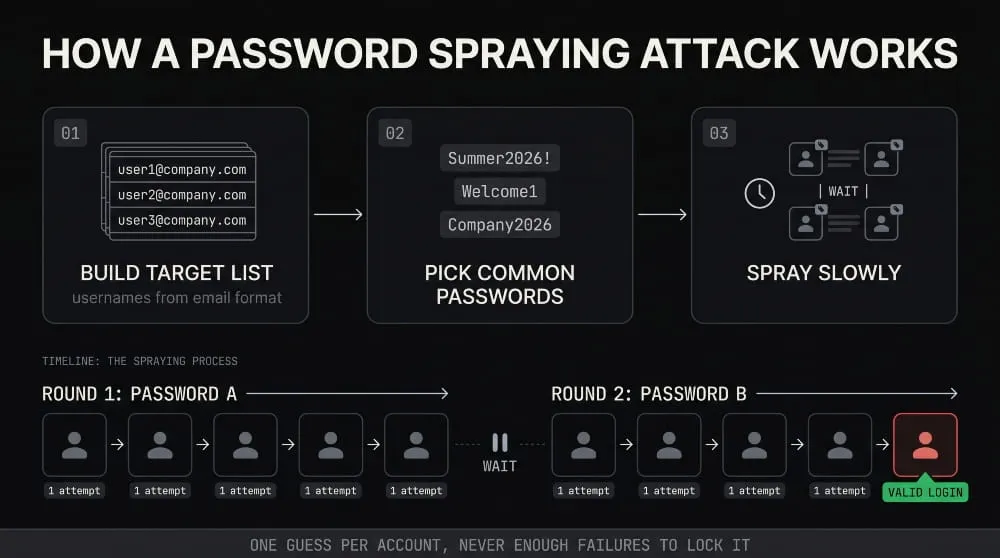
Step by step: target list, common password list, slow, low-volume attempts
A spraying attack follows three stages. First, the attacker builds a list of valid usernames, often from a company’s email format, public profiles, or earlier breaches. Second, they pick a short list of likely passwords, such as seasonal patterns, company names with a year, and common variants like “Password1” that satisfy typical complexity rules. Third, they try one password across every account, wait, then try the next. Any pair that succeeds becomes a working login.
Why it avoids account lockouts and rate limits
Lockouts count failures per account, so a single attempt per round stays below the threshold. The pause between rounds lets the counter reset, and sending attempts from many addresses, such as proxies or cloud hosts, sidesteps per-IP rate limits. Each failed login looks like a typo, so the traffic blends in.
Common targets (cloud logins, VPNs, remote access, email)
Attackers aim at internet-facing services that accept a username and password. The usual targets are cloud identity providers and email platforms (Microsoft 365, Google Workspace, Okta), VPN and remote access gateways, remote desktop and virtual desktop portals, and single sign-on pages. Endpoints that respond differently for valid and invalid usernames are especially attractive because they let the attacker confirm which accounts exist.
A simple password spraying example
Suppose an attacker has collected 5,000 email addresses for a mid-size company. They try one password, such as the current season and year, against every address and record which logins succeed. They then wait an hour and try a second password. Even if only a handful of employees used either one, the attacker now has valid accounts, and no single user saw more than a couple of failed sign-ins.
Password spraying technique variations
The core idea stays the same, but operators adjust it. Low-and-slow spraying stretches attempts over days to avoid detection. Distributed spraying rotates source IPs for every request. Some attackers validate usernames first to avoid wasting attempts on non-existent accounts, while others tailor passwords to the target using the company name, location, or recent events. After a hit, many follow up with MFA prompt fatigue or MFA method changes.
Password Spraying vs Credential Stuffing vs Brute Force
Password spraying vs credential stuffing
Credential stuffing replays real username-password pairs leaked from other breaches, while password spraying guesses common passwords without any known pair. Stuffing succeeds through password reuse; spraying succeeds through weak or predictable passwords. Defenders see them differently, too: stuffing arrives with many different passwords per account, while spraying uses the same password across many accounts. For a full breakdown of the first attack, see credential stuffing.
Password spraying vs brute force
Brute force throws many guesses at one account, which is loud and quickly triggers lockouts. Password spraying inverts that pattern: it makes very few guesses per account but covers many accounts. MITRE ATT&CK classifies spraying as a sub-technique of brute force, so the two are related, but their traffic patterns and the controls that stop them differ.
Password spraying vs dictionary attack
A dictionary attack tries words from a large list against a target, and it can run offline against stolen password hashes. Password spraying uses a very short list of likely passwords and always runs online against a live login. The dictionary attack depends on the list’s size and quality; spraying depends on how many accounts it can reach.
Side-by-side comparison table
| Attack | What the Attacker Uses | Attempts Per Account | Where It Runs | What It Exploits |
|---|---|---|---|---|
| Password spraying | A few common passwords | One or two per round | Online, against many accounts | Weak, predictable passwords |
| Credential stuffing | Leaked username and password pairs | Usually one pair per account | Online, against many accounts | Password reuse across sites |
| Brute force | Every possible or generated guess | Thousands | Online or offline, one account at a time | Short or simple passwords |
| Dictionary attack | A wordlist of likely passwords | Many | Online or offline | Passwords built from real words |
Why Password Spraying Still Works
Weak and predictable passwords
Password spraying still works because people choose passwords in predictable patterns. Complexity rules produce a capital letter, a number, and a symbol attached to a common word, and a season-plus-year or company-name pattern is easy to guess. Across thousands of accounts, a few users will land on the attacker’s short list.
Missing multi-factor authentication
An account without MFA relies on a password alone, and that gap is how a well-known intrusion began. In January 2024, Microsoft disclosed that the Russian state-sponsored group Midnight Blizzard used password spraying to compromise a legacy, non-production test tenant account without MFA, then used that foothold to reach corporate email accounts. Even a forgotten account can become the way in.
Exposed login portals and legacy authentication
Legacy authentication protocols, such as basic authentication for older email clients, cannot prompt for MFA, so spraying them bypasses MFA policies that protect modern sign-in. Forgotten test tenants, old VPN gateways, and unused portals add more exposed login surfaces. Every internet-facing page that accepts a password is a place an attacker can spray.
Why low-and-slow attempts slip past basic alerting
Most alerting counts failed logins per account or per source address. A spray produces one or two failures per account from many sources, so neither count looks abnormal. Catching it requires correlating failures across accounts, which basic lockout and per-account alerts never do.
How to Detect Password Spraying
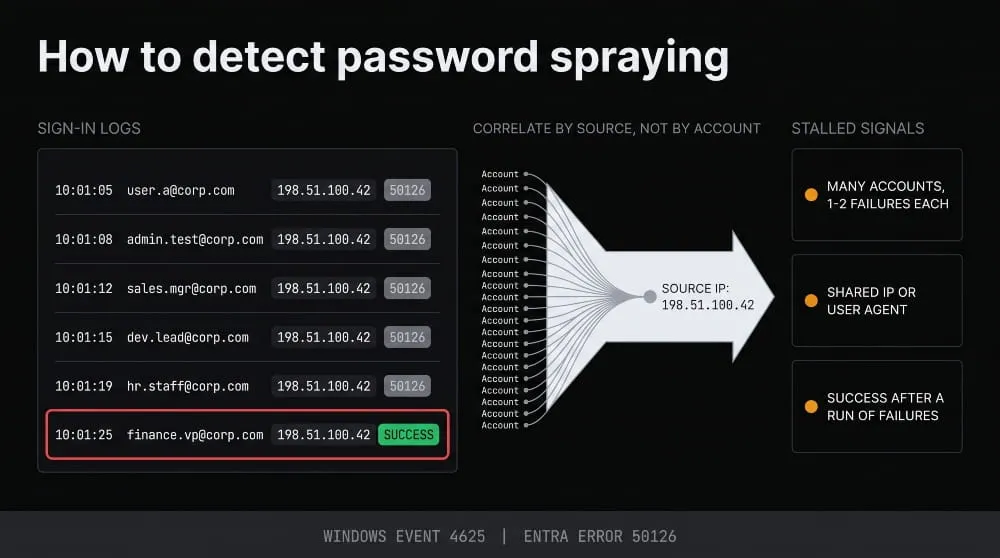
Signs of a password spray attack (many accounts, few attempts each, shared IP or user agent)
The strongest indicator is many different accounts each showing one or two failed sign-ins in a short window. Other signs include the same password pattern across accounts, a shared source IP, network, or user agent, failures against non-existent usernames, and a single success from the same source right after a run of failures. Activity over legacy protocols or at unusual hours adds further weight.
Password spray attack detected: what the logs show
On Windows, a spray appears as failed logon events (event ID 4625) across many usernames from one source. In Microsoft Entra ID sign-in logs, it appears as a cluster of invalid username or password errors (error code 50126) spread across many users. The highest-priority pattern is a successful sign-in from the same source shortly after failures against other accounts, because it suggests that one guess landed.
Detection approaches (identity provider sign-in logs, SIEM correlation, failed-login baselines)
Start with identity provider sign-in logs, since they see every authentication attempt. In a SIEM, write correlation rules that count distinct accounts failing per source, user agent, or time window rather than failures per account. Baselines of normal failed-login rates make bursts stand out, and built-in identity risk detections can automatically flag spray patterns.
A password spray attempt involving one user vs many users
A burst of failures against a single account usually points to brute force or a forgotten password, while shallow failures across many accounts point to spraying. Some spraying targets only a few high-value accounts, such as administrators or executives, so look at the source’s behavior across the whole environment rather than at one victim alone.
How to Prevent and Mitigate Password Spraying
Password spraying attack prevention basics (MFA, strong password policy, banned-password lists)
The most effective prevention is MFA on every account, starting with administrators, email, and remote access, with phishing-resistant methods where possible. Pair it with long passwords, a banned-password list that blocks common and previously breached passwords, and unique passwords for every account. NIST’s digital identity guidance (SP 800-63B) recommends screening new passwords against lists of known compromised and commonly used passwords.
Smart lockout and conditional access controls
Smart lockout, such as Microsoft Entra smart lockout, distinguishes sign-ins from familiar locations from attacker sign-ins, so it can block the attacker without locking out the real user. Conditional access adds another layer by requiring MFA or a compliant device for risky sign-ins and blocking access from unexpected countries or networks.
Block legacy authentication and limit exposure
Disable legacy and basic authentication protocols so that MFA applies everywhere. Retire unused portals and test tenants, place remote access behind single sign-on with MFA, restrict access by network where that is practical, and avoid login pages that reveal whether a username exists. Reducing the number of places an attacker can try a password reduces the attack surface.
How to protect yourself as an individual user
Use a long, unique password for each account, stored in a password manager, so a single guessable password can’t unlock anything else. Turn on MFA, preferably through an authenticator app or passkey rather than text messages, and be suspicious of unexpected sign-in prompts you didn’t start.
Responding to a confirmed password spraying attack
First, identify every account that successfully logged in from the attacking source. Force password resets and revoke active sessions and tokens for those accounts. Then check for attacker persistence: new mailbox rules, newly granted application permissions, and changed MFA methods. Block the offending sources, remembering they often rotate; extend your log review window to find earlier activity; and close the gap that allowed the attack, usually missing MFA or an exposed legacy protocol.
Password Spraying in MITRE ATT&CK and CISA Guidance
MITRE ATT&CK technique and the valid accounts connection
MITRE ATT&CK tracks password spraying as T1110.003, a sub-technique of brute force (T1110) in the credential access tactic. A successful spray leads to the Valid Accounts technique (T1078), where the attacker uses legitimate credentials for initial access, persistence, or privilege escalation. The framework recommends MFA, account lockout and use policies, and strong password policies, with detection through authentication log analysis.
What CISA’s password spraying guidance recommends
A joint advisory from CISA, NSA, FBI, and the UK’s NCSC in July 2021 described a Russian military intelligence brute force campaign that used password spraying against enterprise and cloud environments. Its recommendations center on MFA, strong passwords, time-out and lockout controls, monitoring for abnormal failed logins, and network segmentation. The same advice applies to most organizations today.
NIST definitions and how they line up
NIST’s published definitions describe the same pattern: a small number of common passwords tried across a large number of accounts. Its digital identity guidelines add the defensive side, calling for rate-limiting failed attempts and screening passwords against known weak and breached lists. MITRE, CISA, and NIST all point to the same core defenses of MFA, throttling, and strong password hygiene.
Password Spraying and Compromised Credentials
What a successful spray gives an attacker
A successful spray gives the attacker a valid username and password, and in the logs, that attacker now looks like a legitimate employee. That access can mean reading email, viewing the company directory, sending convincing internal phishing, or reaching cloud files and applications. It is usually the first step, not the goal.
How sprayed accounts feed later attacks
A single compromised account often becomes a foothold for lateral movement, privilege escalation, data theft, or ransomware, and attackers may reuse or sell the harvested credentials. What happens after an account is taken over is covered in compromised credentials and credential theft.
Why exposed credentials make spraying more effective
Previously leaked passwords show attackers which patterns real employees choose, and exposed usernames and email formats give them accurate target lists. Spraying built on that knowledge hits more often than guessing blind. If your organization’s credentials are already circulating, you are easier to target, which is why leaked credentials matter before and after an attack.
Password Spraying Defense for MSSPs and Client Environments
Why spraying is hard to spot across many client tenants
Each client tenant sees only a handful of failed logins, below any per-tenant alert threshold, while the same infrastructure may hit dozens of clients at once. Every tenant also has its own baseline, so what is normal for one is suspicious for another. Spotting a spray across a client base requires correlating source addresses, user agents, and timing across tenants.
Combining sign-in log monitoring with credential exposure monitoring
Sign-in logs show an attack as it unfolds, while credential exposure monitoring shows which accounts and password patterns are already circulating, and therefore which accounts are most likely to fall. Used together, they let an MSSP prioritize the accounts at greatest risk before and during an attack. Credential exposure monitoring supplies the second half of that picture.
What to report to clients after a spraying attempt
A useful client report covers what was observed (the time window, number of targeted accounts, and source), whether any attempt succeeded, what was done in response (resets, session revocation, blocks), and which gap was closed, such as enforcing MFA or turning off legacy authentication. It should end with clear follow-up recommendations. For MSSPs that need to deliver this under their own brand across many clients, Mispar provides the monitoring layer.
Password Spraying FAQs
What is password spraying in simple terms?
Password spraying is trying one or a few common passwords against many accounts instead of many passwords against one. Because each account sees very few failures, normal lockout rules don’t trigger.
Is password spraying the same as brute force?
No, but they are related. Brute force makes many guesses against one account, while password spraying makes very few guesses against many accounts. MITRE ATT&CK treats spraying as a sub-technique of brute force.
What’s the difference between password spraying and credential stuffing?
Credential stuffing uses real username-password pairs leaked from other breaches, while password spraying guesses common passwords without a known pair. Stuffing exploits password reuse; spraying exploits weak passwords.
How do attackers choose passwords for a spray?
They pick passwords that many people are likely to use: seasonal patterns with a year, the company name, and simple variants like “Welcome1” that satisfy complexity rules. Some tailor guesses to the target’s name, location, or recent events.
Does MFA stop password spraying?
MFA stops most of the damage, because a correct password alone no longer grants access. It doesn’t stop the guessing itself, and it leaves gaps wherever legacy authentication or unprotected accounts bypass it, so pair MFA with banned-password lists and legacy authentication blocks.
How do I know if I’m being password sprayed?
Look for many different accounts with one or two failed sign-ins each in a short window, often from a shared IP address or user agent. A successful login from that same source after those failures is the strongest warning sign.
Why don’t account lockouts stop password spraying?
Lockouts count failed attempts per account, and a spray makes only one or two attempts per account before moving on. The attacker waits between rounds so the counters reset, keeping every account below the threshold.
What does MITRE ATT&CK say about password spraying?
MITRE ATT&CK lists password spraying as T1110.003, a sub-technique of brute force within credential access. It recommends MFA, account lockout and use policies, and strong password policies as mitigations, and it advises detecting spraying through analysis of authentication logs.