
No, Telegram is not part of the dark web. It is a regular messaging app that runs on the open internet, while the dark web is a set of hidden services you can reach only through special software like Tor. The confusion exists because criminals use both, and some Telegram channels behave a lot like dark web marketplaces.
What the dark web actually is
The dark web is the portion of the internet that is intentionally hidden and reachable only through anonymizing networks, most commonly Tor. Its sites use .onion addresses that don’t resolve in a normal browser, aren’t indexed by mainstream search engines, and conceal both the visitor’s and the host’s locations by routing traffic through multiple relays. Anonymity is the defining feature, which is why the dark web hosts both legitimate privacy tools and illegal marketplaces. For details on access mechanics and legality, see how to access the dark web.
What Telegram actually is
Telegram is a cloud-based messaging platform you access through a standard app or website, using a phone number to create an account. Anyone can download it from a standard app store, and its servers sit on the clearnet like any other consumer service. Telegram announced in March 2025 that it had passed one billion monthly active users, making it one of the world’s largest messaging platforms. Its scale is the first reason it attracts both everyday users and bad actors.
Why people call Telegram “the new dark web”
People use that label because certain Telegram channels offer what dark web markets do: stolen data, fraud services, and illicit goods, with less friction. Channels can be created in seconds, grow to thousands of members, and are reachable from a phone without installing anything unusual. The comparison describes what is sold there, not the technology underneath. Telegram remains a clearnet app, and the “dark web” label is shorthand for a behavior, not a technical category.
How Telegram and the Dark Web Compare
The two differ most in how people reach them, how anonymous participants really are, and how easily content gets removed. Telegram is far easier to use and far less anonymous than Tor, which shapes what criminals do on each.
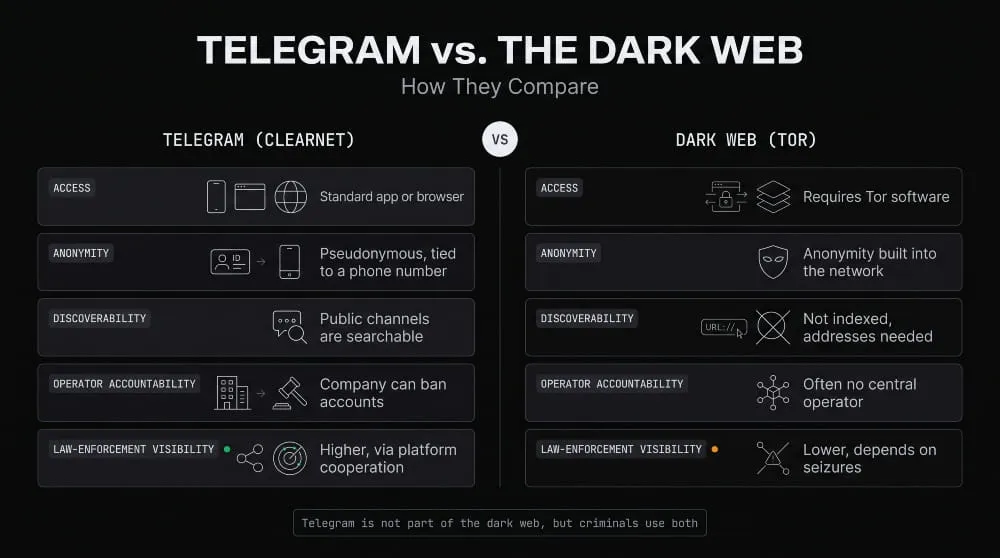
Access and anonymity
Reaching the dark web requires Tor or a similar tool, and it shields a visitor’s identity by design. Telegram requires an account tied to a phone number, though users can hide that number from other members and operate under a public username. That is pseudonymity, not true anonymity, because Telegram itself holds the underlying account data. In September 2024, Telegram updated its policy to say it may share a user’s IP address and phone number with authorities in response to valid legal requests, which narrowed the gap between “private” and “traceable.”
Public channels vs. private groups vs. hidden services
Telegram has three main structures. Public channels are searchable and open to anyone, private groups require an invite link, and hidden services on the dark web are unreachable without the right software and the exact address. On Telegram, you can find a public channel through the app’s search, while invite-only groups spread by link through other channels. On the dark web, nothing is discoverable through normal search, which is why directories and word of mouth matter there.
Moderation and takedowns
Telegram can and does ban channels, though enforcement has historically been uneven and slow, and banned channels often reappear under new names. Dark web sites have no central operator to appeal to, so takedowns usually depend on law enforcement seizing servers or arresting administrators. In both cases, content tends to resurface, but Telegram has a company it can compel to act, while a Tor hidden service often has no such pressure point.
Comparison table
| Factor | Telegram | Dark Web (Tor) |
|---|---|---|
| Access | Standard app or browser, phone number required | Requires Tor or similar software |
| Anonymity | Pseudonymous, account tied to a phone number | Anonymity built into the network |
| Discoverability | Public channels are searchable in-app | Not indexed, requires known addresses |
| Typical content | Everything from news to leaked data and scams | Mix of privacy services and illicit markets |
| Operator accountability | Company can ban accounts and respond to legal requests | Often no central operator to pressure |
| Law-enforcement visibility | Higher, through platform cooperation | Lower, depends on seizures and investigations |
What Gets Traded in “Dark Web” Telegram Channels
The illicit material on Telegram is dominated by stolen data and fraud services, the same categories that fill dark web marketplaces. Understanding the categories matters more than knowing any particular channel, because the channels change constantly.
Leaked data and stolen credentials
Some channels post or sell breach data, including email and password pairs, customer databases, and internal documents. Posts range from free samples used to advertise a larger dataset to complete dumps. For organizations, the practical risk is that credentials tied to their domains circulate here, sometimes before a breach is publicly known.
Infostealer logs and combolists
Infostealer logs are files malware harvests from infected devices, containing saved passwords, browser cookies, and session tokens. Combolists are large compilations of credentials assembled from many sources and used for credential-stuffing attacks. Telegram has become a common distribution channel for both because it lets attackers share files instantly with large audiences. Session tokens in these logs can be especially damaging because they may bypass passwords and even multi-factor authentication.
Fraud services and scams
Other channels advertise fraud tooling and services, such as phishing kits, fake document generation, and account takeover services. A large share of the activity is also scams aimed at the channel’s own members, including fake sellers who take payment and never deliver. Anyone assuming the sellers in these spaces are trustworthy is the most likely victim.
Why channels appear, vanish and reappear.
Channels rarely last. When Telegram bans one or an administrator abandons it, the same operators typically create a new channel and announce it through backup channels, so the same activity keeps moving between names. That churn is why lists of “top channels” go stale within weeks, and why monitoring by topic and by exposed data is more reliable than tracking any individual channel.
Why Criminals Use Telegram Alongside the Dark Web
Criminals use Telegram because it is easier, faster, and more convenient than the dark web, not because it is more secure. Most operations use both: the dark web for durable infrastructure, Telegram for reach and speed.
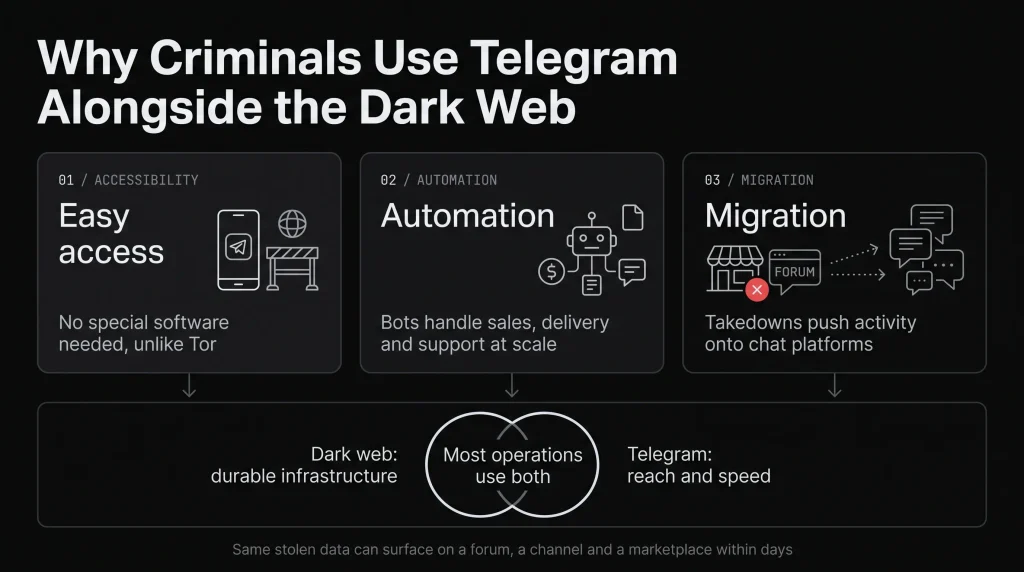
Ease of access vs. Tor
Setting up Tor, finding trustworthy addresses, and navigating slow, unreliable sites is a barrier. Telegram removes it. A seller can reach thousands of potential buyers through an app they already have, lowering the skill level needed to participate and widening the pool of both sellers and buyers.
Bots and automation
Telegram’s bot system lets operators automate sales, delivery, and customer service. A bot can accept payment, check whether a stolen credential still works, or deliver a file on request without a human involved. That automation is a major reason low-skill actors can run fraud operations at scale.
Migration from forums and marketplaces
As law enforcement has taken down major dark web marketplaces and forums, activity has fragmented, and some of it has moved to chat platforms. Telegram is an attractive landing spot because communities can reform quickly after a takedown. The result is an ecosystem where the same stolen data may appear on a dark web forum, a Telegram channel, and a private marketplace within days.
Risks of Joining or Searching for These Channels
Joining these channels exposes you to legal, technical, and personal risk, and the people most at risk are usually the curious, not the criminals. Even someone with research intentions should understand what they’re walking into.
Legal exposure
The law varies by country, but the pattern is consistent. Reading a public channel is generally not a crime by itself, while downloading, possessing, buying, or using stolen data, access credentials, or illegal material often is. Material involving the sexual exploitation of children is illegal to access or hold almost everywhere, and merely opening it can create serious liability. Researchers and journalists who need to review this material should work within a legal and organizational framework, not on a personal account. If you are unsure, assume that interacting beyond passive reading carries risk.
Malware and scam links
Files and links shared in these channels are a common route for malware delivery. A “free database” or “cracked tool” may be an infostealer aimed at the person downloading it, so people hunting for stolen credentials often end up with their own credentials stolen. Fake sellers and “recovery” services add a layer of straightforward financial scams on top.
Doxxing and account compromise
Joining a channel can expose your username, profile photo, and phone number to other members, and some participants actively collect that information. Accounts that interact with these groups can be targeted for phishing, harassment, or takeover. Anything shared in a group, including screenshots and files, is outside your control the moment you post it.
What This Means for Businesses and MSSPs
For businesses and MSSPs, the practical lesson is that stolen credentials may surface on chat platforms before they appear anywhere else, so monitoring that only covers the dark web leaves a gap. The threat is concrete: the data that matters is employee and client credentials, not the platforms themselves.
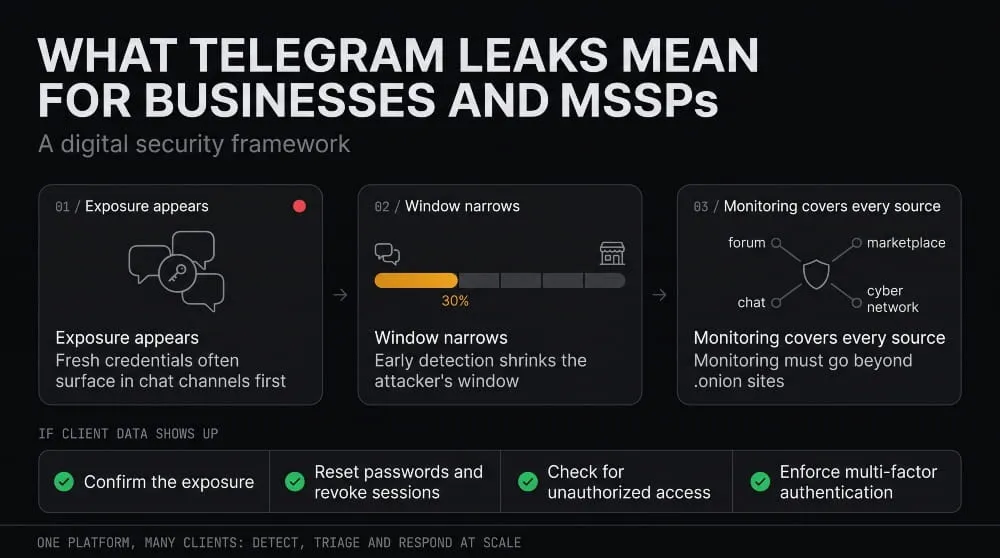
Credentials leaked on Telegram before they reach marketplaces.
Fresh infostealer logs and breach samples are often shared in chat channels shortly after collection, while the credentials are still valid. By the time the same data is packaged and sold on a marketplace, it may be older and already partially exploited. Early detection in the channels where data first appears narrows the window attackers have to use it.
Why monitoring needs to cover chat platforms, not just .onion sites
An approach that scans only .onion sites misses where a large share of this activity now happens. Effective dark web monitoring must follow data across forums, marketplaces, and chat platforms, and match what it finds against the domains and identities a client actually owns. The goal isn’t to watch every channel, but to detect when your clients’ credentials appear in any of them and turn that into a prioritized alert.
What to do if your data shows up
If a client’s credentials appear, the sequence is the same regardless of where they were found: confirm the exposure is genuine, force password resets and revoke active sessions for affected accounts, check for signs of unauthorized access, and make sure multi-factor authentication is in place. For MSSPs, the harder part is doing this consistently across many clients. A platform with continuous dark web monitoring built for multi-tenant use lets you detect exposures across your whole client base, triage them by severity, and respond under your own brand. Explore how that works at Mispar.
How to Report Illegal Content on Telegram
You can report illegal content directly in the app and, for serious cases, to authorities. In Telegram, open the channel or message, tap Report, and select the category that fits, such as spam, violence, illegal goods, or child abuse. Telegram also accepts reports at [email protected]. For child sexual abuse material, Report to your national hotline or reporting body, such as the NCMEC CyberTipline in the United States or the Internet Watch Foundation in the UK, and do not download, forward, or screenshot the material. For fraud or stolen data, report to local law enforcement or your national cybercrime reporting service, and notify any affected organization directly.
Frequently Asked Questions (FAQ)
Is Telegram on the dark web?
No. Telegram is a clearnet service reached through a standard app or website, not through Tor or .onion addresses. Some illicit activity that once lived on the dark web now also happens on Telegram, but the platform itself is not part of the dark web.
Is Telegram safe to use?
Telegram is safe for ordinary use, but its privacy is more limited than many people assume. Regular chats are stored on Telegram’s servers and are not end-to-end encrypted by default, and only one-to-one “secret chats” use end-to-end encryption. Groups and channels are not end-to-end encrypted. Safe use also means being cautious with unknown links, files, and strangers.
Can you be tracked on Telegram?
Yes. Telegram stores account data tied to a phone number, and the company says it may share IP addresses and phone numbers with authorities in response to valid legal requests. Hiding your number from other users limits what members can see, but it does not make you anonymous to the platform.
Is it illegal to join these channels?
It depends on the jurisdiction and on what you do. In many places, joining or reading a public channel is generally not illegal in itself, but downloading, possessing, buying, or using stolen data or illegal material often is, and some content is illegal to access at all. This is general information, not legal advice, so if you are researching these spaces professionally, get guidance from a qualified lawyer first.
How is Telegram different from Tor?
Tor is an anonymity network that hides your location and routes traffic through relays to reach hidden .onion sites, while Telegram is a messaging app that requires an account tied to a phone number. Tor is built for anonymity, and Telegram is built for convenience and scale, so they attract different levels of risk and different kinds of activity.