
Dark web forums are discussion communities hosted on anonymity networks such as Tor, where members trade information, tools, and stolen data under pseudonyms. They matter to security teams because stolen credentials and access often surface in these communities before the victim knows a breach happened.
What Are Dark Web Forums?
Dark web forums defined (and how they differ from surface-web forums)
A dark web forum is an online discussion board reachable only through anonymity software, usually Tor, rather than a standard browser and public DNS. Structurally, it looks like any other forum, with threads, private messages, user profiles, and moderators. The difference is the environment. Members are pseudonymous, the host is hidden, and much of the content would be removed or prosecuted on the surface web.
How they’re hosted: onion services, invite-only access, and clearnet-adjacent forums
Most dark web forums run as onion services, meaning the server’s location is concealed, and the address ends in .onion. Access ranges from fully open registration to invite-only or vetted membership, where a new user needs a sponsor, a fee, or proof of reputation. A third group is clearnet-adjacent. These are forums reachable on the ordinary web, sometimes with an onion mirror, which blurs the line between “dark web” and “criminal forum.” For security purposes, the hosting model matters less than what is being traded and who can see it.
Dark web forum vs. dark web marketplace vs. dark web site
A forum is for discussion, a marketplace is for transactions, and “dark web site” is the umbrella term covering both plus everything else on anonymity networks. Marketplaces list goods with prices and checkout flows. Forums are where people debate, vet, recruit, and negotiate, and they often host the reputation systems marketplaces rely on. Many ordinary dark web sites, such as news mirrors and privacy tools, are not criminal. For the broader category, see dark web sites.
Why forums persist as the social layer of the dark web
Forums persist because anonymous commerce still needs trust, and trust needs a place to build reputation, share reviews, and settle disputes. A marketplace alone cannot do that. Forums also serve as the knowledge base where less skilled actors learn techniques from more skilled ones. That is why forums tend to outlast individual marketplaces, and why law enforcement and threat researchers treat them as intelligence sources.
Types of Dark Web Forums
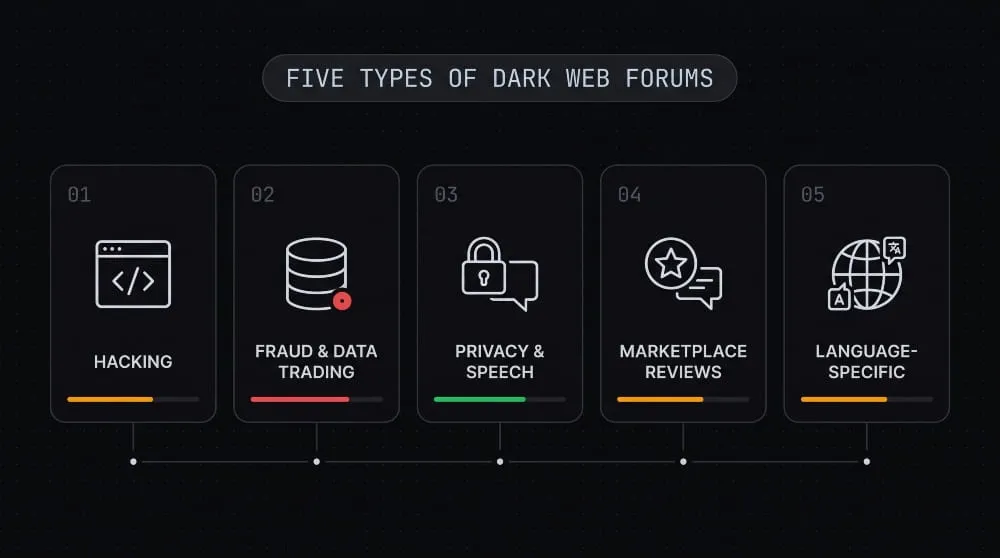
Hacking and hacker forums
Hacking forums focus on technical tradecraft, including exploit discussion, malware development, tooling, and vulnerability research. Some are skills-sharing communities where members teach and learn. Others are commercial, with members selling access, tools, or services. Researchers watch these communities because new attack techniques often appear there before they show up in public incident reports.
Fraud and data-trading communities
Fraud-focused communities center on monetizing stolen data, such as compromised accounts, payment data, and personal records. This guide describes the category only. Naming specific communities or explaining how to reach them would serve the people these communities protect, not the organizations they target. Defensively, what matters is that these communities create a market for any credential or record that leaks from a business.
Privacy, anonymity, and political-speech communities
Not every dark web forum is criminal. Many exist for privacy tooling, whistleblower discussion, journalism, and political speech in places where open discussion is dangerous. They share the technical infrastructure but not the intent, and that distinction is why “dark web” and “illegal” are not synonyms.
Marketplace discussion and review forums
Some forums exist mainly to discuss marketplaces, covering vendor reviews, scam warnings, uptime reports, and reputation checks. They act as informal consumer-protection layers inside illicit commerce. For researchers, they also show which marketplaces are active, which have collapsed, and where activity is migrating.
Language-specific communities (Russian-language and others)
Many cybercrime communities are organized by language, and Russian-language forums have long been a major part of the ecosystem for ransomware, access brokering, and malware development. Chinese-language, Portuguese-language, and other regional communities exist with their own norms and specialties. Language gating works as a trust filter, and it is one reason monitoring only English-language sources leaves large gaps.
Top Dark Web Forums in 2026
The most frequently cited dark web forums in threat intelligence reporting are Dread, Exploit, and XSS, along with forums law enforcement has recently seized, including LeakBase and RAMP. The list changes quickly, so treat it as a snapshot of what researchers track rather than a ranking of where to go.
How researchers decide which forums matter
Threat analysts weigh a forum by its influence on the cybercrime economy, not by its size. They ask whether it hosts stolen data or network access that affects real organizations, whether it sets norms for other communities, and whether disrupting it changes attacker behavior. A forum with a small, vetted membership can matter more than a large open one.
Dread
Dread is a long-running discussion hub, often compared to Reddit, where members talk about darknet marketplaces, vendor reputations, and privacy. It is mainly a social and reputation layer, not a place to buy data directly. Researchers follow it for early signals about marketplace activity and shifts in the wider ecosystem.
Exploit
Exploit is a long-running Russian-language forum focused on malware, access sales, and technical tradecraft. A Flare analyst described it and XSS as the backbone of the high-level Russian-speaking cybercriminal ecosystem. It is monitored mainly because access brokers advertise there.
XSS
XSS, formerly known as DaMaGeLaB, was a Russian-speaking cybercrime platform whose suspected administrator was arrested in Kyiv on July 22, 2025. Ukrainian, French, and Europol authorities carried out the arrest, and the forum had more than 50,000 registered users. KELA data put its registered users at 48,750 with over 110,000 threads, and noted that its reputation and escrow systems were designed to reduce scams between criminals. It is a clear example of how disruption of one forum redistributes its members to others.
Recently seized forums: LeakBase and RAMP.
RAMP launched in July 2021 after Exploit and XSS banned ransomware advertising, and became a hub where ransomware groups recruited affiliates and traded access. The FBI seized RAMP in January 2026, replacing both its Tor and clearnet sites with a seizure notice.
LeakBase, an English-language forum for stolen databases and hacking tools, was dismantled in March 2026 through Europol-coordinated “Operation Leak” involving 14 countries. The Department of Justice reported over 142,000 members. Authorities seized the forum’s database, which allowed investigators to deanonymize users who believed they were anonymous.
BreachForums and the cycle of relaunches
BreachForums is the standard example of repeated disruption and revival. The name has been seized, shut down, and relaunched several times, often by new operators who borrow its reputation. Treat any version you see cited as current as unverified and possibly law-enforcement controlled.
What this landscape means for organizations
The takeaway is not which forum is biggest. Stolen credentials, databases, and network access move between communities and survive the closure of any single one. A seizure removes a venue but not the data already copied from it, which is why continuous coverage of many sources matters more than any one forum. For how that coverage works, see dark web monitoring and Mispar’s monitoring feature.
How Dark Web Forums Work
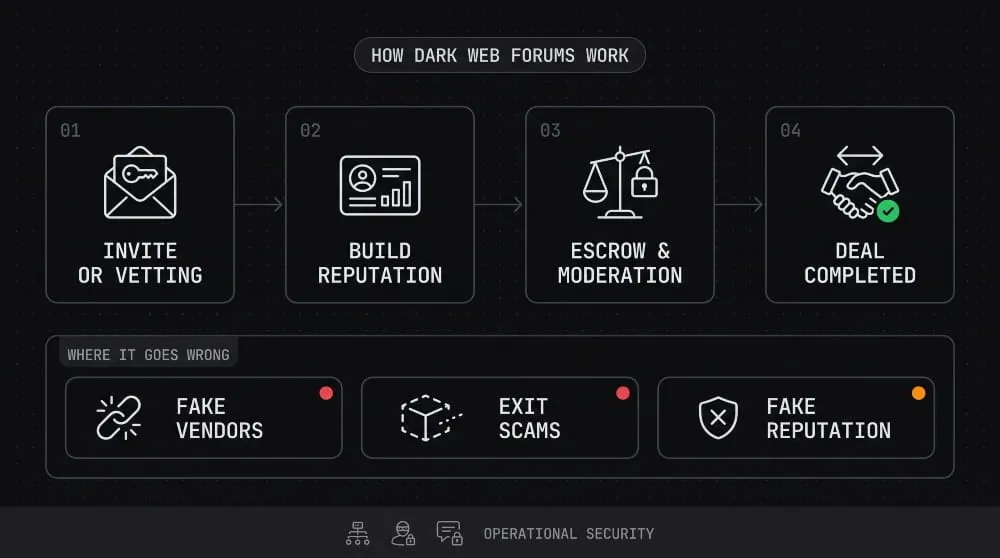
Registration, invite systems, and reputation scores
Registration ranges from open signup to vetted membership. Higher-trust communities often require an invitation, a deposit, or a demonstration of skill or standing. Once inside, members build reputation through post counts, vouches, verified sales, and moderator endorsements. That reputation is the community’s main asset, which is why it is guarded and why it is a recurring target of impersonation.
Moderation, escrow, and dispute-handling norms
Moderators enforce rules, ban scammers, and rule on disputes, much as on any large forum. Many communities provide escrow, where a trusted third party holds payment until both sides confirm delivery. Arbitration threads let buyers and sellers present evidence to staff. These norms mimic legitimate commerce because the participants cannot rely on courts, so they build internal substitutes.
Why scams and exit-scams are common even inside criminal communities
Scams are common because no one can sue anyone. Fake vendors, fake escrow, and fabricated reputation are routine, and even a trusted operator can run an exit scam by taking deposits and disappearing. Communities respond with vetting and public blocklists, but the incentives never go away. Threat researchers use this to remind organizations that a claimed leak on a forum isn’t automatically real, and that claims need validation.
Operational security: why members use anonymity tools
Members use anonymity tools because exposure carries real legal risk. Typical practices include Tor access, separate pseudonyms per community, encrypted messaging, and cryptocurrency payments. The same discipline also slows law-enforcement operations against forums, which usually rely on mistakes, infiltration, or seized infrastructure rather than breaking the anonymity itself.
What Gets Discussed and Traded
Stolen credentials and data leaks
Stolen credentials are among the most commonly traded items. They appear as combo lists, database dumps, and sample posts advertising larger sales. For organizations, the exposure is rarely a single leaked password. It is the chain of reuse that follows, because one exposed login can unlock several systems when employees recycle credentials.
Initial access and infostealer logs
Initial access listings advertise a foothold in a company, such as a VPN login or remote desktop credential, usually sold to someone else who will carry out the attack. Infostealer logs are the raw output of malware that harvests saved passwords, cookies, and session tokens from infected devices. They matter because a stolen session token can bypass multi-factor authentication, so a password reset alone may not close the exposure.
Tools, exploits, and tradecraft discussions.
Beyond data, forums host discussion of exploits, malware builders, phishing kits, and evasion techniques. Much of this is knowledge-sharing rather than direct sales, and it spreads techniques quickly across the ecosystem. Defenders read these discussions to anticipate attack patterns that have not yet reached public reporting.
Recruitment and affiliate programs (ransomware-as-a-service)
Forums are where ransomware operators recruit affiliates and advertise revenue-sharing models, in which developers supply the malware and partners carry out the intrusions. They also host job-style posts for specialists such as developers, negotiators, and access brokers. This division of labor is why a single breach often involves several separate actors, each of whom may have posted at some point.
Popular Dark Web Forums: The Landscape in 2026
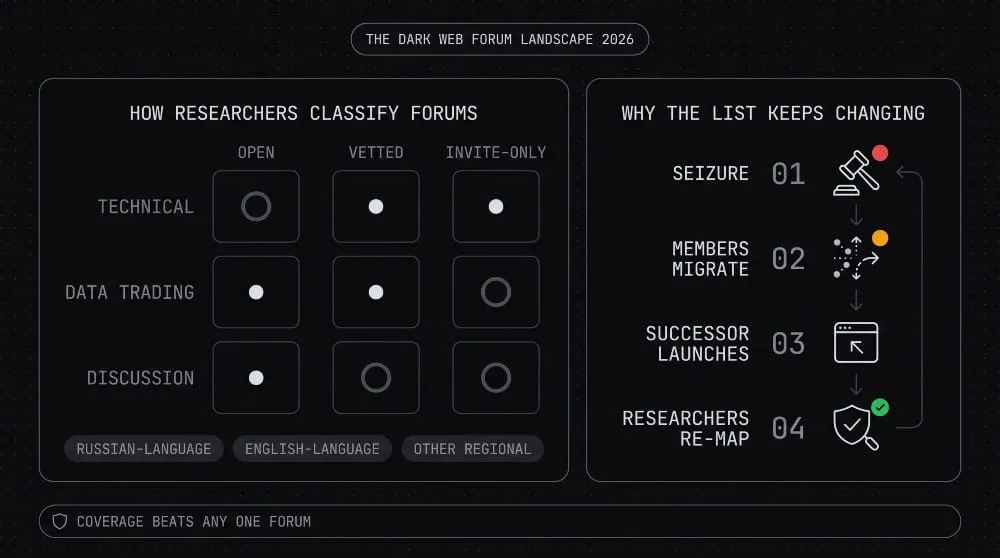
How threat researchers categorize the ecosystem
Researchers categorize forums by function and trust level rather than by popularity. Common dimensions are the type of activity (technical, fraud, marketplace discussion), the access model (open, vetted, invite-only), and the primary language. A forum’s value to an investigator depends on what it reveals about data exposure and attacker behavior, not its size.
Why the “popular” forums change so often
Popularity on the dark web is short-lived. Seizures, exit scams, internal disputes, and infiltration regularly end large communities, and members migrate quickly to successors. A ranked list of “top” forums would be out of date within months, and it would serve the wrong audience. This guide treats the landscape as a pattern, not a list.
Language and regional differences in the cybercrime economy
Regional ecosystems differ in specialty and structure. Russian-language communities have historically focused on ransomware, access brokering, and malware, while other regions skew toward fraud and local-market services. Organizations with a global footprint need coverage that reflects this, because a monitoring service that reads only English sources will miss exposures discussed elsewhere.
Why this section deliberately names no live forums or links
This section names no active forums, addresses, or access routes on purpose. A page that lists them becomes a directory for people looking to join criminal communities, which this guide does not support. Readers who need to understand the landscape for defensive reasons get more from the categories above, and organizations that need real visibility should use monitoring that covers these sources on their behalf.
Takedowns, Seizures, and Forum Churn
RaidForums and the 2022 law-enforcement seizure
RaidForums was a widely known data-trading forum whose infrastructure US and international law enforcement seized in April 2022, with its alleged administrator arrested earlier that year. It is a useful case study because it was open enough to be heavily used and visible enough to be targeted. The seizure removed the site, but not the data traded on it, and it did not end the demand that created it.
Why seized forums reappear under new names
When a forum is seized, former members usually regroup elsewhere within days or weeks, often under a successor name that borrows the original’s reputation. Successors face a trust problem, since seized databases can reveal member identities, and some “relaunches” are suspected law-enforcement traps. The pattern is churn rather than disappearance, and it continues each time a major forum falls.
What takedowns mean for stolen data already in circulation
A takedown does not recall data that has already been downloaded and resold. Leaked databases and credentials are copied many times before a forum goes offline, and they often reappear on later forums or in private channels. For an organization whose data was exposed, a seizure is not a reason to assume the exposure is over.
Why “dark web forums 2024 / 2025 / 2026” keeps changing
The landscape changes every year because the forums do. As of 2026, the pattern remains fragmentation, with communities splitting across onion services, invite-only groups, and encrypted chat platforms after each enforcement action. Details here should be treated as a snapshot, and this section is reviewed and updated annually.
Are Dark Web Forums Illegal?
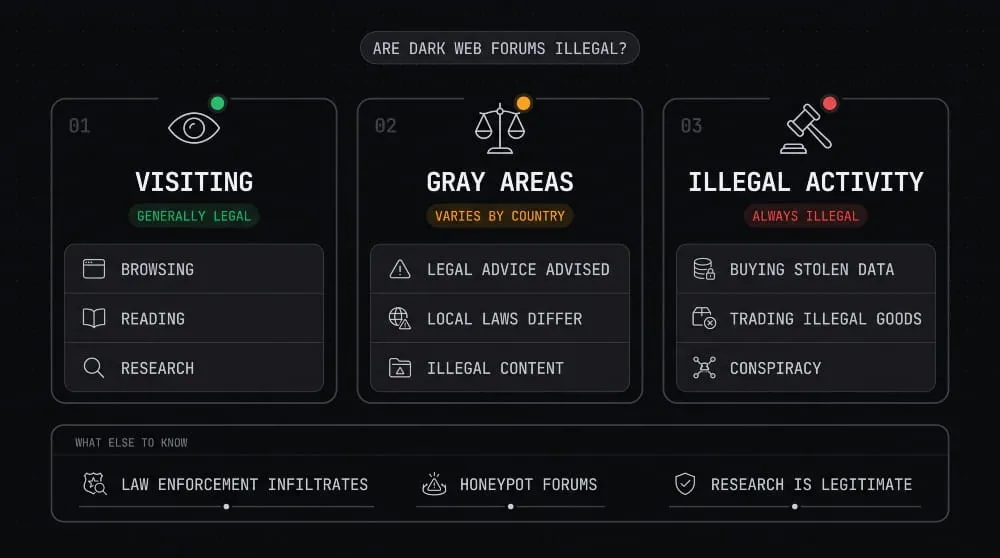
Is visiting a forum illegal vs. participating in illegal activity
In most jurisdictions, visiting a dark web forum is not itself a crime, and the technology is legal. Buying stolen data, trading illegal goods, or taking part in a conspiracy is illegal wherever it happens. The line is activity, not access, though laws vary by country and anyone with a specific concern should consult a lawyer. For the access side, see the How to Access the Dark Web guide.
Legal risks, law-enforcement infiltration, and honeypot forums
Law enforcement actively infiltrates and sometimes operates forums, and past investigations have used undercover accounts and seized servers to identify members. This creates real risk for participants and a corresponding distrust inside the communities themselves. Honeypot forums, set up to attract and identify users, are a documented investigative tactic, which is one reason casual participation is risky.
Why researchers and analysts have legitimate reasons to monitor them
Security researchers, threat intelligence analysts, and incident responders monitor forums to detect exposed data, understand attacker behavior, and warn affected organizations. They do this work under legal and ethical frameworks, using purpose-built tooling. That’s why professional dark web monitoring exists.
Risks of Visiting Dark Web Forums
Malware, scams, and phishing inside forums
Dark web forums are hostile environments. Downloads are frequently trojanized, links lead to phishing or credential-stealing pages, and members routinely target one another. A visitor with no operational discipline can end up infected or defrauded, even when the visit was only curiosity.
Deanonymization and legal exposure
Anonymity tools reduce risk but do not eliminate it. Misconfiguration, reused identifiers, malicious exit nodes, or enforcement operations can expose a user’s identity. Viewing content that is itself illegal creates separate legal exposure in many places.
Why casual curiosity is the riskiest use case
Casual visitors carry the most risk because they lack the technical discipline, legal context, and clear purpose professionals work with. They are more likely to click, download, or register without understanding the consequences. Anyone who needs this visibility for work is better served by monitoring services than by browsing directly.
Learning how to browse safely
Readers who want to understand safe access in general, including the technical setup and the legal context, should start with the how to access the dark web guide. Safe browsing is about reducing risk, not about visiting forums, and this guide does not recommend doing so.
Why Dark Web Forums Matter to Organizations
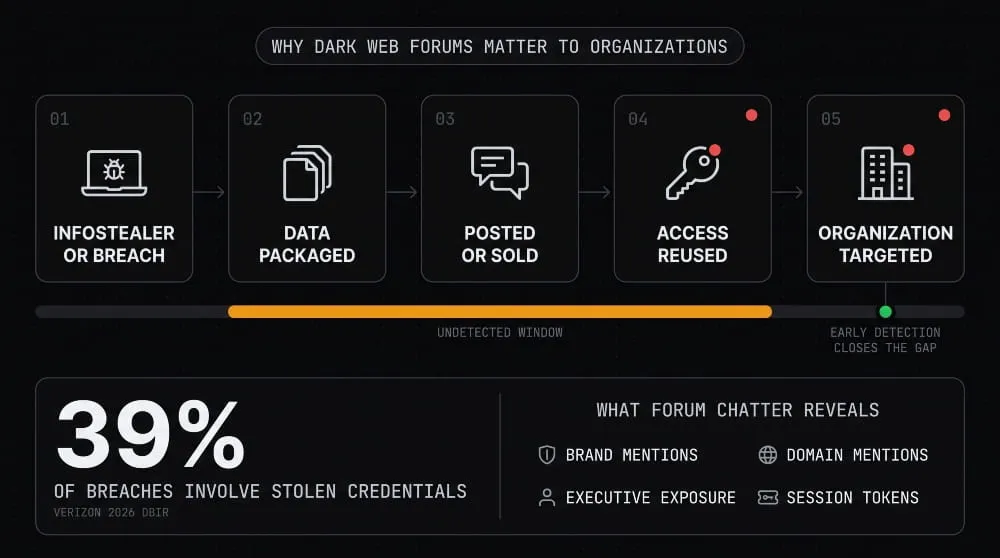
How stolen credentials move from a breach to a forum post
A typical path begins with a breach or infostealer infection. Attackers collect the data, package it, sell it privately or post it as a sample, and then circulate and resell it. By the time a credential appears on a forum, it has often passed through several hands, and the original victim may not know anything happened. Verizon’s 2026 Data Breach Investigations Report found stolen credentials involved in 39% of breaches, which explains why this pipeline is a security priority.
The time gap between data theft and public discovery
A gap usually exists between theft and discovery, and attackers use it. Credentials may be exploited privately long before they are advertised, so a forum listing is often the later and more visible stage of a longer exposure. Faster detection shortens the window in which stolen access can be used against the organization.
Infostealer logs, session tokens, and initial-access brokers
Infostealer logs and initial-access listings are particularly dangerous because they can contain valid session tokens and working logins. Brokers sell this access to ransomware operators and other attackers, turning a single employee’s infected laptop into a company-wide incident. Resetting passwords without revoking sessions can leave that access intact.
What forum chatter reveals: brand mentions, domain mentions, executive exposure
Forum activity can show a company’s name or domain in a sale post, a leaked database containing employee emails, or discussion of an executive’s exposed accounts. Each is an early warning that costs nothing to act on if caught in time. Brand and domain mentions also signal targeting, since attackers often discuss organizations they are planning to approach.
How Organizations Monitor Dark Web Forums
Manual monitoring vs. automated collection
Organizations can monitor forums manually or through automated collection, and the practical differences are large.
| Factor | Manual Monitoring | Automated Collection |
|---|---|---|
| Coverage | A handful of sources an analyst can visit | Many sources across languages and regions |
| Speed | Hours to days between checks | Continuous collection and near-real-time matching |
| Risk | Analyst exposure to malware and legal risk | Collection handled by controlled infrastructure |
| Matching | Manual searching for names and domains | Automated matching to monitored domains and employees |
| Scalability | Limited to one organization at a time | Scales across many clients |
| Consistency | Depends on analyst availability | Runs on a defined schedule with an audit trail |
What monitoring covers, and what it can’t
Monitoring covers accessible forums, leak sites, paste sites, and exposed data collections. It cannot see everything, because closed and invite-only communities, private channels, and one-to-one sales are out of reach. Any honest provider will say so, and organizations should treat monitoring as a way to reduce blind spots, not eliminate them.
How alerts are matched to domains and employees
Alerts are generated by matching collected data against assets the organization has registered, such as email domains, employee addresses, and brand terms. A match produces an alert with context on the exposure type, source, and timing so that analysts can prioritize. Good matching reduces noise, since an alert for an old, already-resolved exposure should look different from one for a fresh infostealer log.
Why MSSPs add this as a service for clients
MSSPs add dark web monitoring because clients cannot build the capability themselves and it is easy to package as a recurring service. A multi-tenant, white-label platform lets an MSSP monitor many client domains under its own brand without building collection infrastructure. For a deeper look at how continuous monitoring works, see dark web monitoring, and for the product capability, see Mispar’s monitoring feature.
What to Do If Your Data Appears on a Dark Web Forum
First-hour response checklist
Speed matters more than perfection in the first hour. A practical sequence is:
- Confirm the exposure is real by checking the sample or claim against known systems.
- Reset the affected passwords and revoke active sessions and tokens.
- Enforce or re-enroll multi-factor authentication on affected accounts.
- Check for signs of use, such as unfamiliar logins, forwarding rules, or new devices.
- Isolate any compromised device and begin incident response if the attacker used access.
Notification and compliance considerations
Depending on the data and jurisdiction, an exposure may trigger breach notification duties with strict deadlines, and cyber insurance policies usually require prompt notice. Document what you found, when, and what you did, since auditors and insurers will ask. Legal counsel should confirm the obligations that apply to the specific situation.
Checking personal exposure
Individuals who want to check their own exposure and learn how to respond can start with the guide on whether their information is on the dark web. It covers the individual version of this problem, including what to check and how to reduce further risk.
Frequently Asked Questions (FAQ)
Are dark web forums legal?
Visiting a dark web forum is generally legal in most countries, but taking part in illegal activity there is not. Laws vary by jurisdiction, and anyone unsure should seek legal advice.
What are dark web forums used for?
They are used for discussion, trading, and community-building, covering both legitimate uses like privacy and speech and criminal uses like trading stolen data and tools. Security teams care about the criminal portion because it is where stolen credentials and access surface.
Are dark web forums safe?
No. They carry risks of malware, scams, phishing, and legal exposure. Organizations that need visibility into them are safer using monitoring services than browsing directly.
Can law enforcement see dark web forum activity?
Law enforcement can infiltrate forums, operate undercover accounts, and seize servers, and past cases show they do. Anonymity tools raise the cost of identifying users but do not guarantee protection.
Do dark web forums sell stolen data?
Yes, many forums host listings or discussions of stolen credentials, databases, and access. Claims are sometimes fake, so exposures need validation before companies make response decisions.
How do companies find out their data is on a dark web forum?
Most find out through monitoring services that match collected data against their domains and employee addresses. Others learn from law enforcement, a third-party notification, or a threat researcher. Continuous dark web monitoring shortens the time between exposure and detection.
Why do dark web forums get shut down and come back?
Law enforcement seizures, exit scams, and internal disputes shut down forums, and members usually regroup under new names. Communities reform because demand and the user base remain even when the infrastructure is removed.