
The dark web supports both legitimate and illegal activity; journalists, researchers, and privacy-conscious users rely on it to communicate anonymously and access information safely, while it also hosts illicit marketplaces for drugs, stolen data, and other criminal trade. In one widely cited analysis, researchers at dark web intelligence firm Terbium Labs found that legal content made up roughly 54.5% of the domains they sampled more than the popular image of the dark web as a purely criminal space would suggest. What separates the two uses isn’t the technology itself, which is neutral, but what someone chooses to do with the anonymity it provides. Understanding that distinction matters whether you’re trying to grasp what the dark web actually is, weighing whether using it is legal or safe, or trying to figure out why your own information might be circulating there.
What the Dark Web Is Actually Used For (Overview)
At its core, the dark web is used for anything someone wants to do without being identified or tracked, from legitimate privacy protection to illegal trade. It’s a small, deliberately hidden portion of the internet, accessible only through specialized software like the Tor browser, that routes traffic through multiple encrypted layers. As a result, neither the visitor’s identity nor location is easily traceable. That anonymity is the entire point, and it’s also why the dark web attracts such a wide range of uses: the same technology that lets a journalist protect a source also lets a criminal market operate with less risk of being shut down.
Dark Web vs. Deep Web vs. Surface Web
The internet most people use every day search engines, news sites, social media is the surface web, and it’s a small fraction of what actually exists online. Beneath it sits the deep web, which includes anything not indexed by standard search engines: your email inbox, online banking portal, private cloud storage, and internal company databases. Nearly all of the deep web is mundane and non-nefarious; it’s simply content that requires a login or isn’t meant to be publicly searchable. The dark web is a small subset of the deep web that goes a step further, using encryption tools like Tor to intentionally conceal the identity of both the sites and the people visiting them. In short: deep web means “not searchable,” while dark web means “not searchable and anonymized by design.”
The Most Common Reasons People Visit It
Most visits to the dark web fall into a handful of recurring categories rather than a single use case. People go there to communicate or browse without being monitored, whether that’s a general preference for privacy or a specific need to avoid surveillance in a restrictive environment. Journalists and whistleblowers use it to exchange sensitive documents and protect sources from retaliation. Researchers, threat intelligence analysts, and law enforcement monitor dark web forums and marketplaces to track cybercrime, stolen data, and emerging threats. Less positively, a significant share of activity involves illegal marketplaces trading drugs, stolen credentials, counterfeit goods, and hacking tools. Independent research supports this mix: an analysis by dark web intelligence firm Terbium Labs found that legal content made up roughly 54.5% of the domains it sampled, suggesting the dark web’s reputation as an exclusively criminal space overstates reality, even as illegal marketplaces remain a real and active part of it.
Who Uses the Dark Web, and Why
The dark web draws a mix of users with very different motives, from people simply protecting their privacy to those running illegal operations; the same anonymizing technology serves them all equally. Understanding who’s actually there, and why, is the clearest way to separate the dark web’s reputation from its reality.
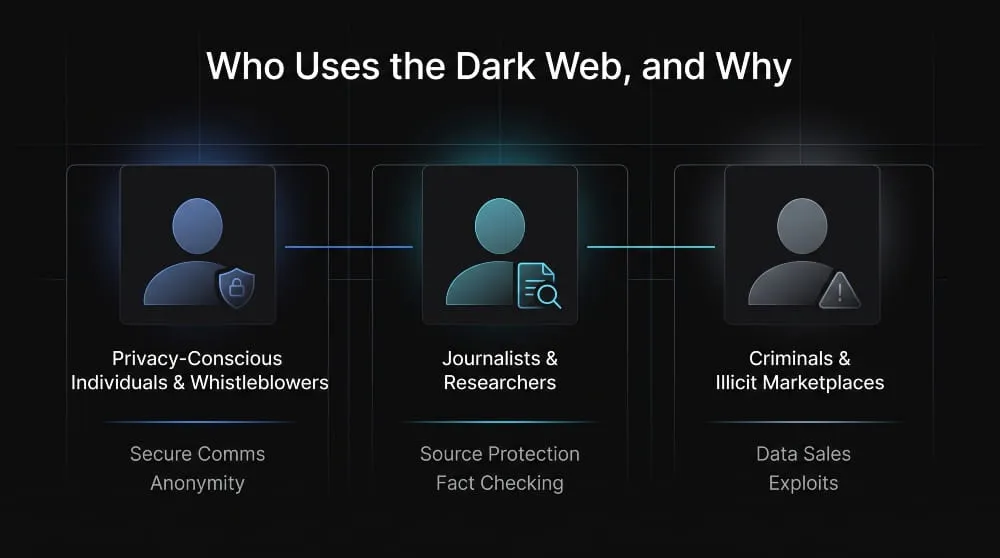
Privacy-Conscious Individuals and Whistleblowers
Many people use the dark web for the same reason they’d use a VPN or encrypted messaging app: to keep their online activity private from advertisers, internet service providers, or governments. This is especially common among people living under censorship or surveillance, where the dark web offers a way to access blocked news, social media, or communication tools without exposing their identity. Whistleblowers and activists rely on it for a more specific reason: sharing sensitive information or documents while minimizing the risk of identification and retaliation. Dark web usage has grown substantially in recent years; one analysis by Panda Security found that daily dark web users surpassed 3 million by March 2025, with the largest shares of that traffic coming from the US and Germany.
Journalists and Researchers
Investigative journalists use the dark web to communicate securely with sources and receive leaked documents without exposing either party to detection; major news organizations, including outlets like The New York Times and the BBC, even run official dark web mirrors of their sites for readers in censored regions. Academic researchers and cybersecurity analysts use it differently: they monitor dark web forums, marketplaces, and leak sites to study cybercrime trends, track stolen data, and gather threat intelligence that informs security research and law enforcement investigations. For both groups, the dark web functions less as a destination and more as a controlled environment for gathering or exchanging information that couldn’t safely move through the open web.
Criminals and Illicit Marketplaces (Brief, Non-Facilitating)
The dark web is also home to a real, active criminal economy, which drives much of its reputation. Illicit marketplaces on the dark web have historically facilitated the sale of drugs, stolen financial and personal data, counterfeit goods, and hacking tools, operating with reduced risk of detection thanks to the same anonymity that protects legitimate users. This is also the segment of dark web activity most directly relevant to businesses: stolen credentials and company data routinely surface for sale on these marketplaces after a breach, which is why security teams monitor the dark web not to participate in it, but to catch exposure before it turns into a larger incident.
Legitimate Uses of the Dark Web
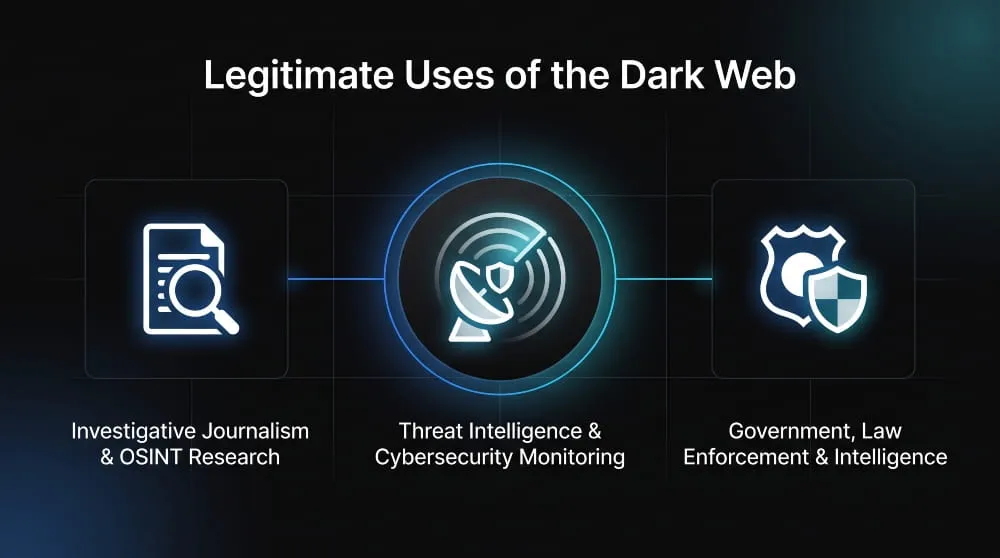
Beyond privacy protection, the dark web serves several professional and institutional purposes that rarely make headlines but represent a meaningful share of its actual traffic. Journalism, government work, and cybersecurity monitoring are three clear examples of how organizations use the dark web deliberately and legally.
Investigative Journalism and OSINT Research
Journalists use the dark web both to communicate securely with sources and to conduct open-source intelligence (OSINT) research tracking leaked documents, monitoring extremist forums, or verifying claims tied to an investigation. Many news organizations maintain secure submission systems built on Tor specifically so whistleblowers can share information without exposing their identity through standard web traffic. Researchers studying misinformation, human trafficking, or organized crime similarly use the dark web as a source of raw, unfiltered data that wouldn’t surface through conventional search engines, treating it as a research environment rather than a place to transact.
Government, Law Enforcement, and Intelligence Use
Government agencies were early architects of the anonymity technology the dark web relies on: the Tor network originated from research funded by the U.S. Naval Research Laboratory and built to protect government communications. That same infrastructure is now used by law enforcement and intelligence agencies to conduct undercover investigations, track illicit marketplaces, and gather evidence in cases ranging from drug trafficking to child exploitation, all without revealing an agent’s identity or location. Diplomats and intelligence personnel in high-risk regions also use dark web tools to communicate securely when standard channels could be monitored or compromised.
Threat Intelligence and Cybersecurity Monitoring
For businesses, the most practical legitimate use of the dark web isn’t visiting it; it’s monitoring it. Security teams and managed service providers track dark web forums, marketplaces, and leak sites to catch stolen credentials, leaked customer data, or mentions of their company before that exposure turns into a full-blown breach. This matters more than most organizations realize: Verizon’s Data Breach Investigations Report has repeatedly found that stolen or compromised credentials are involved in a large share of confirmed data breaches, many of which trace back to credentials that were already circulating on the dark web well before the breach occurred. That gap between exposure and detection is exactly what dedicated dark web monitoring is built to close, continuously scanning the dark web for an organization’s data rather than relying on a one-time check after damage is already done.
Is Using the Dark Web Legal?
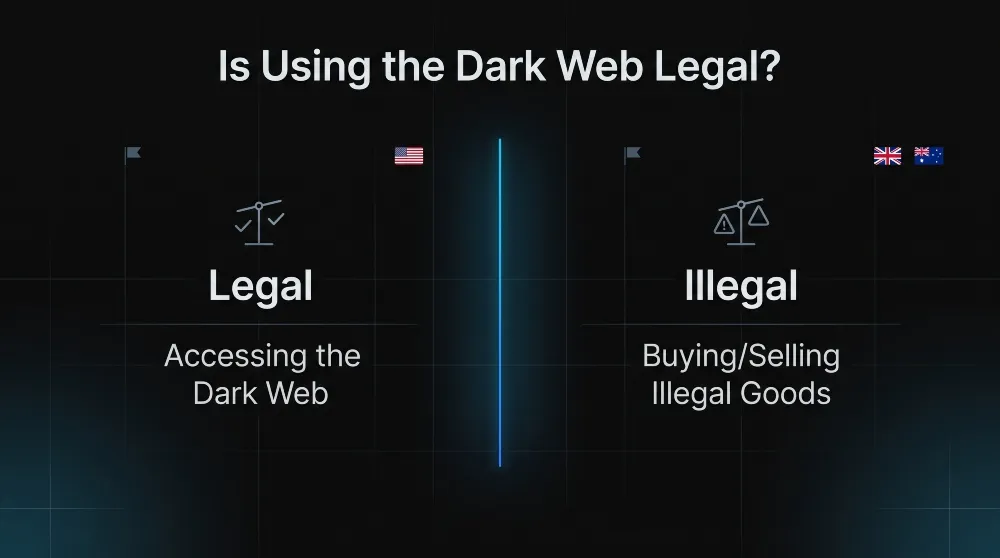
Using the dark web is legal in most countries, including the US, UK, and Australia; what matters is what you do there, not accessing it. Because that distinction gets confused so often, it’s worth separating the legality of the technology from the legality of specific activities.
Legality in the US, UK, and Australia
In the United States, accessing the dark web through Tor or similar software is legal, and no law prohibits simply browsing it. The same holds in the United Kingdom and Australia: using Tor, visiting .onion sites, or maintaining anonymity online isn’t, by itself, a criminal act in any of these countries. Governments and law enforcement agencies in all three use the same anonymity tools for their own investigative and intelligence work, which underscores that the technology itself isn’t inherently illegal. What changes the legal picture is entirely dependent on what a person does once they’re there.
What Actually Crosses Into Illegal Territory
The dark web becomes a legal problem the moment someone uses it to buy, sell, or access something already illegal on the surface web: drugs, stolen financial data, counterfeit documents, hacking tools, or exploitative material, for example. Purchasing illegal goods on a dark web marketplace carries the same legal consequences as buying them anywhere else; the anonymity doesn’t create a legal exemption, it just makes enforcement harder, not impossible. Simply reading about these marketplaces, or even accidentally landing on a page hosting illegal content, generally isn’t itself a crime, but knowingly downloading illegal material or engaging in a transaction is. In practice, the safest way to think about it is that the dark web doesn’t change what’s legal it just removes some of the friction and visibility that normally accompanies breaking the law.
Is the Dark Web Safe to Use?
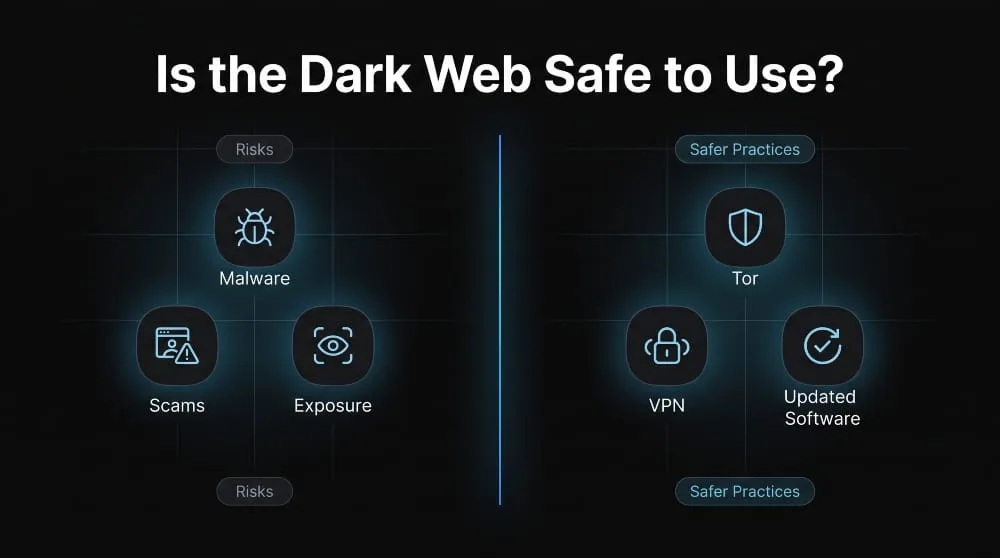
The dark web isn’t inherently unsafe, but it carries far more risk than the surface web because it lacks the moderation, verification, and security standards that protect ordinary browsing. Visiting a legitimate .onion mirror of a news site is low-risk; the danger concentrates in unverified marketplaces or forums.
Common Risks (Malware, Scams, Exposure)
Malware is one of the most immediate threats disguised downloads, malicious links, and compromised sites are far more common on the dark web than on the surface web, since there’s no equivalent to a search engine flagging dangerous pages. Scams are just as prevalent: dark web marketplaces have no consumer protections, so fraudulent vendors and fake listings are common, and there’s no recourse if a transaction goes wrong. There’s also a real risk of personal exposure. Some dark web sites attempt to deanonymize visitors through tracking scripts or exploits, and simply browsing certain forums or marketplaces can put a user’s IP address or identity at risk if their security setup has gaps. Panda Security’s analysis of dark web activity found that around 60% of dark web domains host illegal content, which shows how much of the dark web a typical visitor needs to avoid rather than casually browse.
How to Use It More Safely (Brief)
Reducing risk starts with the basics: use the official Tor Browser rather than a modified or third-party version, keep it updated, and avoid downloads or link clicks from unfamiliar sources. Pairing Tor with a reputable VPN adds another layer of protection, and disabling scripts and plugins closes off common attack vectors. These are just the starting points for a full walkthrough of safe setup and access, including device-specific instructions; see our complete guide to accessing the dark web.
Accessing the Dark Web on Different Devices
You can access the dark web from a phone or computer, but the process and level of security vary significantly by device. On desktop, the official Tor Browser is the standard and most secure route on both Windows and Mac. On mobile, Android users have a legitimate official Tor Browser app. In contrast, iPhone users need a third-party app like Onion Browser, since Apple doesn’t allow the standard Tor Browser on iOS. Mobile access generally carries more risk than desktop, since phones are more often used on unsecured networks and have fewer built-in safeguards against tracking. For step-by-step setup instructions by device, see our full guide to accessing the dark web.
What Currency Is Used on the Dark Web?
Cryptocurrency is the dominant form of payment on the dark web, with Bitcoin historically the most widely used due to its early adoption and broad acceptance across marketplaces. Its popularity stems from its perceived anonymity. However, Bitcoin transactions are permanently recorded on a public blockchain, allowing law enforcement to trace and unmask users in numerous cases over the years. Because of that traceability gap, privacy-focused cryptocurrencies like Monero have gained ground on dark web marketplaces specifically because their transactions are far harder to trace back to an individual. No currency used on the dark web is illegal to own or use on its own; what determines legality, as with everything else here, is what the transaction is actually for.
The Dark Web’s Blind Spot: Knowing When Your Own Data Ends Up There
Understanding what the dark web is used for doesn’t tell you whether your own business’s data is already circulating there, and for most organizations, that’s the more urgent question. Stolen credentials, customer records, and internal documents routinely surface for sale on dark web marketplaces and forums well before a company even realizes a breach occurred, often months in advance. Manually checking for this exposure isn’t practical at scale, and by the time it’s discovered through other means, the damage is frequently already done. This is the gap that dark web monitoring is designed to close: continuous, automated scanning of dark web sources for an organization’s credentials, domains, and data, with alerts the moment exposure is detected rather than a retroactive scramble after an incident.
Frequently Asked Questions (FAQ’s)
Can the dark web be used for good?
Yes, the dark web is used for legitimate purposes like protecting journalists’ sources, helping people bypass censorship, and supporting law enforcement investigations. Its anonymity is a tool, and like most tools, its use determines whether it’s helpful or harmful.
How do people tell if someone is using the dark web?
Network administrators can often spot dark web activity through Tor-specific traffic patterns, since connecting to the Tor network leaves a detectable signature even though the content itself stays encrypted. On a personal device, there’s no reliable way to tell without direct access to browser history or network logs.
Is DuckDuckGo used for the dark web?
DuckDuckGo offers a version accessible through Tor and is commonly used as a privacy-focused search engine once inside the dark web. Still, it isn’t a dark web search engine itself; its standard version only indexes the surface web. Most dedicated dark web content requires marketplace- or forum-specific search tools instead.