
Accessing the dark web is legal in most countries, including the US and UK. What makes something illegal is what you do there, such as buying stolen data or prohibited goods, not the act of browsing. For how individual countries treat it, see the country-by-country breakdown below.
Is It Illegal to Be on the Dark Web?
No. In most countries, being on the dark web is legal, and the law focuses on your conduct rather than your location on the network. The sections below explain why, where the line falls, and what is still worth being careful about.
Why browsing alone isn’t a crime in most countries
Most legal systems punish specific acts, such as fraud, trafficking, or possessing prohibited material, rather than the tools or networks used to reach them. The dark web is a part of the internet that requires special software, most commonly Tor, to reach. Opening that software and visiting a site doesn’t break any law in the US, UK, Canada, Australia, or most of the EU. Journalists, researchers, security teams, and privacy-minded people use it routinely.
The best comparison is a physical one. Walking into a back-alley market isn’t a crime, but buying stolen goods there is. The setting changes the risk, not the legality of walking in.
Legal vs illegal: a quick comparison table
The pattern is consistent: access is lawful, and illegal transactions or illegal content are not. The exact offenses vary by jurisdiction, and the country sections below cover the differences.
| Activity | Generally Legal? | Why |
|---|---|---|
| Installing and using Tor | Yes in most countries | Privacy software is lawful to own and run |
| Visiting a dark web site | Yes in most countries | Viewing a page is not a prohibited act on its own |
| Reading news or forums on .onion sites | Yes | Lawful content, lawful access |
| Using a dark web search engine | Yes | Search is not the offense |
| Buying or selling illegal goods or services | No | The transaction is the crime |
| Buying or sharing stolen data, such as card numbers | No | Trafficking in stolen data is a crime |
| Downloading or possessing illegal content | No | Possession is an offense regardless of the network |
| Hiring someone for hacking or other illegal services | No | Soliciting a crime is a crime |
Is everything on the dark web illegal?
No. A large share of the dark web is legitimate, and many well-known organizations run sites there to reach people in censored or surveilled environments. Privacy tools, news outlets, secure messaging services, and whistleblower submission systems operate on the dark web alongside the criminal marketplaces that get most of the headlines. Illegal activity is real and present, but it is a subset of the dark web, not a description of all of it.
Is It Illegal to Visit, Look At, or Browse the Dark Web?
No. Visiting, viewing, or browsing the dark web is not illegal in most countries, as long as you aren’t engaging with illegal content or transactions. The verb you use (visit, look, surf, watch, enter, open) makes no legal difference, because the law cares about what you do, not how you describe it.
Visiting, viewing, and watching
Looking at a page on the dark web is legally the same as looking at a page on the regular web: lawful content is lawful to view, and the network it sits on doesn’t change that. In the US, UK, Canada, Australia, and most of the EU, no law makes it an offense to load a dark web site, read a forum, or watch a video that is itself legal.
The risk comes from the content, not the viewing. Viewing material that is illegal to possess, such as child sexual abuse material, can be a serious crime in nearly every jurisdiction, because many legal systems treat displaying or caching such material as possession. The same applies to knowingly viewing content that a specific country bans, even when the site is legal elsewhere. So “is it illegal to look at the dark web?” has a different answer depending on what is on the page, not on whether the page is on the dark web.
Surfing and entering: does opening Tor change anything?
No. Opening Tor, entering a .onion address, or “surfing” the dark web does not create a legal event on its own. Tor is a privacy tool, and launching it signals nothing about your intent to a court. Typing a .onion address into Tor Browser is, legally, the same act as typing a web address into any other browser.
What changes is your exposure to unexpected content. Dark web sites aren’t indexed or moderated like mainstream sites, so a link can lead somewhere you didn’t intend. The legal line sits at interacting with illegal material or services, not at the moment you open the browser.
Accidentally landing on illegal content.
Accidentally landing on illegal content is generally not treated the same as seeking it out, because most offenses require knowledge or intent. A person who clicks a misleading link, sees something illegal, and leaves immediately is in a very different position from someone who searches for it, downloads it, or shares it.
If this happens, the practical steps are simple: close the page, don’t download or save anything, don’t share the link, and don’t go back. If the content involves the exploitation of children, report it to the relevant authority in your country, such as the National Center for Missing & Exploited Children in the US or the Internet Watch Foundation in the UK. How a given case is handled depends on the facts and the jurisdiction, and this is general information, not legal advice.
Is using Tor itself legal?
Yes. Using Tor is legal in the US, UK, Canada, Australia, the EU, and most other countries. It is lawful privacy software, and ordinary users, journalists, researchers, and companies rely on it for anonymity and to get around censorship.
A small number of countries restrict, block, or discourage it. Where Tor is blocked, people may need workarounds, and in the most restrictive jurisdictions, using circumvention tools can carry its own penalties. The country sections below cover these cases.
What Is Illegal on the Dark Web?
What is illegal on the dark web is the same conduct that is illegal anywhere else: trafficking in prohibited goods, fraud, trading stolen data, and possessing or sharing illegal content. The dark web doesn’t create new crimes. It hosts familiar ones behind anonymity.
Illegal activities by category
Illegal activity on the dark web falls into a few broad groups, and each is a crime in nearly every legal system.
The first is the sale of prohibited goods, such as controlled substances, weapons, and counterfeit documents or currency. The second is financial and data crime, including the trade in stolen credentials, payment card data, and personal records from breaches. The third is services sold for illegal purposes, such as hacking for hire, fraud toolkits, and laundering. The fourth is the distribution of illegal content, which includes material banned outright in most countries.
Buying, selling, brokering, or promoting any of these is an offense whether it happens on the dark web, a street corner, or an ordinary website. Anonymity doesn’t change the charge, and law enforcement agencies in many countries have repeatedly shut down dark web marketplaces and prosecuted buyers and sellers.
Illegal content and possession: why the content itself is the problem
Some material is illegal to possess or view regardless of where it is hosted. Child sexual abuse material is the clearest case, and it is a serious crime in almost every country, including simply downloading, saving, or sharing it. Other categories, such as certain extremist or terrorism-related material, are restricted in many jurisdictions, though the rules differ by country.
This is why “is it illegal to look at the dark web?” doesn’t have a single answer. The network is not the offense. The content is. A lawful page on the dark web is lawful to read, and an unlawful file is unlawful to hold on any network. If you come across material like this, leave the page and don’t save or share it. Reporting options are covered in the section on accidentally landing on illegal content above.
Legitimate uses: journalism, privacy, whistleblowing, censorship circumvention
The dark web has a substantial lawful side. Journalists use it to receive tips from sources who need protection. Whistleblowers use secure submission systems that don’t log their identities. People living under censorship or surveillance use it to read and publish information their governments restrict, and privacy-conscious users rely on it to avoid tracking.
Many mainstream organizations, including major news outlets, run .onion versions of their sites so readers in restrictive countries can reach them. These uses help explain why Tor and the dark web are legal in most democracies, and why digital rights groups defend them.
How much of the dark web is illegal?
Research suggests that illicit content is common on dark web sites, but it doesn’t show that the whole dark web is criminal. The most widely cited study, by Daniel Moore and Thomas Rid of King’s College London, crawled Tor hidden services, found 5,205 live sites, and classified 2,723 of them by content, with about 57% (1,547) hosting illicit material.
Three caveats matter when using that number. The study dates from 2016, and the dark web has changed since. It measured sites a crawler could reach and categorize, excluding private or hard-to-find services and many sites that couldn’t be classified. It also counted sites, not traffic or users, and most Tor use is people reaching ordinary websites privately rather than visiting hidden services. The honest answer to “what percentage of the dark web is illegal?” is that a large share of indexable hidden-service sites host illicit material, and no one has a reliable current figure for the whole thing.
Why Does the Dark Web Have a Reputation for Being Illegal?
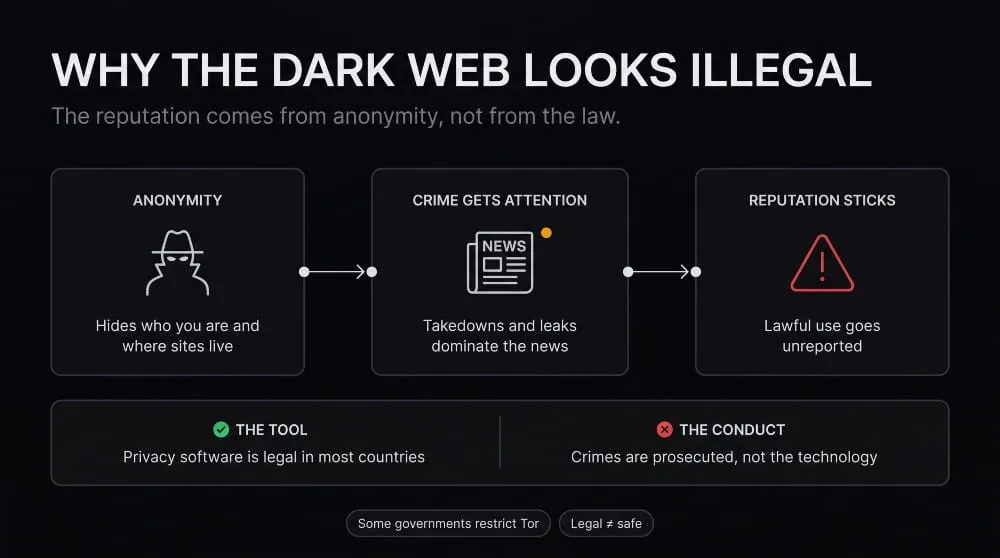
The dark web has a reputation for illegality because anonymity attracts people who want to avoid being identified, and high-profile criminal marketplaces and leaks have dominated its coverage. The reputation describes who sometimes uses it, not what the law says about the technology.
Anonymity and why it attracts crime
The features that protect a journalist also protect a criminal. Dark web sites hide both the visitor’s identity and the server’s location, making them hard to trace, shut down, and moderate. Anything that lowers the risk of being identified will attract people with something to hide, and that is true of cash, encrypted messaging, and shell companies as well as Tor.
Media coverage amplifies the effect. Marketplace takedowns, data leaks, and ransomware leak sites make news, while the everyday lawful use of Tor by ordinary people does not. The result is a public picture built mostly from its worst examples.
Why that doesn’t make the technology illegal
Laws generally target conduct, not tools. Tor was designed as privacy infrastructure, and its onion-routing concept originated with the US Naval Research Laboratory before being developed as an open-source project now maintained by the nonprofit Tor Project. The software itself is lawful to download, run, and study in most countries.
The same logic applies to other dual-use tools. Encryption protects bank transfers and also shields criminals, and cars serve commuters and getaway drivers alike. Legal systems in democratic countries have largely concluded that banning the tool would harm far more lawful users than it would stop offenders, and they prosecute the crimes instead. That is why running Tor is legal in the US and UK while selling prohibited goods through it is not.
Why some governments restrict it
Governments that restrict the dark web usually have one of two motives. Some are responding to crime, such as drug trafficking and the trade in stolen data, and want to make it harder for offenders to hide. Others are concerned about control, because anonymity tools also let citizens read blocked information, organize, and communicate without surveillance.
In practice, this means a few countries, including China and Russia, have blocked or tried to block Tor, while others require registration or ban anonymity tools outright. The legal position of the dark web in a given country is therefore as much a question of how that government treats anonymous communication as it is a judgment about crime. The country-by-country section that follows lays out where each major jurisdiction stands.
Is the Dark Web Illegal in Your Country?
In most countries, including the US, UK, India, Australia, Canada, Germany, and the rest of the EU, accessing the dark web is legal and only illegal activity or content is prosecuted. A smaller group of countries block or restrict anonymity tools, so the answer depends on where you are.
United States
Accessing the dark web and using Tor is legal in the United States. No federal law prohibits visiting a .onion site, and Tor Browser is lawful software. Illegal conduct is prosecuted under the same laws that apply offline, including drug trafficking statutes, wire and access-device fraud laws, computer crime laws, and federal law covering child sexual abuse material. US agencies have repeatedly taken down dark web marketplaces and charged buyers and sellers, which is a useful reminder that anonymity does not remove legal risk for illegal transactions.
United Kingdom
Accessing the dark web is legal in the UK, and so is using Tor. There is no offense in visiting a dark web site. Illegal activity is covered by existing laws such as the Computer Misuse Act, the Misuse of Drugs Act, the Fraud Act, and the laws on indecent images of children. UK police and the National Crime Agency investigate the dark web, and people have been convicted for buying illegal goods or possessing illegal content there, not for browsing.
India
India has no law that specifically bans accessing the dark web or using Tor. As in other countries, what matters is the activity: illegal purchases, cybercrime, and prohibited content fall under the Information Technology Act and criminal and narcotics law, and Indian agencies have made arrests in dark web drug and fraud cases. Because enforcement priorities and blocking orders can change, it is sensible to check current guidance before relying on this, especially for anything beyond ordinary browsing.
Australia and Canada
Accessing the dark web is legal in both Australia and Canada. Neither country has a law against using Tor or visiting a hidden service. Both prosecute dark web crime under their general criminal codes, covering drug trafficking, fraud, cybercrime, and illegal content, and both have run enforcement operations against dark web markets. Australia, in particular, has strong laws on illegal material and cybercrime, so the risk lies in what you view, buy, or share rather than in access itself.
Germany and the EU
Accessing the dark web is legal in Germany and across the EU, and no EU-wide ban exists on Tor or anonymity tools. Criminal law is set mostly by each member state. Germany adds a notable rule: since 2021, it has been an offense to operate an online trading platform whose purpose is to facilitate serious crimes, which targets site operators more than ordinary visitors. For users, the same principle applies as elsewhere: illegal purchases and illegal content are punished, not the act of browsing.
UAE and countries with heavy restrictions
In the UAE and several other countries, the rules are stricter and the safest assumption is to treat anonymity tools with caution. The UAE has broad cybercrime and content laws, and using tools to hide your identity or to commit or conceal a crime can carry its own penalties. The legal position of circumvention tools there is more nuanced than in Western countries, so anyone in the UAE should check current law before using Tor.
Some countries go further. China maintains extensive internet controls that block Tor and restrict unapproved circumvention tools; Russia has moved to block Tor and pressure its operators; and Iran and a few others restrict or monitor anonymity tools. In these places, using Tor or similar tools can attract attention or penalties even when the content itself is lawful, and the practical risk is higher than the written law alone suggests.
Country comparison table
| Country / Region | Using Tor / Accessing Dark Web | Illegal Activity On It | Notes |
|---|---|---|---|
| United States | Legal | Prosecuted under existing federal and state law | No law against visiting .onion sites |
| United Kingdom | Legal | Prosecuted under existing criminal law | Possession of illegal images is an offense on any network |
| India | Legal no specific ban | Prosecuted under IT, criminal, and narcotics law | Check current guidance and blocking orders |
| Australia | Legal | Prosecuted under national and state criminal law | Strong laws on illegal material and cybercrime |
| Canada | Legal | Prosecuted under the Criminal Code and drug law | No law against using Tor |
| Germany | Legal | Prosecuted under national law | Operating platforms that facilitate serious crime is an offense |
| EU (general) | Legal | Set by each member state | No EU-wide ban on Tor |
| UAE | Restricted heavily regulated | Prosecuted under cybercrime law | Using tools to hide a crime can carry its own penalties |
| China, Russia, Iran | Blocked or restricted | Prosecuted, plus broader controls | Higher practical risk even for lawful use |
Can You Get in Trouble Without Doing Anything Illegal?
Yes, in limited ways. Browsing the dark web lawfully doesn’t make you a criminal, but it can still draw attention from your network, your employer, or a service provider, and it can expose you to real risks. Legal and risk-free are different things.
Monitoring, ISP visibility, and what Tor does and doesn’t hide
Tor hides what you do, but not necessarily the fact that you are using it. Your internet provider can usually see that you are connecting to the Tor network, even though it can’t see which sites you visit or what you read. The sites you visit, in turn, can’t see your real IP address.
That distinction matters. Being a Tor user is not evidence of wrongdoing in most countries, and a connection to Tor is not a crime in itself. Still, in some places an unusual traffic pattern can prompt a question from a network administrator, and in countries that restrict anonymity tools it can draw more serious attention.
Tor also does not guarantee anonymity. Users have been identified through their own mistakes, such as logging into personal accounts, reusing usernames, or downloading and opening files that reveal their identity, and in some investigations through software vulnerabilities or by other investigative work. Anonymity depends as much on behavior as on the tool, which is why people sometimes assume they are protected more than they are.
Employer and network policies
Your employer or school can restrict the dark web even where the law doesn’t. Many organizations block Tor on their networks and prohibit installing it on work devices, and using it anyway can violate an acceptable-use policy. The consequence is usually disciplinary, such as a warning or loss of access, rather than criminal, but it can still affect your job.
The same applies to public Wi-Fi and shared networks, which often block Tor or log connections. If you are using a work laptop or a managed network, assume your activity is visible to the administrator and check the policy before connecting.
Why “legal” and “safe” are different questions
Something can be entirely legal and still be a bad idea. Dark web sites are unmoderated so that you can run into malware, scams, phishing pages, and disturbing content with no warning, and lawful browsing doesn’t protect you from any of it. Seeing illegal material by accident is not the same as seeking it out, but it can still be distressing, and acting on it by downloading or sharing can change your legal position quickly.
Safety also includes your own information. Entering real credentials or personal details on an unfamiliar dark web site is the most common way ordinary users get hurt, usually through fraud and account takeover rather than any legal consequence. T
Staying Safe If You Choose to Look
If you choose to explore the dark web, the main risks are malware, scams, and exposing your own information, not the law. A few basic habits cut most of that risk, and our guide on accessing the dark web covers the setup steps.
Safety basics
Use the official Tor Browser, downloaded only from the Tor Project’s own website, and keep it updated. Unofficial copies and “dark web apps” are a common way for malware to reach people, so the download source matters more than anything else on this list.
Keep your browser’s default settings and avoid installing extensions or changing configurations, because unusual setups can make you easier to fingerprint. Don’t log into personal accounts such as your regular email or social media while using Tor, since that links your anonymous session to your real identity. Never reuse a username or password from elsewhere.
Treat everything you find as untrusted. Don’t download or open files from dark web sites, don’t enter personal or payment information, and don’t click links in unsolicited messages. If you only want to read or research, staying on well-known, legitimate sites greatly reduces your exposure. Many people also use a separate device or a dedicated operating system for dark web browsing, which limits the damage if something goes wrong.
Malware, scams, and impersonation risks
Scams are the most common problem, and they are far more likely than any legal trouble. Dark web sites are unmoderated and often anonymous, so there is no reliable way to verify who runs them. Fake marketplaces, fake directories, and sites that take a payment and vanish are widespread, and sellers frequently scam the very people they claim to serve.
Impersonation is the second major risk. Attackers copy the addresses and look of legitimate .onion sites, including well-known services, and swap in their own address so that visitors land on a clone that steals logins or cryptocurrency. Because .onion addresses are long strings that are hard to recognize at a glance, a lookalike can be difficult to spot. Get addresses only from the organization’s own verified channels, such as its official website, rather than from a list or forum post.
Malware is the third. Files, “tools,” and downloads offered on dark web sites are a frequent delivery method for credential-stealing software. A single infected file can give an attacker access to your passwords and accounts well beyond the browser, which is why not downloading anything is the simplest and strongest rule.
The Legal Side of Your Data on the Dark Web
If your personal or company data appears on the dark web, you haven’t broken any law. You are the victim of someone else’s breach or theft, and the legal exposure usually falls on the organization that lost the data, not the person whose information leaked.
Your data being there isn’t something you did wrong.
Personal data ends up on the dark web through breaches, malware that steals saved logins, and phishing, not through anything the owner did by looking or not looking. Having your email address, password, or Social Security number listed there carries no legal consequence for you. Searching to find out whether your information has been exposed is also lawful, since checking your own data is not the same as buying or sharing stolen data.
The legal risk starts with what happens next. Stolen credentials can enable account takeover and identity fraud. If the exposed data is yours, the sensible response is practical: change affected passwords, turn on multi-factor authentication, monitor your accounts, and consider a credit freeze if sensitive identifiers like your SSN were involved. Don’t buy your own data back or contact whoever is selling it, which can create legal and security problems of its own. If you want the step-by-step version, our guide on whether your information is on the dark web walks through checking and cleanup.
What it means for businesses and MSSP clients
For organizations, the legal side is heavier. When customer or employee data is exposed, many laws and contracts attach duties to the company that held it. The GDPR, for example, generally requires notifying the supervisory authority within 72 hours of becoming aware of a qualifying breach, and many US states, sector rules, and cyber insurance policies set their own notification and reporting requirements. Discovering stolen credentials late can turn a manageable incident into a compliance problem.
That is why many security teams treat the dark web as a place to watch, not a place to visit. Dark web monitoring looks for exposed company domains, credentials, and sensitive data so teams learn about a leak before it is exploited and can document their response. For MSSPs, the same capability extends to every client they protect, with alerts routed to the right account. Read more in our overview of dark web monitoring, or see how the monitoring feature works across multiple clients.
Frequently Asked Questions (FAQ)
Is it illegal to look at the dark web?
No, looking at the dark web is not illegal in most countries, including the US, UK, Canada, Australia, and the EU. The law applies to what you view or do, so lawful pages are lawful to read, while viewing or possessing illegal material, such as child sexual abuse content, is a crime on any network. If you land on something illegal by accident, leave the page, don’t save or share anything, and report it if it involves the exploitation of children.
Is the dark web illegal in the US? In the UK?
No, the dark web is legal to access in both the US and the UK. Neither country has a law against using Tor or visiting a .onion site, and both prosecute the same crimes they prosecute offline, such as drug trafficking, fraud, hacking, and possession of illegal images. The main difference is the statutes involved, such as the Computer Misuse Act and the Fraud Act in the UK and federal and state criminal law in the US.
Is Tor illegal?
No, Tor is legal in most countries, including the US, UK, EU, Canada, and Australia. It is privacy software that journalists, researchers, companies, and ordinary users rely on. A small number of countries, such as China and Russia, block or restrict it, and in some places, using circumvention tools can carry penalties, so it is worth checking the rules where you live.
Can you go to jail for visiting the dark web?
Not for visiting alone in most countries, but you can face jail for illegal activity carried out there. Buying prohibited goods, trading stolen data, or possessing illegal content can all lead to prosecution, and the dark web does not shield you from that. In countries that restrict anonymity tools, the risks are higher even for otherwise lawful use, so local law matters. This is general information, not legal advice.
What percentage of the dark web is illegal?
No reliable current figure exists, but the best-known study found that about 57% of the hidden-service sites it could classify hosted illicit material. That research, by Daniel Moore and Thomas Rid of King’s College London, dates from 2016 and covered 2,723 classified sites, so it describes sites a crawler could reach rather than all dark web activity or users. A large share of the dark web is legitimate, and most Tor use is people reaching ordinary websites privately.