
Ransomware is at a record volume in 2026, but fewer victims are paying. GuidePoint recorded 2,760 leak-site victims in Q3 2026, up 75% from Q3 2025, claimed by a record 112 active groups. Coveware reports that nearly 80% of data-theft-only incidents end without a ransom payment. Verizon’s 2026 DBIR found ransomware in 48% of breaches, with 69% of victims declining to pay. The market is crowded and fragmented, extortion increasingly rests on stolen data rather than encryption, and attackers are getting in through trusted identities and unpatched systems rather than through noisy exploits.
What changed since 2025
Three things shifted. First, data theft without encryption went mainstream. Coveware says ransomware is shedding the “ware” in favor of pure data extortion, as groups like Silent Ransom abandon encryption for cloud exfiltration and social engineering. Second, the money got lumpier. Average payments in Q3 2025 were about $376,941, while Q3 2026 averaged $1,025,278 with a median of $400,000. Third, enforcement moved upstream. A June 2026 Operation Endgame sprint took down 326 servers and 142 domains and froze more than $46 million in criminal cryptocurrency.
Where these statistics come from
Every figure here is attributed to its source because each source measures something different. Leak-site trackers such as GuidePoint count victims that groups publicly claim. Coveware reports on incident-response cases it handled. Chainalysis measures on-chain payments. Verizon’s DBIR analyzes confirmed breaches, drawn from more than 31,000 incidents across 145 countries between November 2024 and October 2025. Sophos surveys IT leaders, and the FBI counts complaints people choose to file. Percentages like “how many victims pay” therefore differ by source, and this guide explains why where it matters. Newest figures are Q3 2026, current as of late November 2026.
Ransomware Statistics 2026
Attack volume and leak-site victim counts
Leak-site victim counts have hit record levels for two years running. GuidePoint counted 7,515 publicly posted victims in 2025, up 58%, across 124 groups. December 2025 was the busiest month on record, with 814 claimed victims. Chainalysis put 2025 at nearly 8,000 leak events, a 50% increase. Q3 2026 then topped everything: 2,760 victims, against 2,279 in Q2 2026 and 1,574 in Q3 2025. Trackers differ in method, so compare trends within a source rather than across sources.
Most targeted sectors and regions
Manufacturing leads leak-site counts, and the United States takes the largest share of victims—guidePoint names manufacturing the most impacted industry in Q3 2026. Victims spanned 115 countries, up from 90 a year earlier, and the US accounted for 42%. Coveware’s incident-response caseload skews toward professional and legal services, healthcare, financial institutions, and manufacturing. BlackFog’s July 2026 tally of publicly disclosed attacks put healthcare first at 35%, followed by services and manufacturing, with the US at 53%.
How attacks start (phishing, stolen credentials, exploited vulnerabilities)
The leading entry point depends on who you ask. Phishing, exploited vulnerabilities, and stolen credentials all rank near the top, and the order flips between datasets.
| Source | Top entry points | Notes |
| Coveware, Q3 2026 | Phishing and social engineering about 29%, remote access compromise 22–23%, compromised credentials 14–15%, edge devices and unpatched appliances 11–12% | Incident-response cases |
| Verizon DBIR 2026 | Vulnerability exploitation 31%, phishing 16%, credential abuse 13% | Credential abuse appears at some stage in 39% of breaches |
| Sophos State of Ransomware 2026 | Malicious email 26%, phishing 24%, compromised credentials 23%, exploited vulnerabilities 18% | Survey of IT leaders |
Taken together, the datasets point to identity and social engineering as the dominant way in, with vulnerability exploitation a close second.
Year-over-year table, 2022–2026
Payments peaked in 2023, then fell even as victim counts climbed.
| Year | On-chain ransom payments | Payment rate (Chainalysis) | Median ransom reported | Headline |
| 2022 | $567M as first reported | 78.9% | n/a | Hive takedown and the Ukraine war cited as factors |
| 2023 | $1.25B (revised up) | n/a | $177,614 (Verizon) | Record payments |
| 2024 | $892M (revised up) | 62.8% | $150,000 (Verizon) | A record $75M payment to Dark Angels and $22M paid by Change Healthcare |
| 2025 | $820M, preliminary, may approach $900M | 28.8% | About $140,000 (Verizon) | 7,515 leak-site victims, up 58% (GuidePoint) |
| 2026 (to Q3) | Full-year figure not yet published | Coveware: slight uptick in Q3, still near historic lows | $400,000 (Coveware, Q3) | Record 2,760 victims in Q3 (GuidePoint) |
Chainalysis revises prior years upward as it attributes more wallets, so treat the most recent year as a floor.
The Biggest Ransomware Trends in 2026
Double extortion and data-theft-only attacks
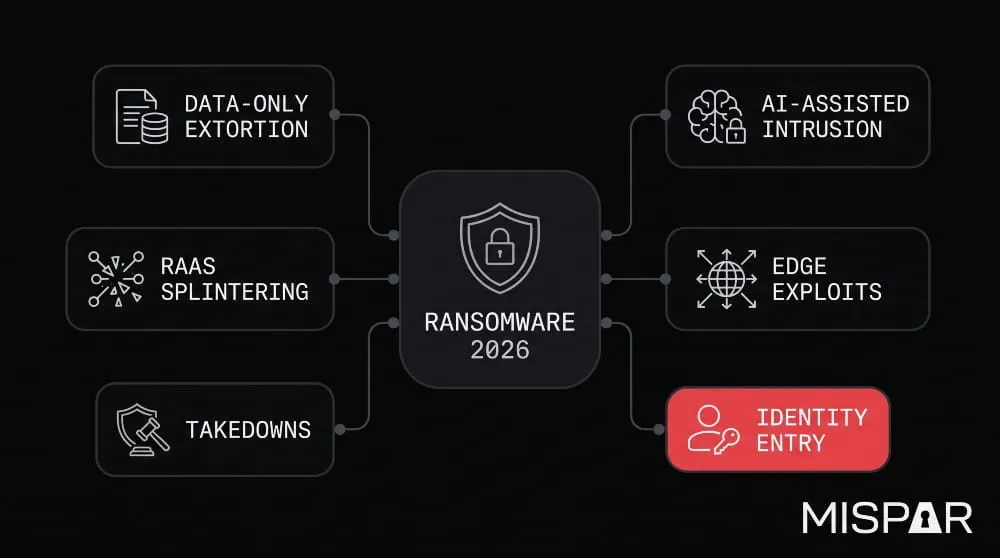
Attackers increasingly steal data and skip encryption, but this model is paying less reliably. More than 76% of the attacks Coveware observed in Q3 2025 involved data exfiltration. Victims are learning that paying for non-disclosure offers no guarantee, and the Silent Ransom chat leak revealed several victims who had paid for silence anyway. Coveware expects some groups to revert to simpler impact tactics, and the share of cases reaching the impact stage rose to 50% in Q3 2026. Expect both models to coexist.
RaaS affiliates and group rebrands
The ransomware market has fragmented into many small crews. GuidePoint tracked 124 groups in 2025, a 46% increase, and 112 in Q3 2026 alone. In Coveware’s Q3 2026 caseload, no actor passed 6%, and independent “lone wolf” operators tied for first place. Chainalysis describes ransomware as less a single criminal enterprise than a supply chain, as old names splinter and rebrand. Tracking group names matters less than tracking the shared dependencies: access brokers, infostealers and laundering services.
AI-assisted and agentic ransomware
AI now speeds up intrusions but has not produced new classes of malware. GuidePoint reports that AI is orchestrating parts of the intrusion phase. Verizon found attackers increasingly using generative AI for targeting, initial access, and malware and tool development. The same report found little novelty: fewer than 2.5% of generative-AI-built malware samples used less-common techniques. The practical effect is speed and scale. Defenders should expect familiar techniques arriving faster.
Edge-device and vulnerability exploitation
Vulnerability exploitation became the top breach entry point in Verizon’s 2026 report. It accounted for 31% of initial access, the first time it has led the DBIR. Median time to fully patch critical vulnerabilities rose to 43 days, up from 32. Even top-performing organizations fix only 30–40% of actively exploited bugs within a week. Edge devices matter here, though not equally everywhere: Coveware saw unpatched appliances and edge devices in 11–12% of Q3 2026 cases, and Sophos saw exploited vulnerabilities fall 14 points to 18%.
Identity-based entry
Most modern intrusions look like normal logins. Coveware describes identity and access abuse as dominating the picture, with compromised credentials rising quarter over quarter and credential access appearing in 56% of cases. MFA is necessary but not sufficient: 97% of Sophos respondents whose root cause was compromised credentials had MFA enabled in some form. Gaps in coverage, session theft, and bypass techniques explain the difference. Related tactics include credential stuffing, session hijacking, MFA bypass, and account takeover.
Law-enforcement takedowns and their effects
Enforcement is now targeting the infrastructure behind ransomware, not just the gangs. Operation Endgame’s June 2026 sprint hit the Amadey and StealC infostealers and the SocGholish delivery framework, none of which are ransomware, and Operation Saffron seized a VPN service used by more than 25 ransomware groups. The Amadey and StealC action also recovered 27 million stolen login credentials. The effects are mixed. Chainalysis credits enforcement against laundering infrastructure, tighter regulation, and big-company refusals for lower payments, yet takedowns also feed fragmentation as crews splinter.
Most Active Ransomware Groups and Campaigns in 2026
Top groups by leak-site activity
The Gentlemen and Qilin lead leak-site counts, and rankings shift by dataset.
| Dataset | Top groups |
| GuidePoint Q3 2026 (leak-site victims) | The Gentlemen 12.9%, Qilin 12.6%, together about one in four victims |
| Coveware Q3 2026 (incident-response cases) | The Gentlemen and Lone Wolf 6% each, Inc Ransom 5%, FulcrumSec, Qilin and ShinyHunters 4% each |
The two views differ because leak sites record what groups claim, while response firms see who actually gets paid or negotiated with.
Active campaigns this month (rolling section)
As of late November 2026, two campaign types dominate. The first is social-engineering extortion against professional services. Coveware warns that Silent Ransom Group is running a vishing and phishing campaign against law firms and forecasts that the majority of the Am Law 100 will be affected. The second is SaaS data extortion. ShinyHunters has been tied to a string of 2026 incidents, including Canvas, Telus, and RingCentral. Update this section monthly.
Groups targeting healthcare
Healthcare is one of the most consistently targeted sectors, but public data does not tie it to a single group. In February 2026, BlackFog counted healthcare as 31% of publicly disclosed attacks, with ShinyHunters and Qilin leading overall and 41% of attacks unattributed. The FBI’s 2025 data show ransomware hit healthcare hardest among critical infrastructure sectors. The reason is pressure, not technology: downtime threatens patient care, and stolen records trigger notification rules.
Groups targeting financial services
Public sources do not reliably break ransomware groups out by financial-sector targeting, so claims that a specific group “focuses on banks” deserve skepticism. Coveware includes financial institutions among the sectors with significant victim volume, alongside legal, healthcare and manufacturing. The data shows a preference for firms where data exposure carries regulatory consequences, which describes much of financial services.
Ransomware Payments, Ransom Demands and Downtime Costs
Average ransom payment and payment rate
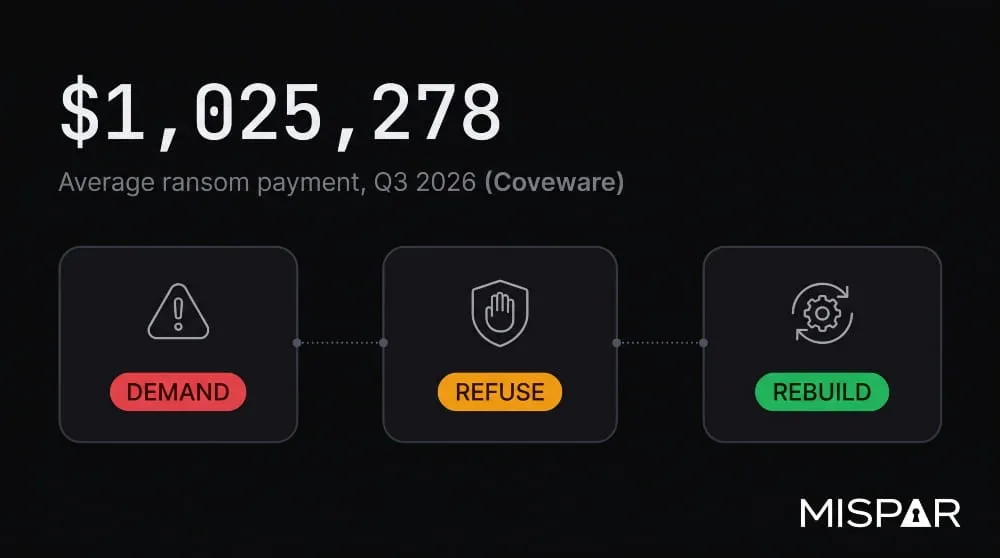
The average ransom payment is roughly $1.0 million, the median is far lower, and fewer than one in three victims pay. Coveware’s Q3 2026 average was $1,025,278, down 45% quarter over quarter, with a median of $400,000. Verizon’s median is about $140,000, and 69% of its victims did not pay. Sophos reports a $769K median payment, and 48% of its encrypted victims paid. Chainalysis, measuring on-chain, puts the payment rate at 28.8%. The numbers differ because the datasets differ: survey respondents, response cases and blockchain flows each see a different slice.
Why payments are declining
Victims are refusing because paying has become a poor bet. Coveware attributes falling payment rates to better responses from law enforcement, legal advisors and security professionals. Paying rarely eases notification duties, and promises to delete stolen data cannot be verified. Chainalysis’s payment rate fell from 78.9% in 2022 to 62.8% in 2024 and to 28.8% in 2025. Coveware recorded a record low of 23% in Q3 2025.
Average downtime and total recovery cost
Recovery costs keep climbing even as ransoms fall. Sophos puts the global average recovery cost at $1.7 million per incident, up 11%, and 56% of attacks still encrypted data, up from 50%. US organizations averaged $2.51 million, up from $1.91 million. On timing, 53% of US organizations fully recovered within a week. At the extreme, Jaguar Land Rover’s 2025 attack carried an estimated £1.9 billion impact. Reported losses understate reality: the FBI logged 3,611 ransomware complaints in 2025 with more than $32 million in reported losses.
Payment methods and sanctions risk
Ransom payments run overwhelmingly through cryptocurrency, which is why Chainalysis can measure them. On-chain payments totaled about $820 million in 2025, with the final figure likely to approach or exceed $900 million. Sanctions risk is a separate legal question. The US Treasury’s OFAC has warned that paying certain ransomware actors can violate sanctions rules, so organizations should involve counsel and their incident-response provider before any payment. This guide is not legal advice.
Ransomware by Industry
Healthcare
Healthcare faces the highest share of publicly disclosed attacks in several trackers. BlackFog put it at 35% of July 2026 incidents. Patient-safety stakes and strict notification rules give attackers leverage, which is why Coveware flags healthcare as a sector facing extreme regulatory and reputational pressure.
Education
Education is a growing target, largely through data extortion. GuidePoint’s Q3 2026 report includes an Education industry spotlight. The Canvas breach was among the most significant education-sector incidents of 2026. Large student-data platforms create concentrated risk, because one compromise exposes many institutions.
Financial services
Financial institutions are a steady, mid-ranked target. Coveware lists them among the sectors with significant victim share. Regulatory reporting duties raise the cost of any data theft, which is the leverage data-extortion crews use.
Critical infrastructure and energy
Ransomware is among the top reported threats to critical infrastructure. The FBI reported more than 3,600 ransomware complaints in 2025, with losses above $32 million. Public trackers do not cleanly separate energy, so sector-specific percentages are unreliable. Operational shutdown is the main lever: manufacturing and operational technology sectors are vulnerable to downtime threats.
Local government (one short section, no per-city targeting)
Local and state governments are the most likely to pay. Sophos found 72% of local and state government victims paid, the highest of any sector. Thin budgets, essential services that cannot stay offline, and public-records obligations explain the pattern.
Small and mid-sized businesses
Mid-market firms bear the volume. The median victim in Coveware’s Q3 2026 caseload had 1,121 employees, up 49% from Q2. Smaller firms struggle to stop attacks in time: only one in three smaller organizations stopped the attack before encryption. The common profile is a company with valuable data and lean security staffing.
How a Ransomware Attack Unfolds
Initial access and stolen credentials
Attacks start with a foothold, most often a stolen credential, a phished user, or an unpatched system. Valid credentials are valuable because they let attackers look like employees. Sources of stolen credentials include credential theft, compromised credentials, and leaked credentials circulating in breach dumps, including combolists.
Infostealer logs and access brokers
Infostealer infections often precede ransomware by weeks. Half of the breach victims in Verizon’s data showed a credential or infostealer event within 95 days of the intrusion. Access is also sold. Chainalysis estimates initial access brokers received at least $14 million on-chain in 2025, and spikes in those payments often precede ransomware payments and US leak posts by roughly 30 days. Darkweb IQ data cited by The Record puts average victim access prices falling from about $1,400 to $439 between 2023 and 2026. See infostealer malware for how these logs are produced.
Lateral movement and privilege escalation
After entry, attackers move quietly using legitimate tools. Lateral movement appeared in 71% of Coveware’s Q3 2026 cases, and abused identities (credential access) in 56%, often through RDP, SMB, and remote monitoring platforms. This activity resembles routine administration, which makes it hard to detect.
Data exfiltration and encryption
Exfiltration is now as common as lateral movement. Data exfiltration appeared in 71% of Q3 2026 cases, using standard web services and cloud storage to blend in, while the impact stage rose to 50%. Whether encryption follows depends on the group’s business model and the victim’s likely response.
Extortion and leak sites
Extortion pressure comes through leak sites and direct contact. Groups post victims, set deadlines, and publish data when demands are refused. Leak-site posts feed the trackers cited in this guide, and stolen data often resurfaces on dark web markets. Posting is not proof of payment or non-payment, which is why leak counts and payment rates diverge.
Types of Ransomware and Ransomware-as-a-Service
Crypto-ransomware vs. lockers
Crypto-ransomware encrypts files and demands payment for the key, while locker ransomware blocks access to the device or screen without encrypting data. Crypto-ransomware dominates enterprise attacks because the damage is harder to reverse. Lockers are more common in consumer and older mobile-malware cases.
Double and triple extortion
Double extortion adds data theft to encryption, so the victim faces both lost access and the threat of a leak. Triple extortion adds a third lever, such as DDoS attacks or contacting customers and partners. Many 2026 campaigns go further and drop encryption entirely, relying only on the leak threat.
How the RaaS model works
In ransomware-as-a-service, developers build and maintain the malware and infrastructure, while affiliates carry out attacks and split proceeds. The model lowers the skill needed to attack, which helps explain why groups multiplied. The FBI identified 63 new ransomware variants in 2025, and the top ten variants accounted for 56% of reported incidents.
Notable examples
Recent names illustrate the range. Qilin and The Gentlemen are leak-site leaders, ShinyHunters and Silent Ransom Group run data-extortion campaigns, and Clop is known for mass exploitation of file-transfer software. Operation Endgame has repeatedly targeted the malware kits that feed such crews.
Ransomware Timeline, 2017–2026
2017: WannaCry and NotPetya/Maersk
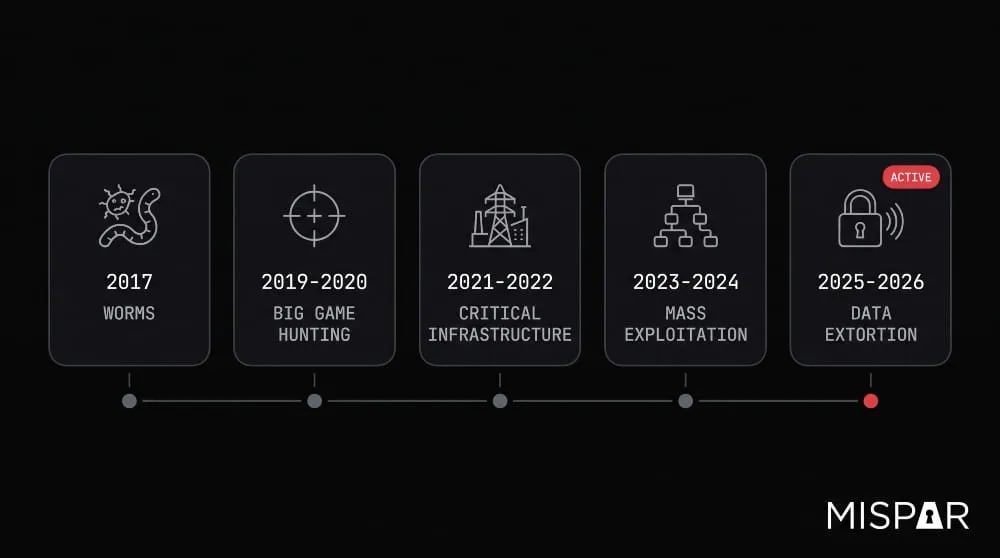
WannaCry spread worldwide in May 2017 by exploiting a Windows vulnerability, hitting hundreds of thousands of computers across more than 150 countries. NotPetya followed in June, disrupting shipping giant Maersk and causing damage the US government later estimated at around $10 billion across victims.
2019–2020: Baltimore, LockerGoga, Ryuk, Garmin
Targeted “big game” attacks emerged. LockerGoga disrupted Norsk Hydro, and the RobbinHood ransomware crippled the City of Baltimore in 2019. In 2020, Ryuk hit hospital operator Universal Health Services and Garmin suffered a multi-day outage.
2021–2022: Colonial Pipeline, Kronos, LAUSD
Ransomware became a national-security issue in May 2021, when DarkSide shut down Colonial Pipeline and caused fuel shortages along the US East Coast. Kronos (UKG) suffered a prolonged outage in late 2021, and the Los Angeles Unified School District was hit in 2022. Payments dipped in 2022 before rebounding.
2023–2024: MOVEit/Clop, Change Healthcare, CDK
Mass exploitation defined 2023, when Clop abused the MOVEit file-transfer flaw to extort thousands of downstream organizations. Payments reached a then-record $1.1 billion that year. In 2024, UnitedHealth’s Change Healthcare paid $22 million to BlackCat, and CDK Global’s outage disrupted car dealerships.
2025–2026
The pattern shifted from encryption toward data extortion and supply-chain pressure. 2025 included the Salesforce ecosystem campaign and the Jaguar Land Rover attack, estimated at £1.9 billion. GuidePoint called 2025 its most active year on record. In 2026, Q3 broke the quarterly record for victims, and Operation Endgame’s June sprint hit the infostealer and delivery layer.
How to Prevent Ransomware: 2026 Checklist
Credential hygiene and MFA
Protect identities first, because identity abuse threads through most attack chains. Enforce MFA on every remote-access path, email, and administrator account, and prefer phishing-resistant methods. The 97% of credential-root-cause victims who had MFA in some form show that partial coverage is the problem. Review the MFA bypass techniques that defeat weak deployments, and manage secrets deliberately.
Patching internet-facing systems
Prioritize anything exposed to the internet. Median time to fully patch critical flaws is 43 days, far longer than attackers need. Patch edge devices, VPNs, and file-transfer tools first, and treat vendor emergency advisories as same-week work.
Backups and immutability
Resilient backups remove the attacker’s strongest lever. Coveware says an organization that can rebuild on its own terms turns a data-theft demand into a deliberate decision. Keep offline or immutable copies, secure administrative access to backups separately from the domain, and time a full restore before you need one.
Monitoring for leaked credentials and dark web exposure
Watch for the signals that precede an attack. Since half of victims showed a credential or infostealer event within 95 days, exposure monitoring can give days or weeks of warning. Dark web monitoring, credential monitoring, and a dark web exposure check show which employee and customer credentials are already circulating. Platforms such as Mispar’s monitoring feature automate this for MSSPs.
Incident response basics
Decide authority before the incident. Coveware recommends clear isolation authority, verified identity systems during containment, and recovery coordinated across the organization. Treat suspected data theft as a legal, governance, and communications event as much as a technical one, and engage counsel and an incident-response firm early.
Should you pay? Decryptors and recovery basics
Paying is a business, legal, and ethical decision, not a guaranteed fix. Paying rarely alleviates regulatory notification obligations, and data-deletion promises cannot be verified. Before paying anything, check whether a free decryptor exists through the No More Ransom project, confirm backups, and consult counsel on sanctions exposure.
What MSSPs Should Do With Ransomware Intelligence
Turning exposure data into client reporting
Ransomware intelligence is most useful when it becomes recurring evidence for clients. Credential exposure, infostealer hits, and dark web findings translate into a monthly view of reduced and remaining risk. Structured reporting also supports client reviews, which is the focus of MSSP reporting and compliance.
Early-warning signals before encryption
The best signals appear before the attack. Newly exposed credentials, infostealer logs, and access-broker listings often precede intrusions, with broker payment spikes leading ransomware activity by roughly 30 days. An MSSP that monitors these signals can force password resets and session revocations before an attacker uses the access. If the model is new to you, start with what an MSSP is.
Compliance and cyber-insurance angles
Ransomware readiness increasingly shows up in audits and insurance reviews. Evidence of MFA coverage, patch cadence, credential monitoring, and tested restores answers the questions assessors ask. Because data theft triggers legal and regulatory consequences even when systems are restored, documented controls help clients explain their posture afterward.
Frequently Asked Questions (FAQ)
Is ransomware increasing in 2026?
Yes, by victim count, but not by revenue. GuidePoint recorded a record 2,760 victims in Q3 2026, up 75% year over year. On-chain payments fell 8% in 2025 even as attacks surged.
What is the average ransomware payment?
It depends on the source. Coveware’s Q3 2026 average was $1,025,278 and its median $400,000. Verizon’s median is about $140,000—a few very large payments skew averages, so the median is the better benchmark.
Which ransomware groups are most active?
The Gentlemen and Qilin led GuidePoint’s Q3 2026 leak-site counts at 12.9% and 12.6%. Coveware’s caseload was more fragmented, with no group above 6%. Rankings change quarter to quarter.
What was the biggest ransomware attack ever?
It depends on how you measure. By economic damage, NotPetya in 2017 is usually cited, with a US government estimate of about $10 billion. Jaguar Land Rover’s 2025 attack is estimated at £1.9 billion, Britain’s costliest cyber incident. The largest known ransom was a $75 million payment to the Dark Angels group in 2024.
What is ransomware-as-a-service?
Ransomware-as-a-service is a business model in which developers lease their malware and infrastructure to affiliates, who carry out attacks and share the proceeds. It lowers the barrier to entry and helps explain why the number of active groups reached 112 in Q3 2026.
How do ransomware attacks start?
Most start with phishing, stolen credentials, exposed remote access, or unpatched software. Coveware’s Q3 2026 data showed phishing and social engineering at about 29% and remote access compromise at 22–23%. Verizon ranked vulnerability exploitation first at 31%.
Ransomware outcomes depend on how early exposed credentials are found and closed. Mispar helps MSSPs deliver that visibility to their clients under their own brand.